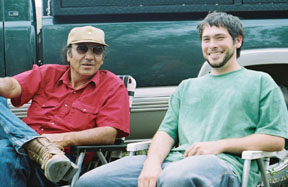
Ron Kiczenski Hemp Legal Case
 by 94.3K
Ron Kiczenski
vs
the US Attorney General, the Drug Enforcement Agency Director, the Secretary of Defense, the Director of Homeland Security, the Secretary of the Interior, and any other Executive Branch administrators of Federal Law regarding cannabis.
Does a human own the natural right to plant a seed? Can the government outlaw a plant? Or did it just assume the jurisdiction?
Congress shall make no law respecting the establishment of religion, or prohibiting the free exercise thereof. –First Amendment to the US Constitution
The enumeration in the Constitution, of certain rights, shall not be construed to deny or disparage others retained by the people. –Ninth Amendment to the US Constitution
The powers not delegated to the United States by the Constitution, nor prohibited by it to the states, are reserved to the states respectively, or to the people. –Tenth Amendment to the US Constitution
All persons born or naturalized in the United States, and subject to the jurisdiction thereof, are citizens of the United States and of the state wherein they reside. No state shall make or enforce any law which shall abridge the privileges or immunities of citizens of the United States; nor shall any state deprive any person of life, liberty, or property, without due process of law; nor deny to any person within its jurisdiction the equal protection of the laws. –Fourteenth Amendment to the US Constitution
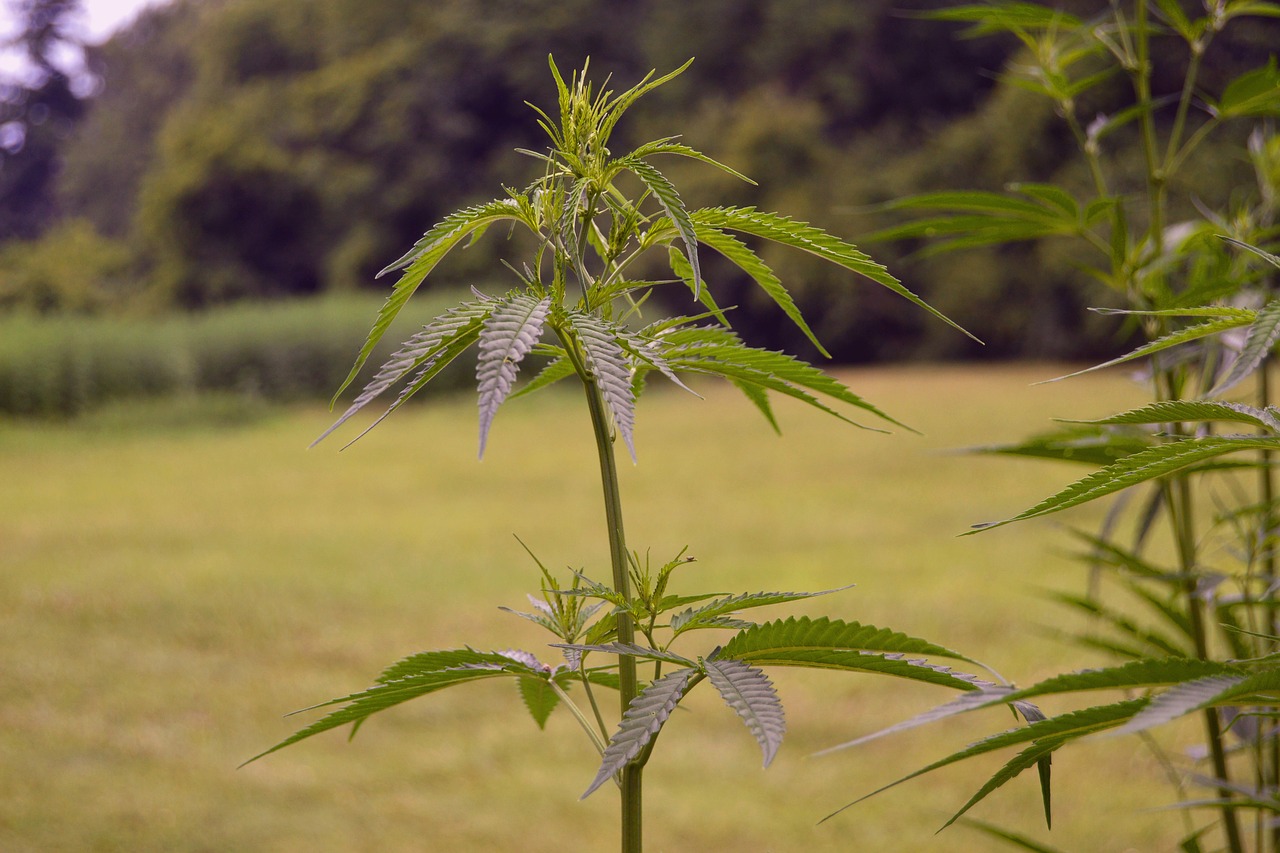
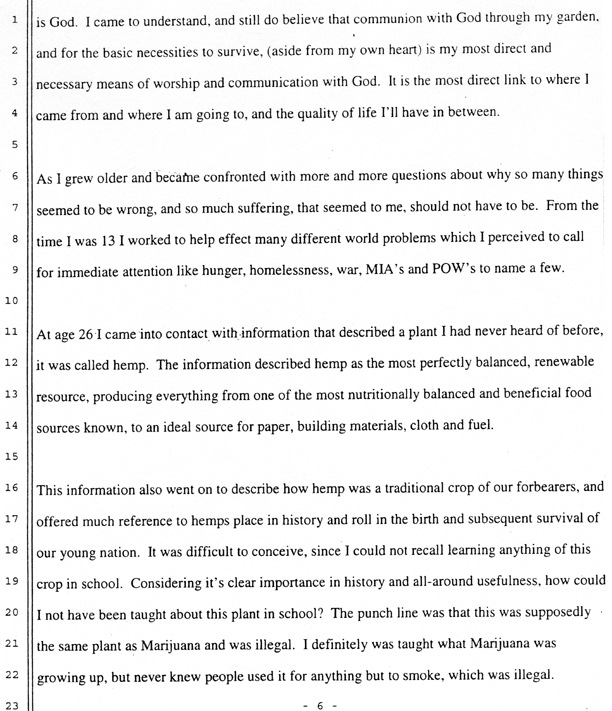
Ron Kiczenski says that God is all things and in all places, even in his garden, even if he grows hemp in his garden.
US Attorney John Gisla says…
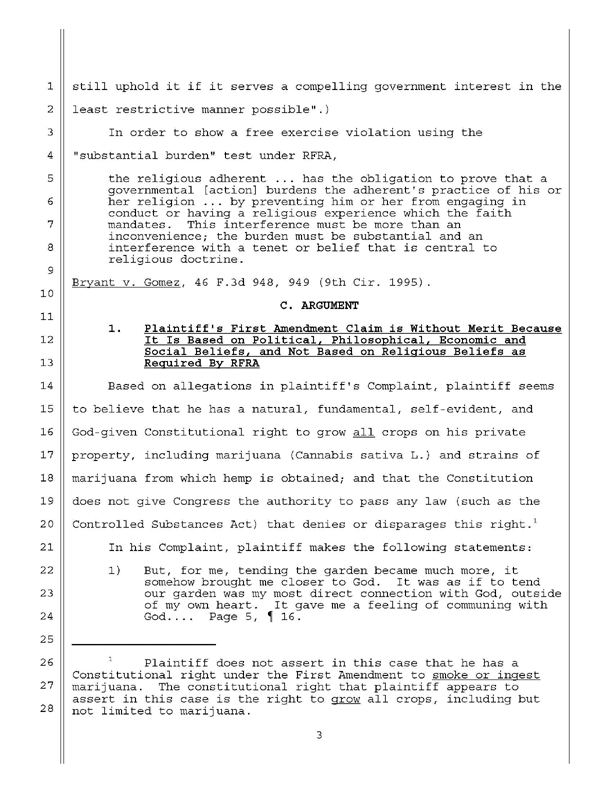
“Although Kiczenski’s beliefs relating to the growing of crops seem to derive from his belief in God, these practices are much more social and philosophical than they are religious, and thus do not come under the umbrella of the First Amendment.”
The government judges, who listen to his pleas that they uphold both the written instructions they are sworn to uphold and the spirit of those instructions, nod patronizingly at him, praise his eloquence, and refuse to uphold the law. They are particularly egregious in their blithe rulings that ignore and override the first clause of the First Amendment;
Congress shall make no law respecting the establishment of religion, or prohibiting the free exercise thereof.
They repeatedly establish religious doctrine, tailoring it to fit their prejudices. There’s a lot of reading in the following series of postings, but the accumulation of case law and arbitrary dicta pronounced from the benches in front of which Kiczenski has appeared provides exemplification of the manner in which the greatest horrors visited upon man by his various governments in the name of God have come about.
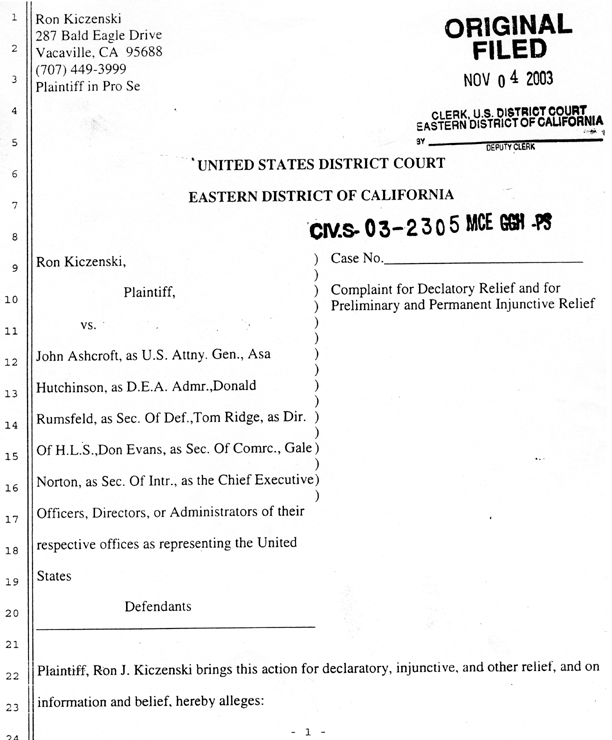
On November 4, 2003, Ron Kiczenski filed a complaint with the United States District Court, Eastern District of California…
Charting unmapped waters, Kiczenski asks for an injunction against the Justice Department to prevent it from prosecuting and punishing him for possessing hemp (or any other cannabis) seeds, or planting and cultivating said seeds. Further, Kiczenski asks the Court to declare the permit process administered by the Drug Enforcement Agency unconstitutional and to declare an irreconcilable conflict of law between the Controlled Substances Act and the Endangered Species Act.


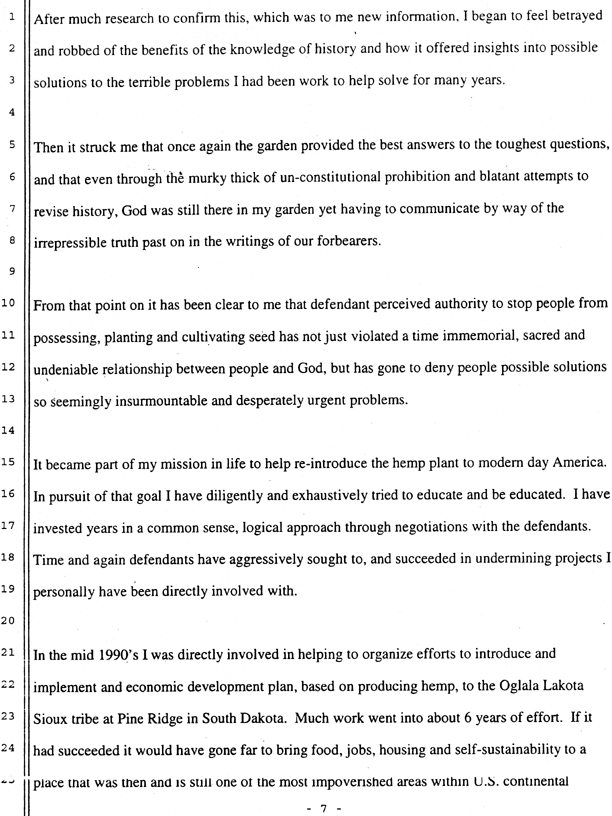
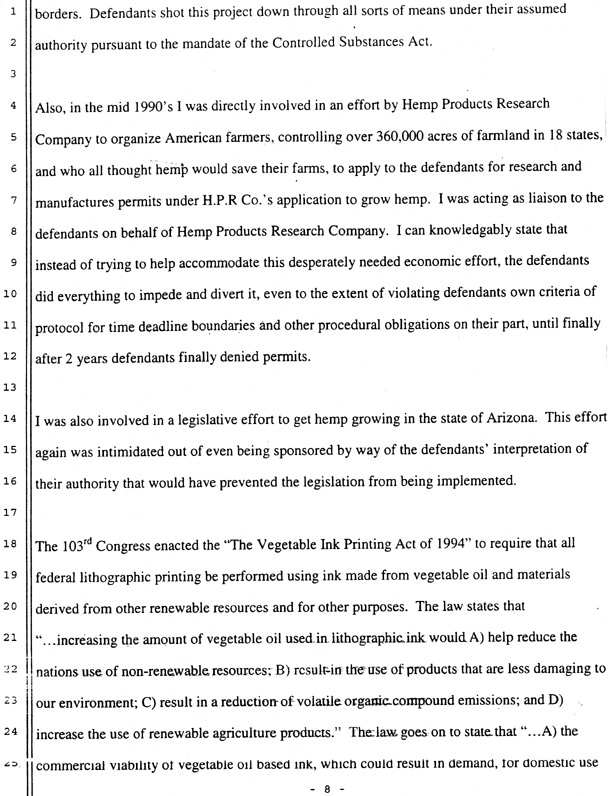

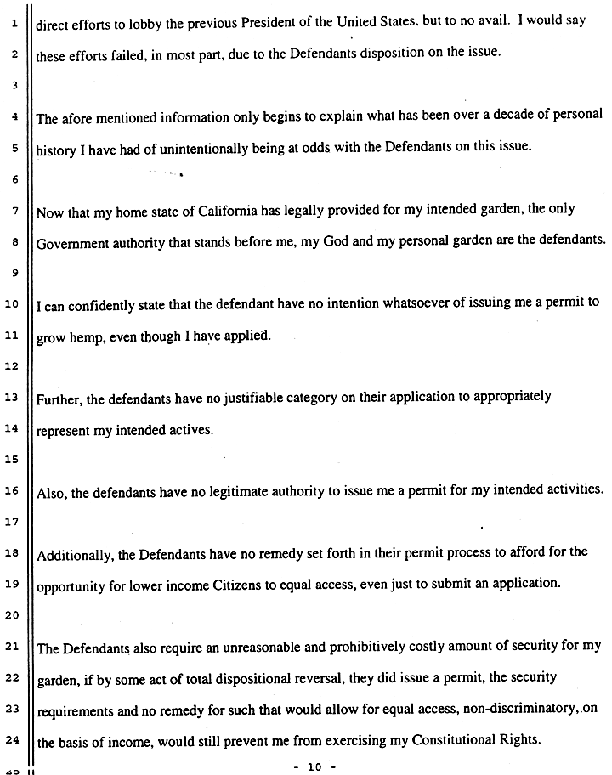
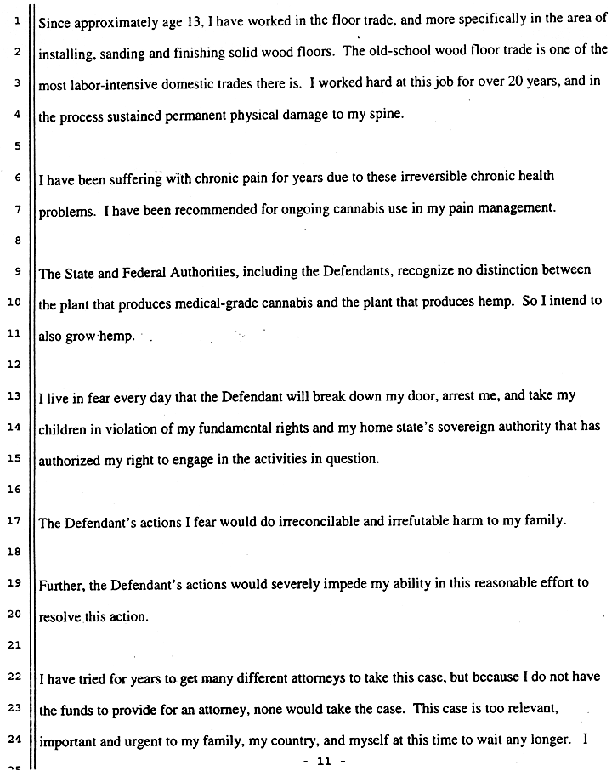

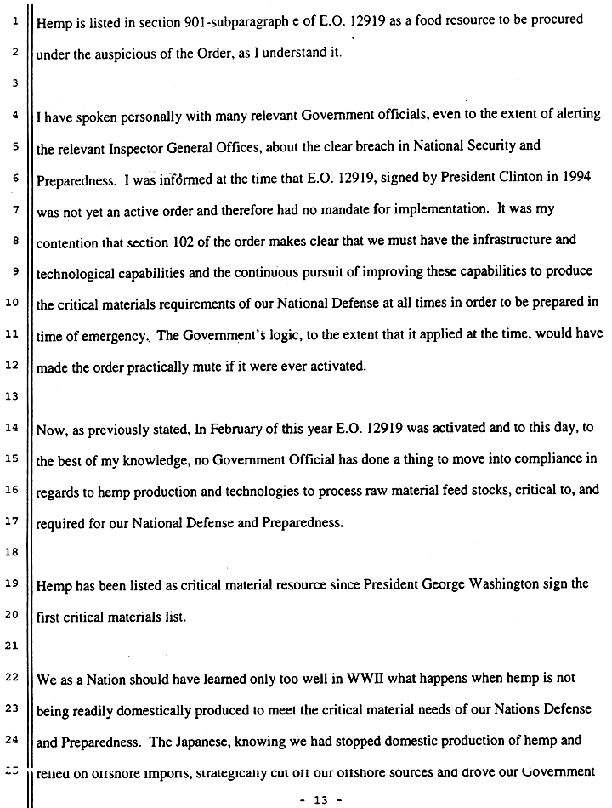
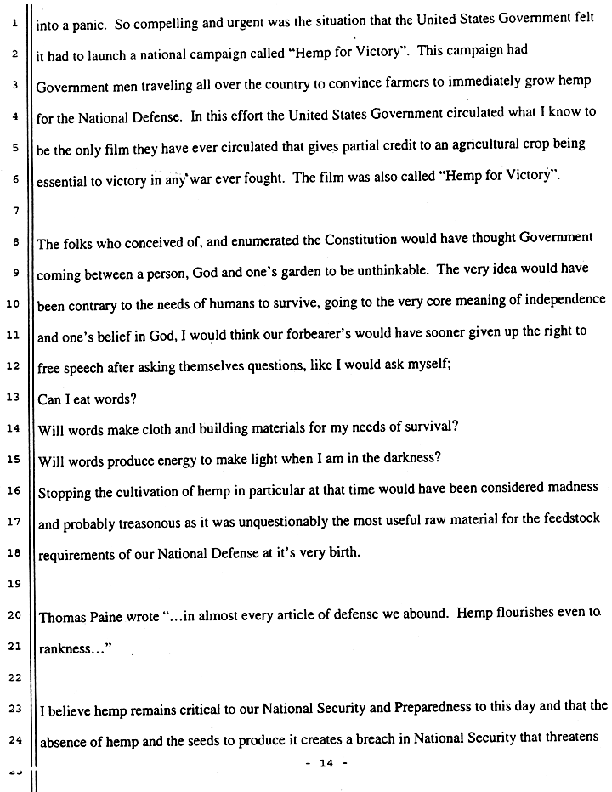
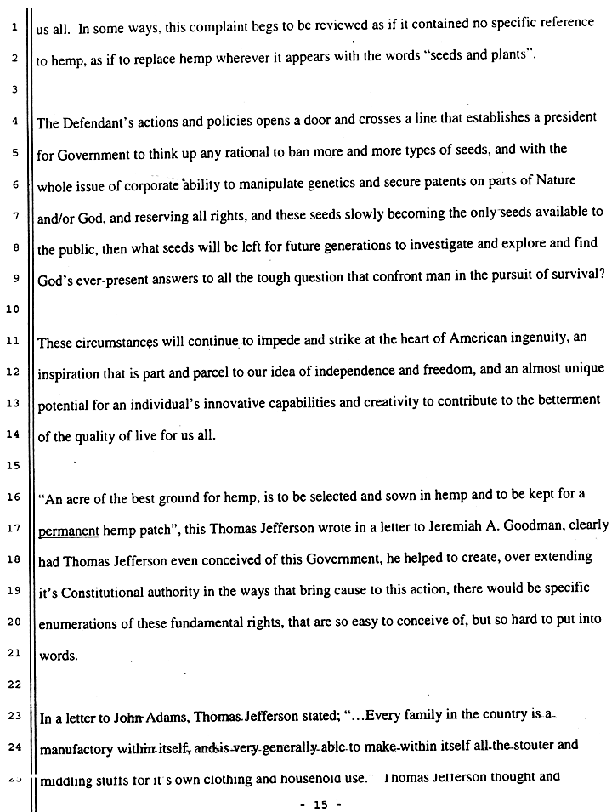
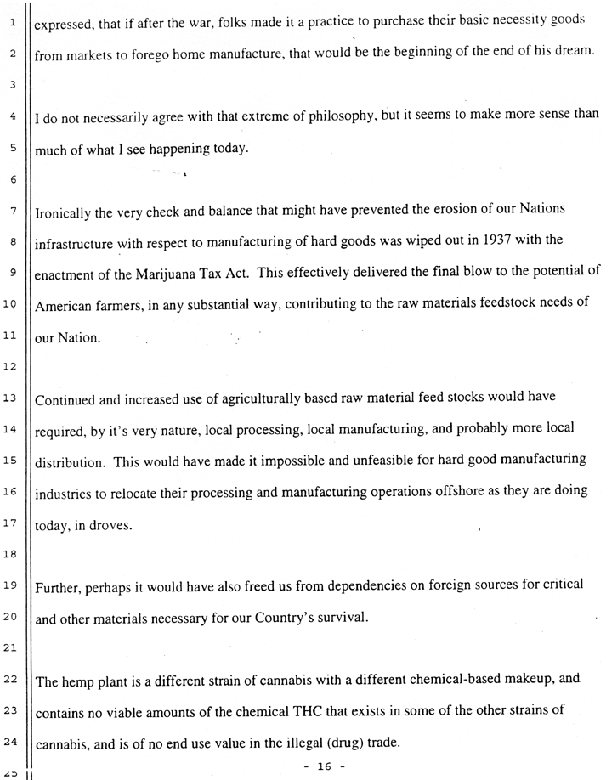
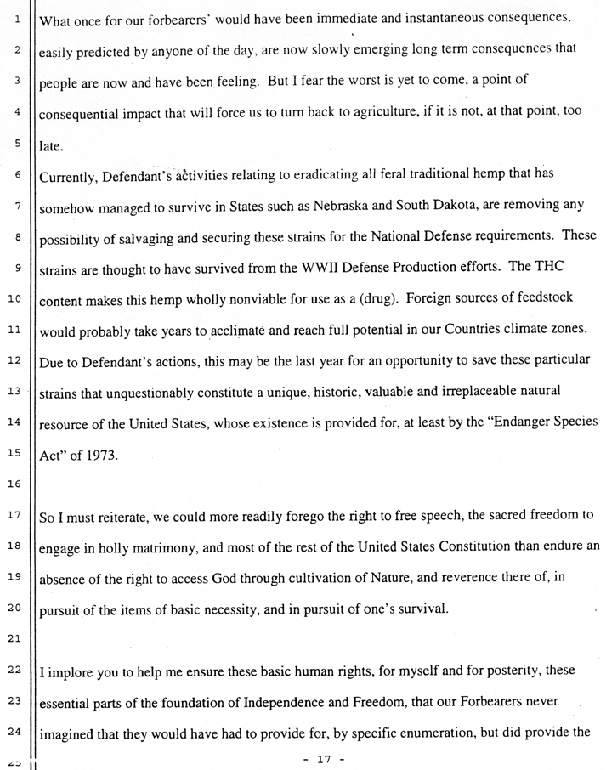

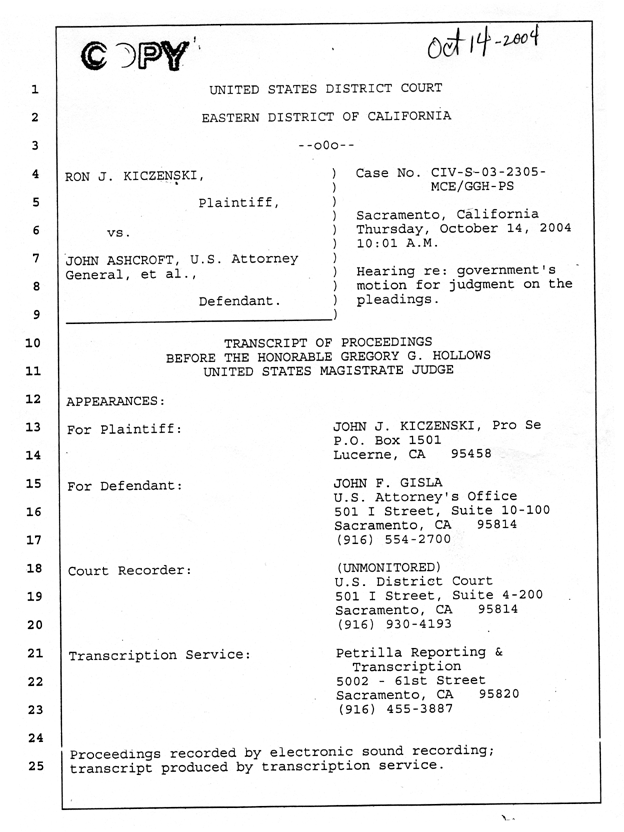
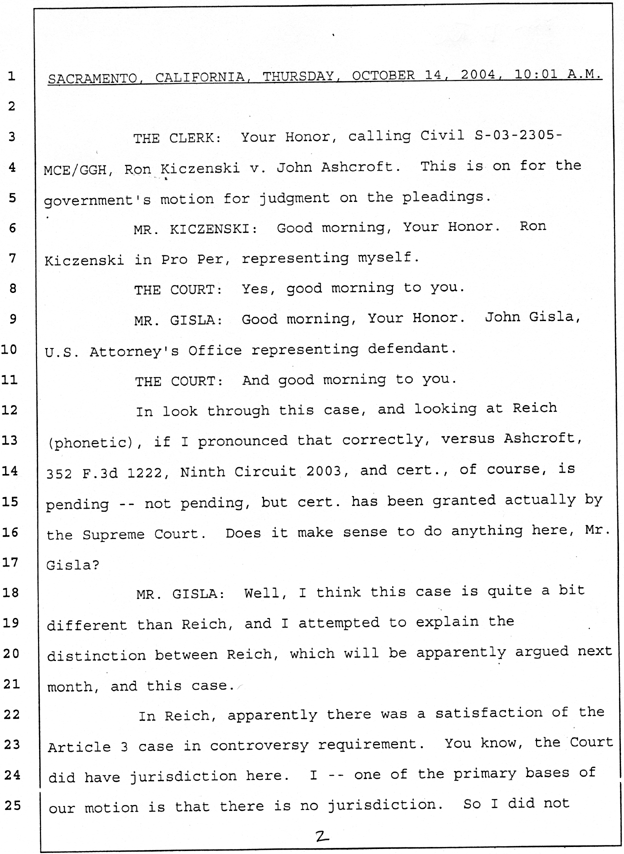
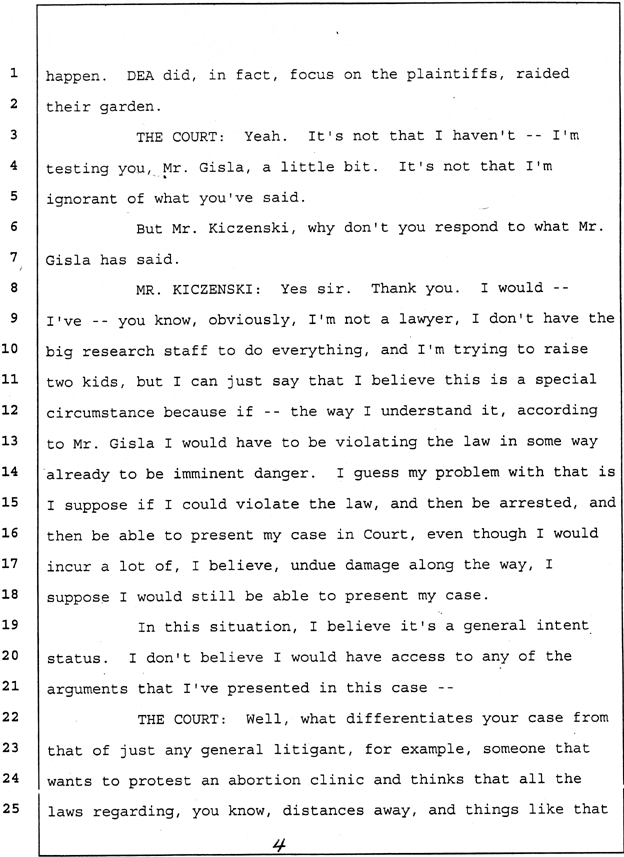
On October 14, 2004, a hearing was held in front of The Honorable Gregory G. Hollows, United States Magistrate Judge…
U.S. Attorney John Gisla attempts to suggest that the Justice Department and DEA would not necessarily prosecute Kiczenski’s violations of law. Kiczenski asks, “Why, then, do you have the law?”
Judge Hollows asks Gisla, “Does he have to wait to get hit on the head before he can ask for declaratory relief?”
Judge Hollows to Kiczenski: “Hold onto those seeds.”

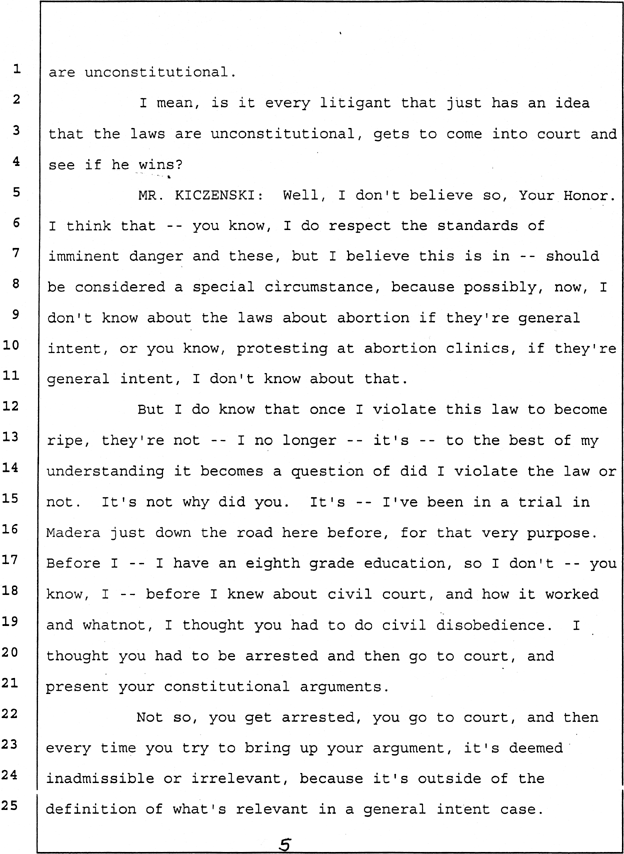
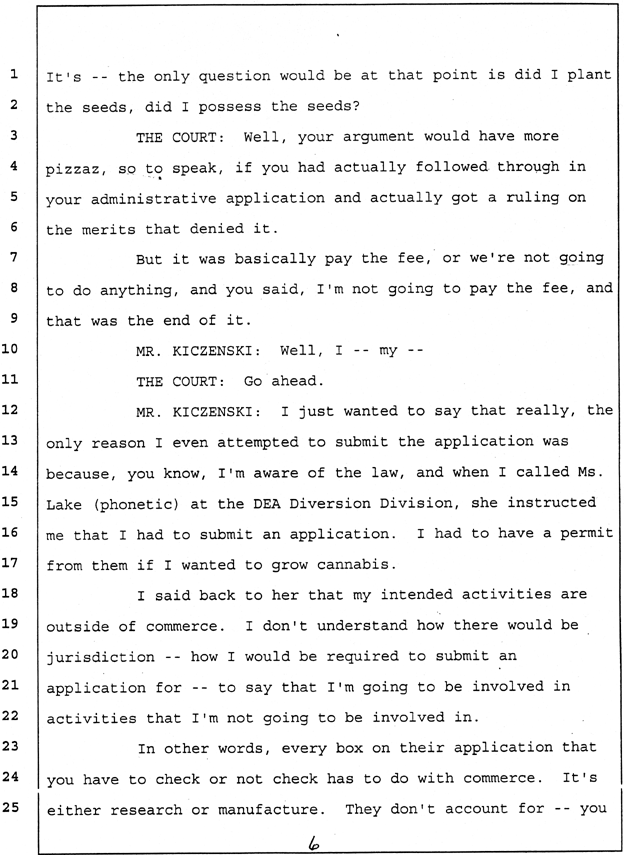
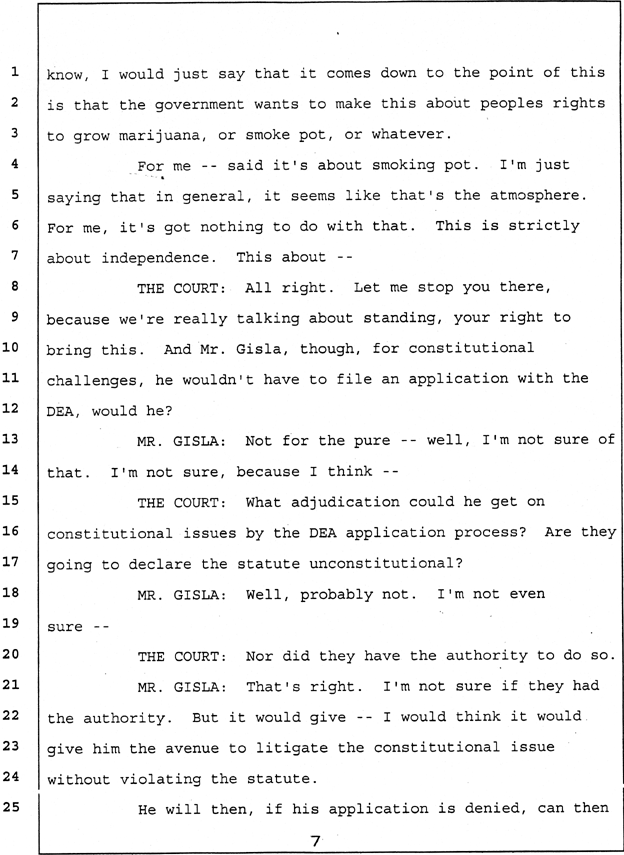

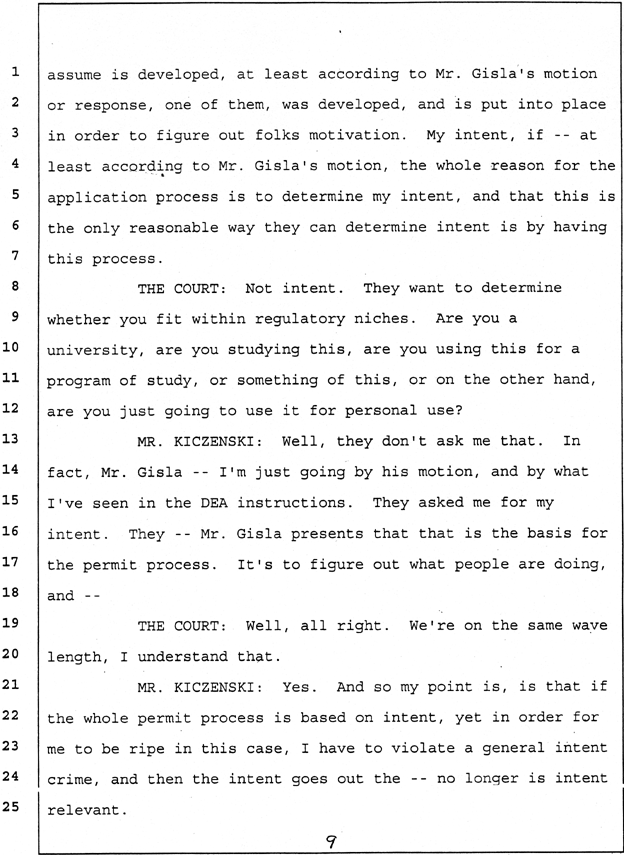
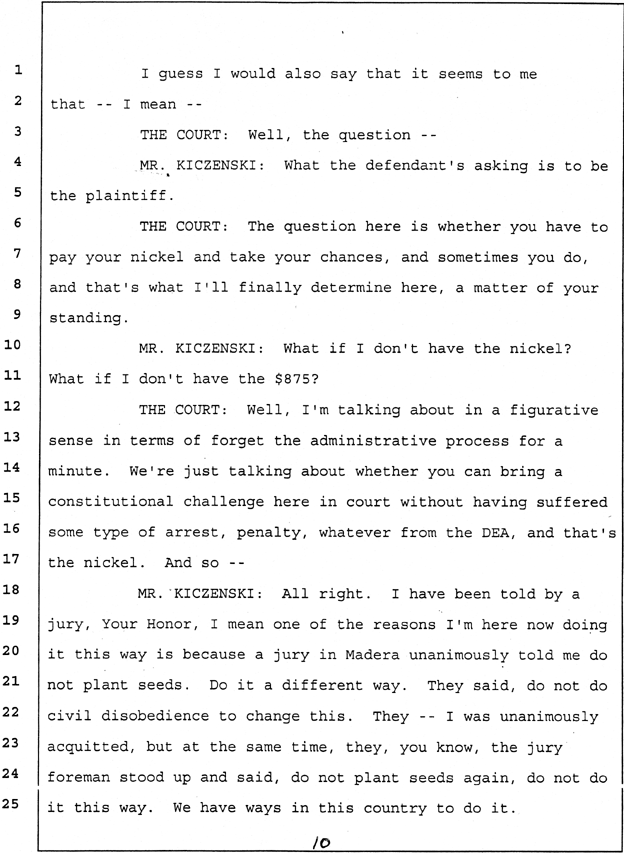

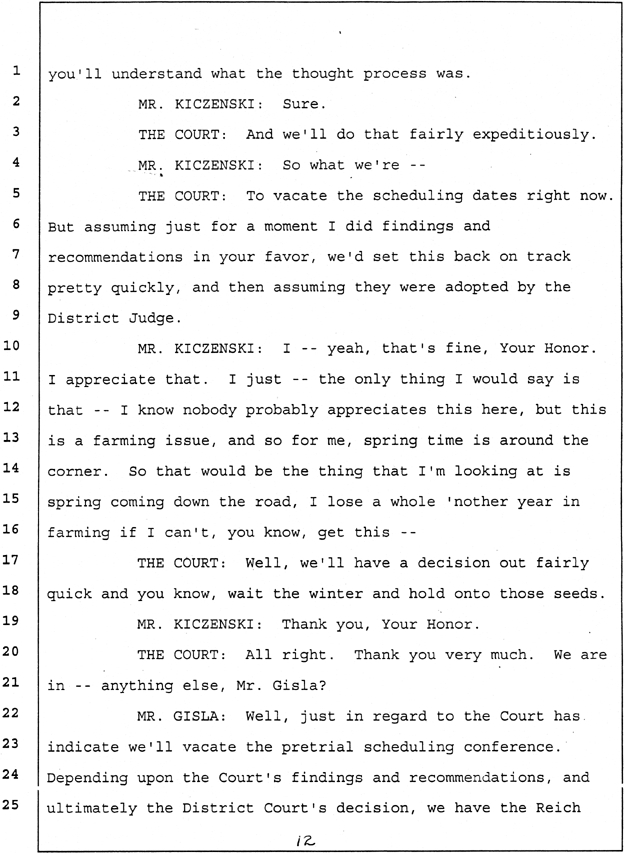


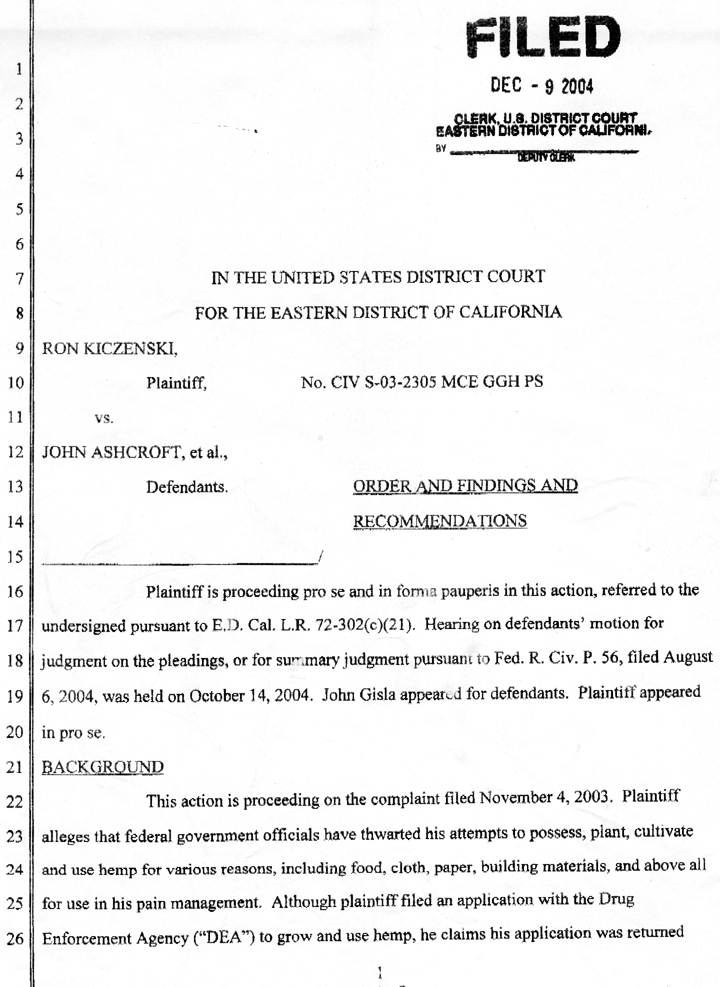
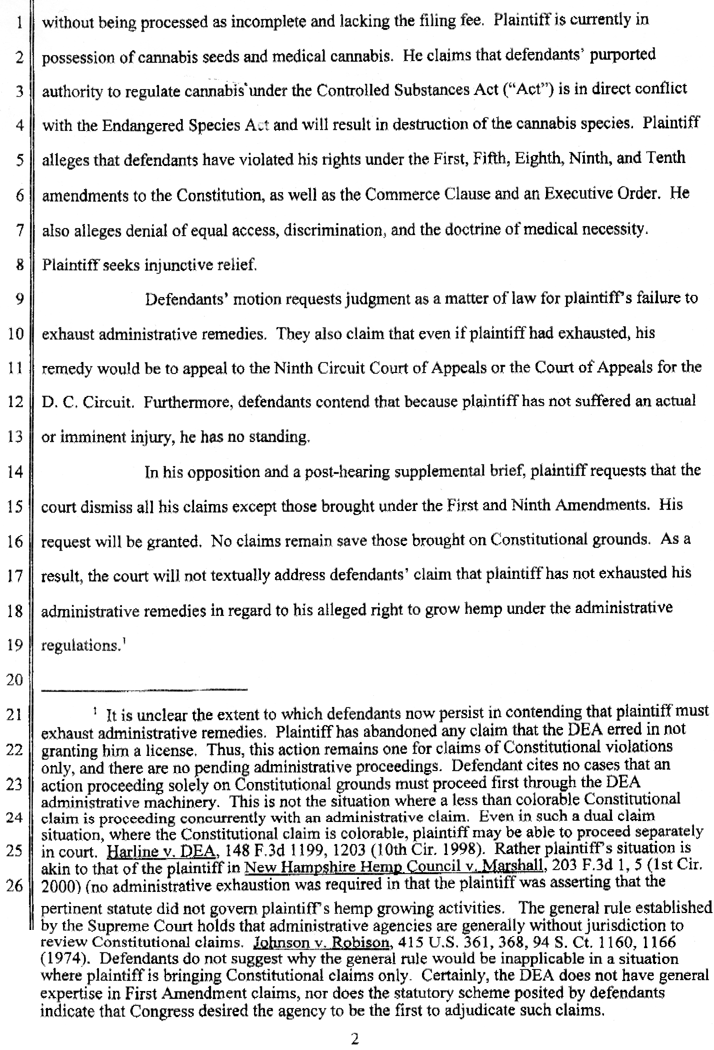
On December 9, 2004, The Honorable Gregory G. Hollows, United States Magistrate Judge, granted Kiczenski’s request for a trial on the issue of whether the Feds should be enjoined from prosecuting Kiczensky for planting hemp…

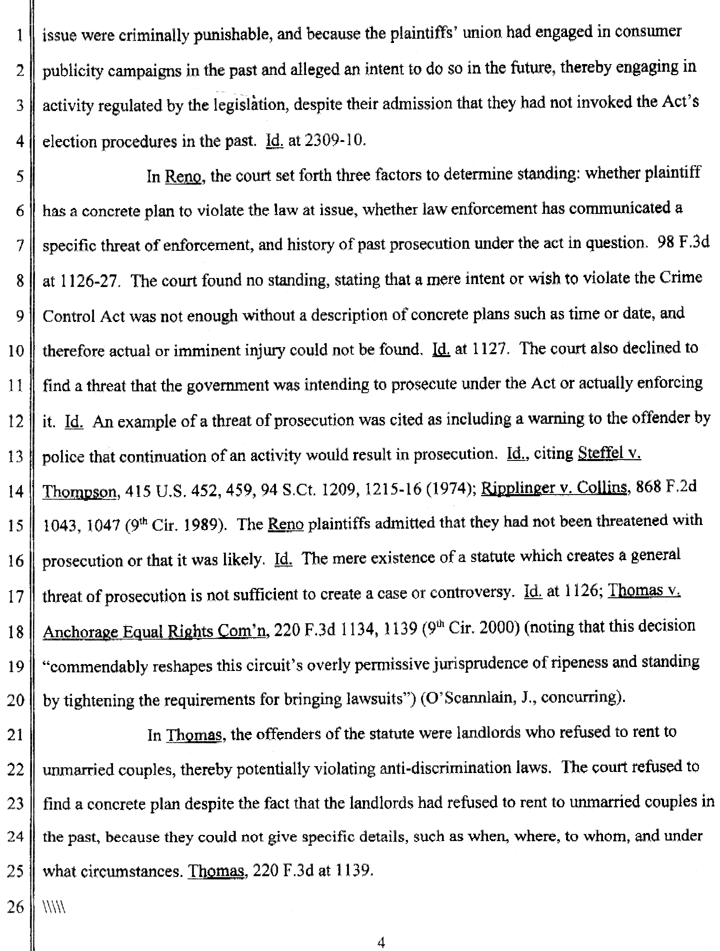
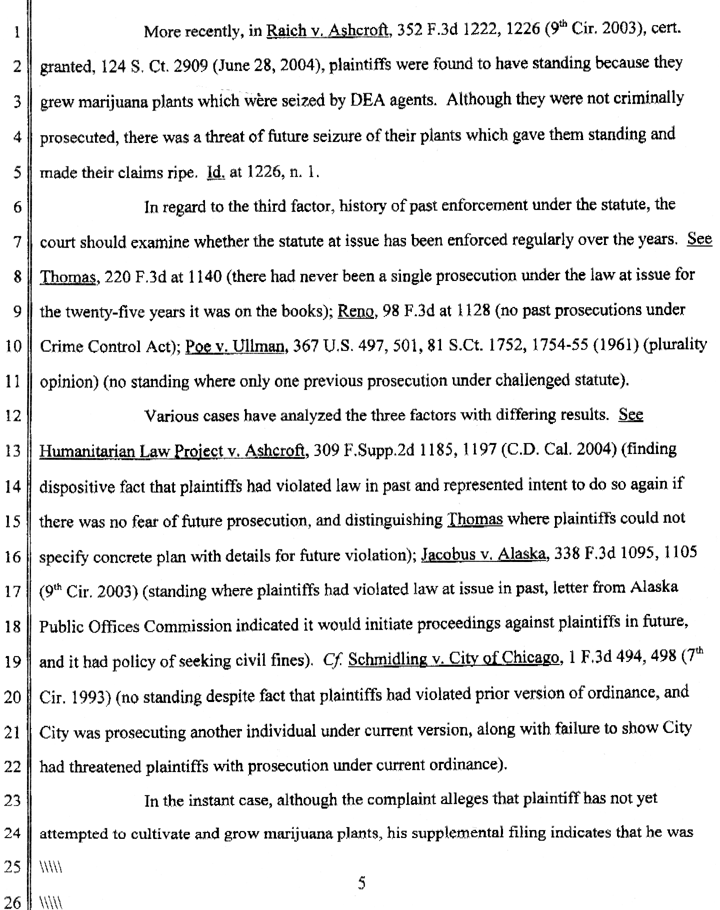
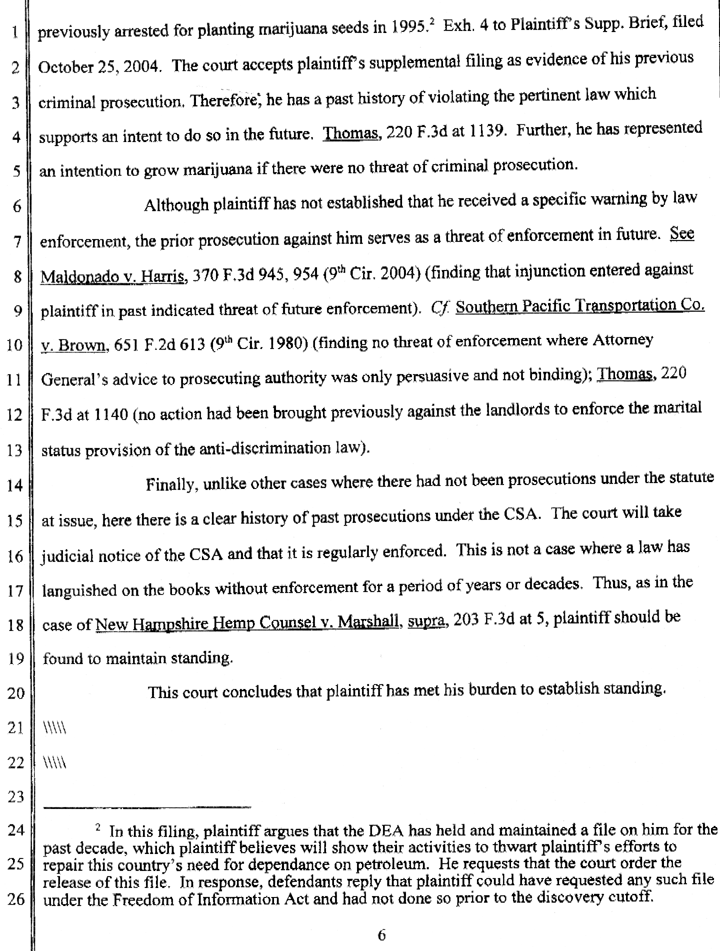


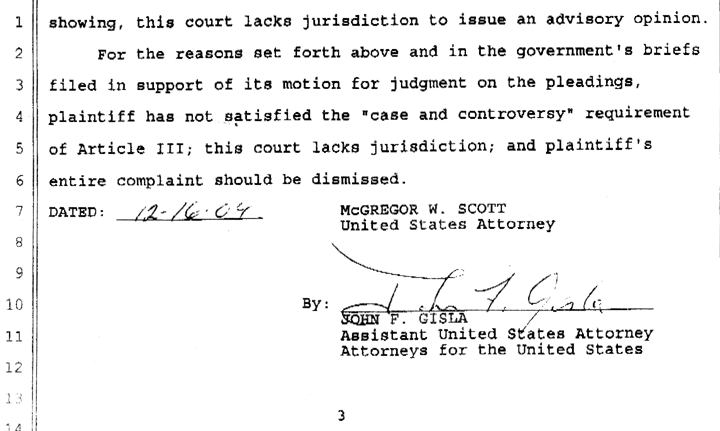
On December 16, 2004, Asst. US Attorney John Gisla filed an Objection to Judge Hollows Order of December 9.

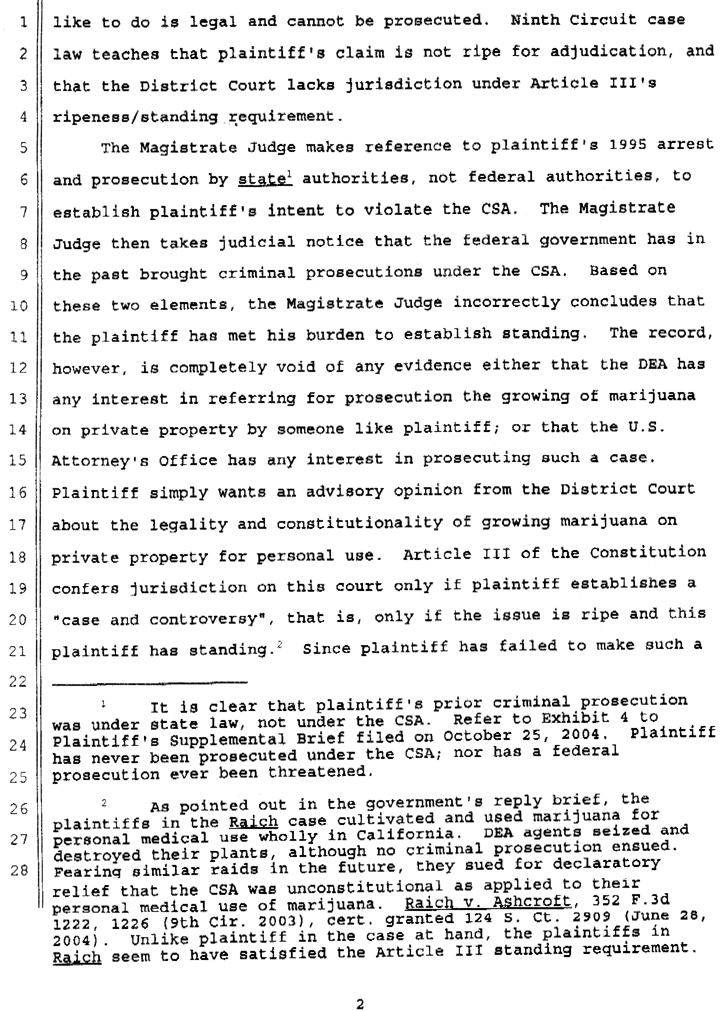
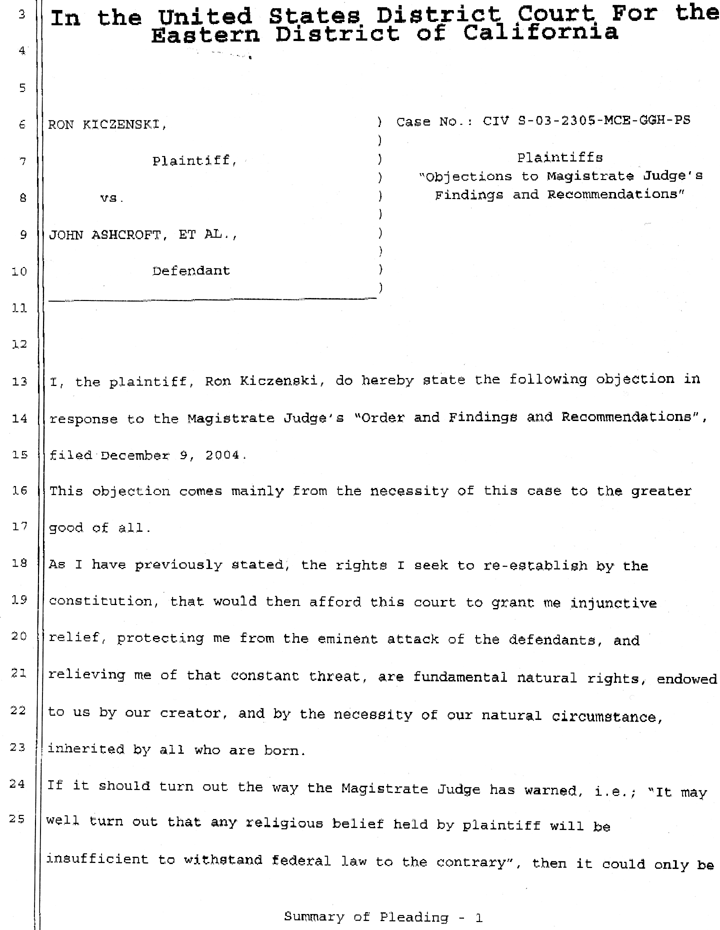
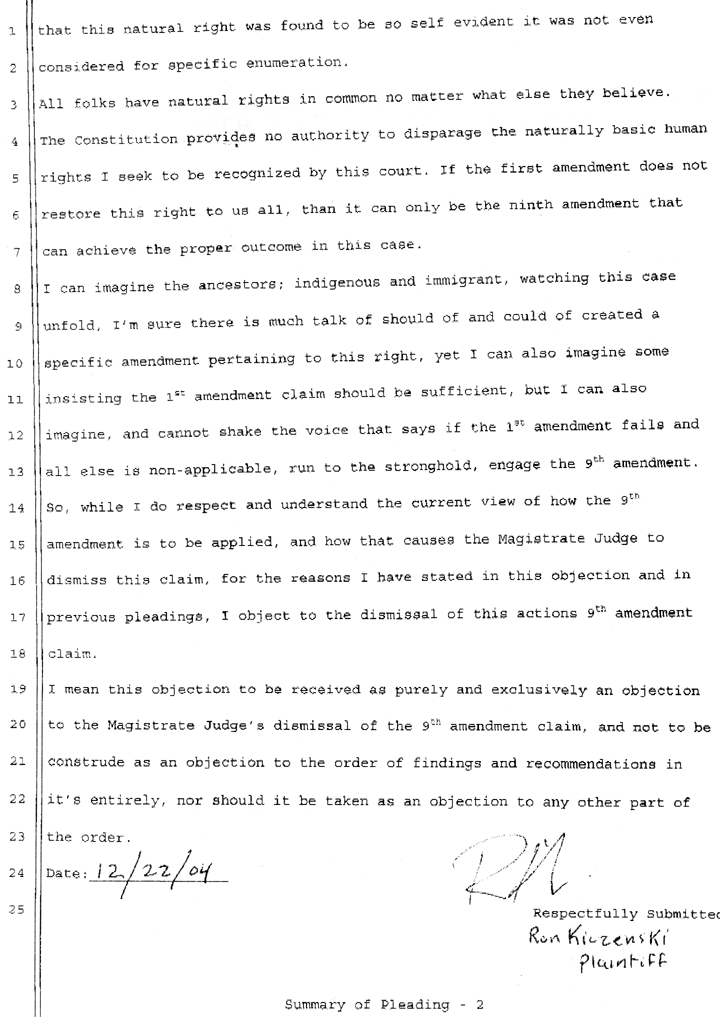
On December 22, 2004, Ron Kiczenski filed an Objection to the Court’s Order of December 9, 2004.
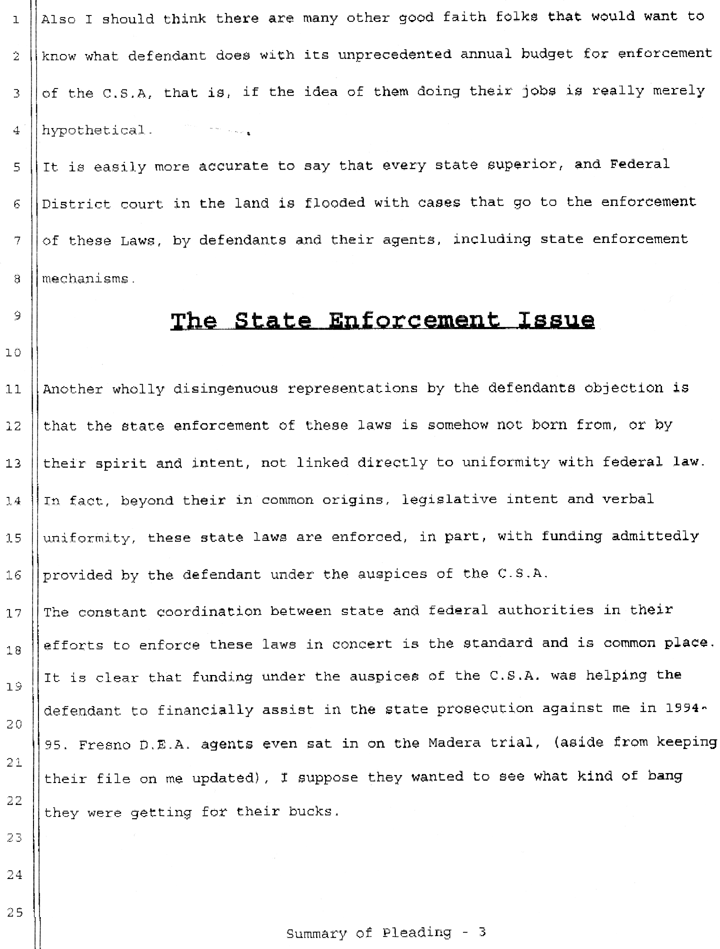
On December 22, 2004, Ron Kiczenski filed a Response to the Government’s Objection of December 16, 2004.



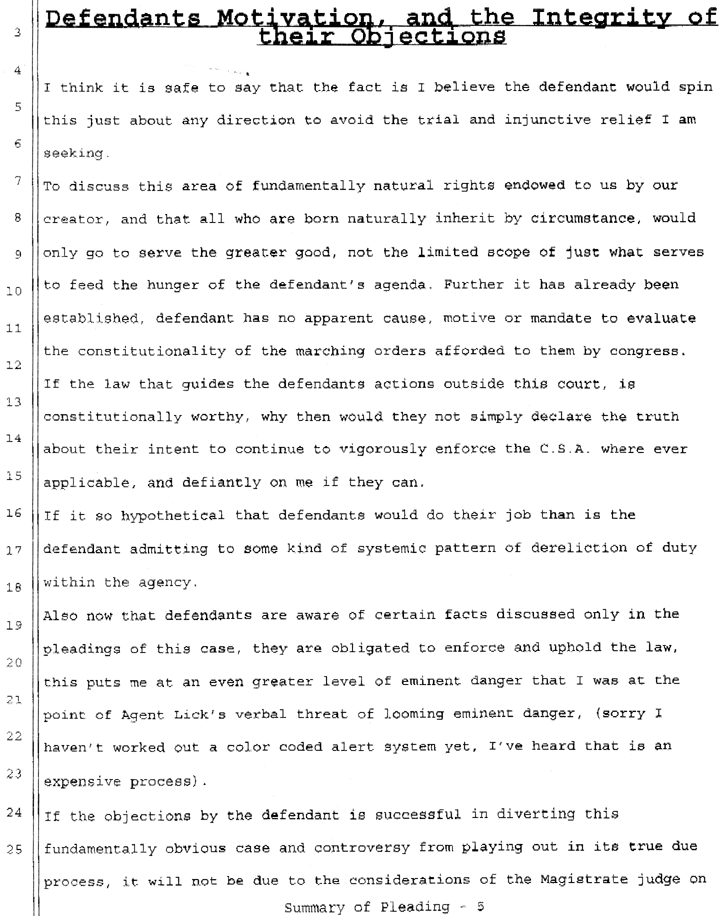
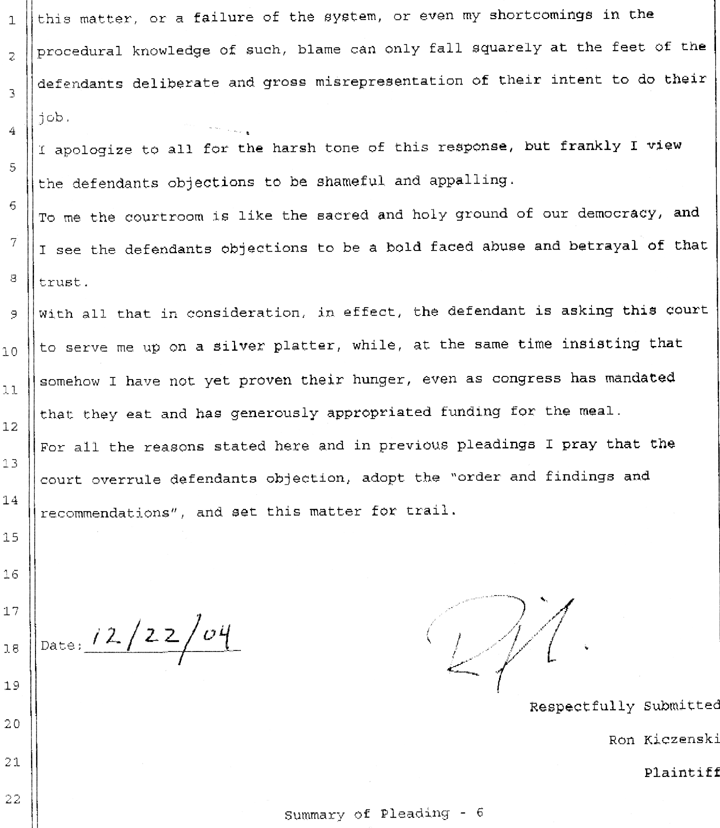
On May 17, 2005, Asst. US Attorney John Gisla filed a Motion to Get In Some Stuff He Should Have Gotten In Before.
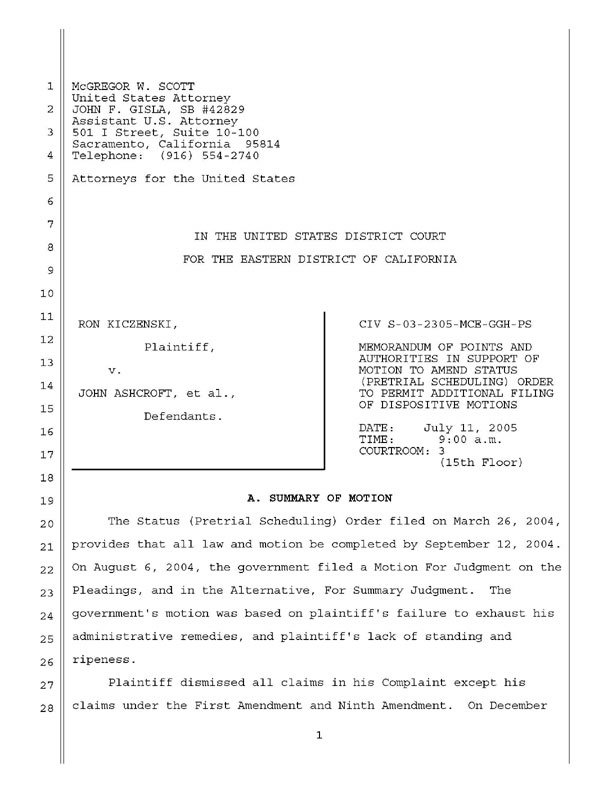
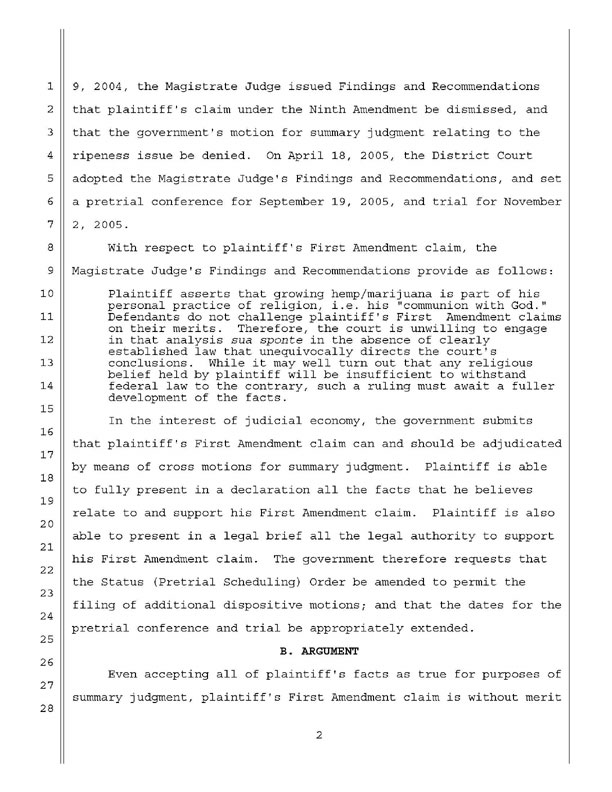
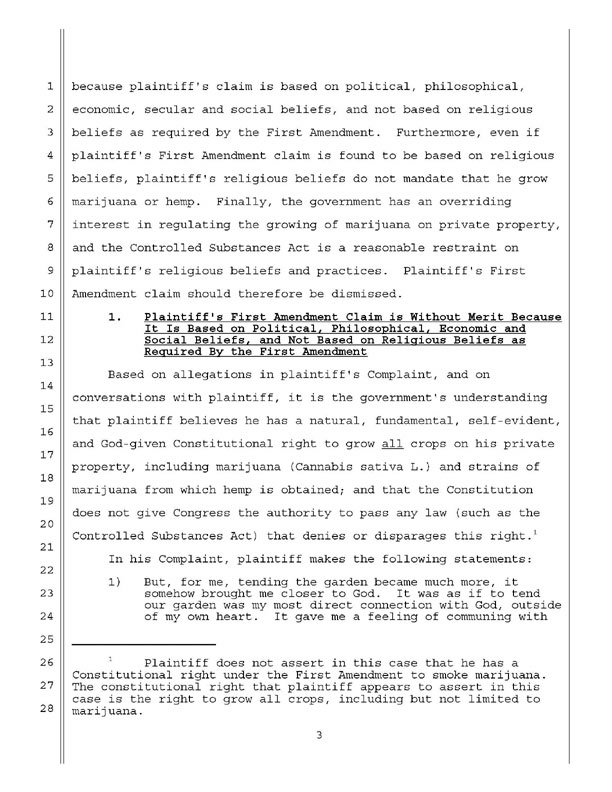
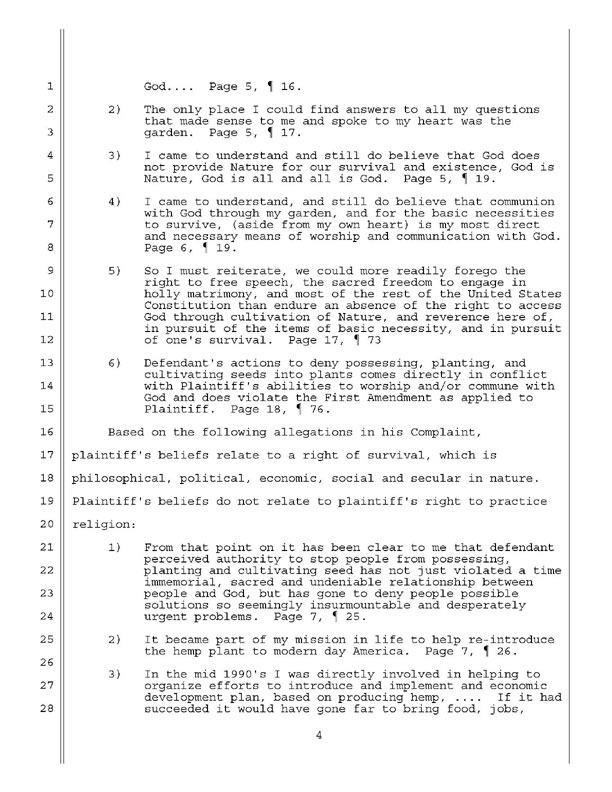
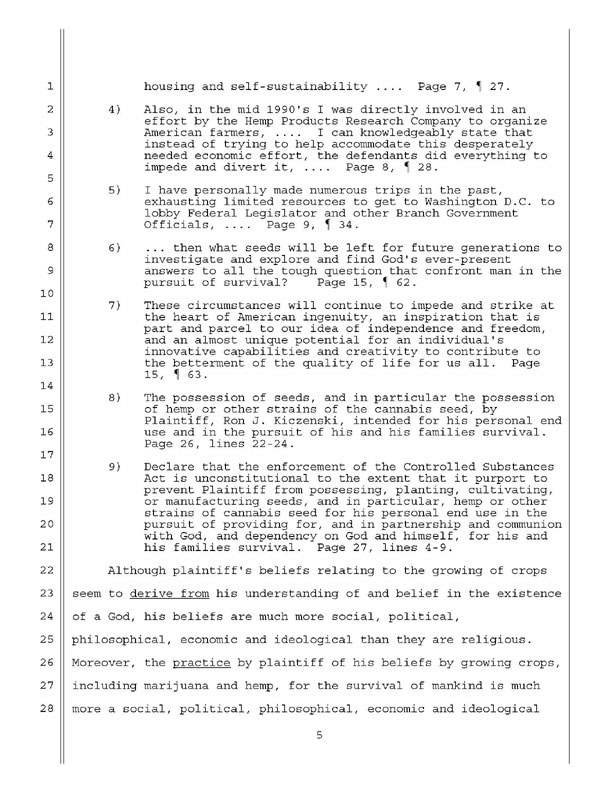
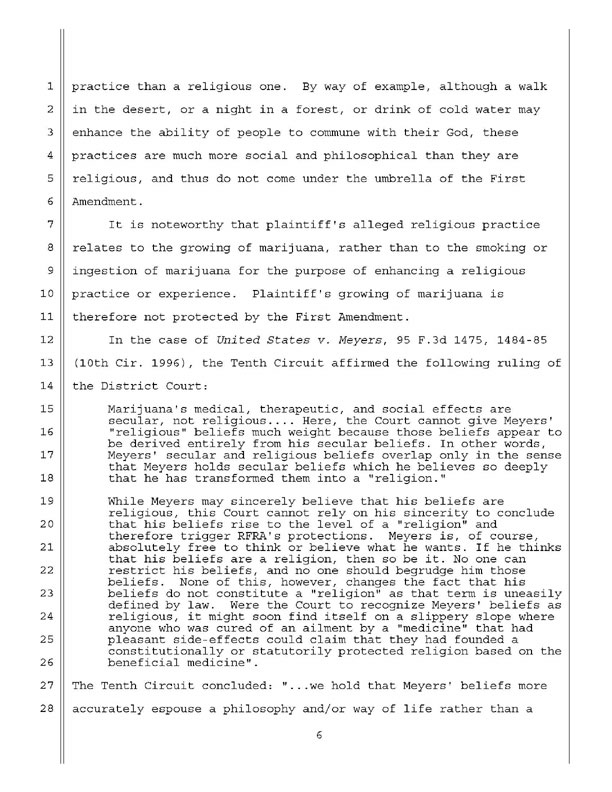
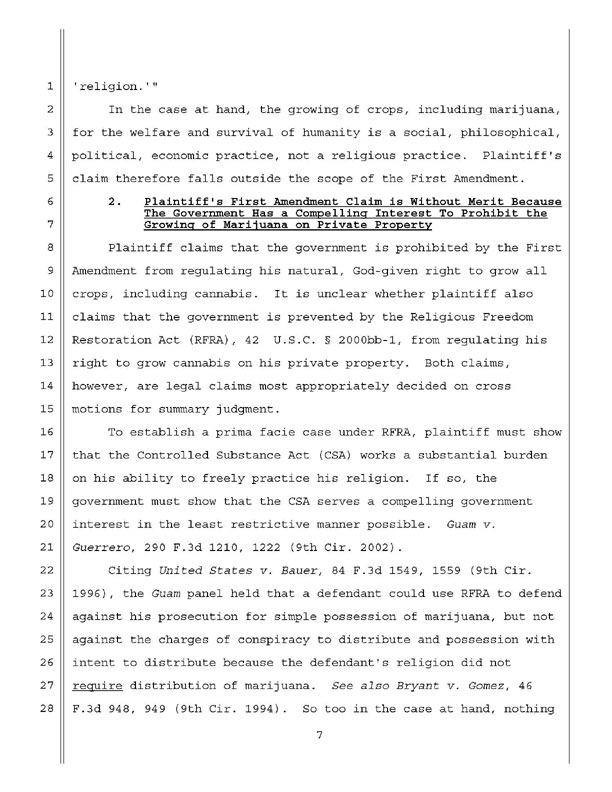
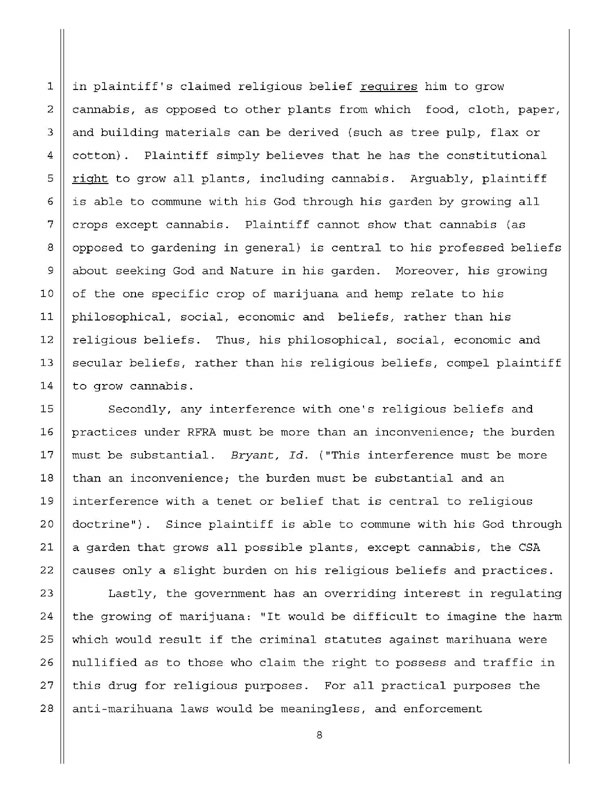
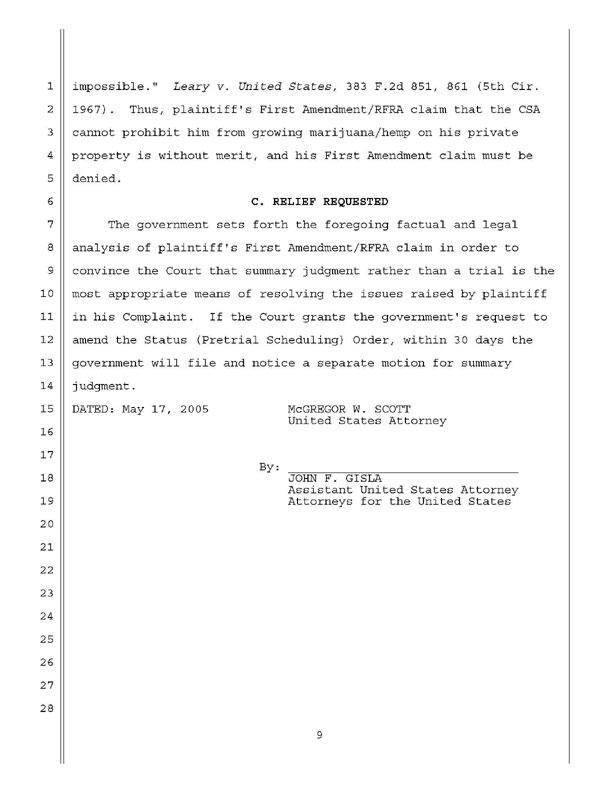
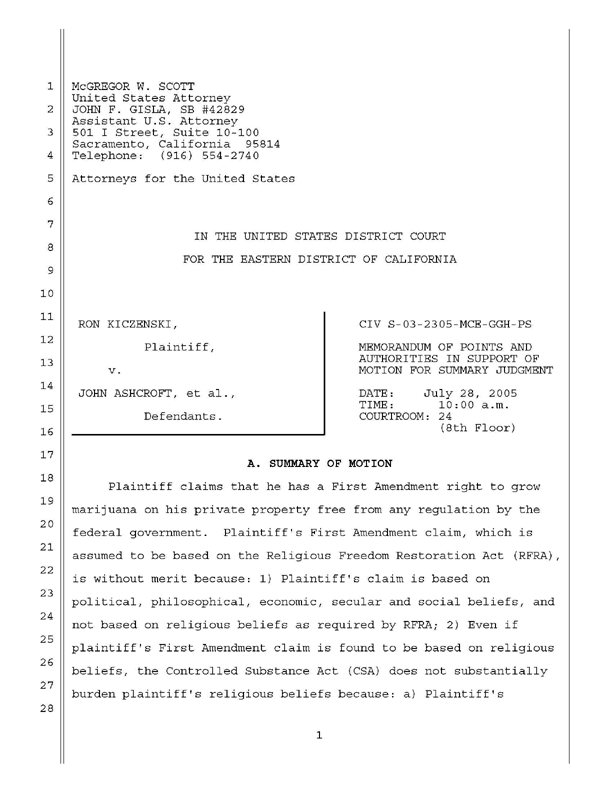
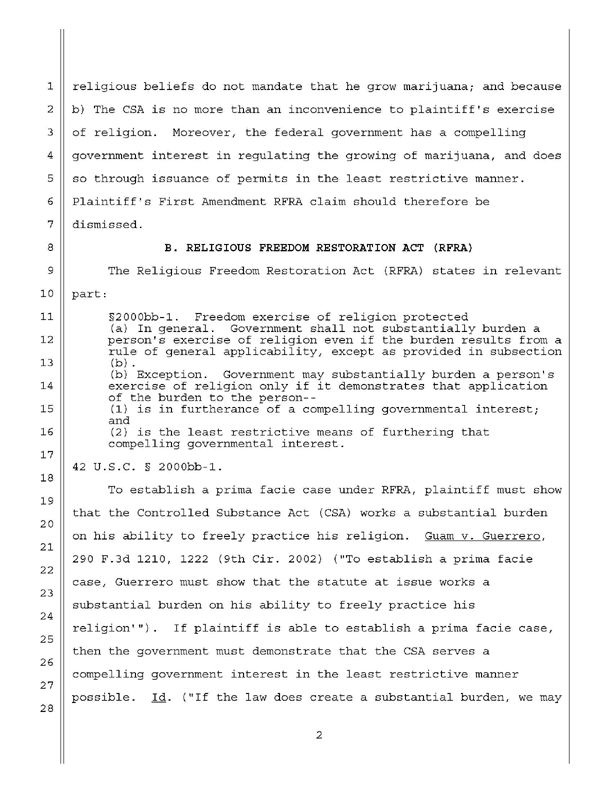
On June 29, 2005, Asst. US Attorney John Gisla filed a Motion and a Memorandum to Get In Even Some More Stuff He Should Have Gotten In Before.
Government Motion:
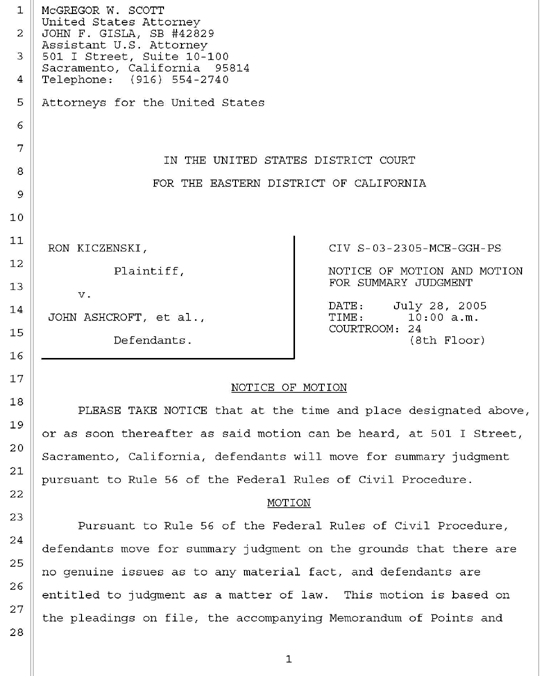
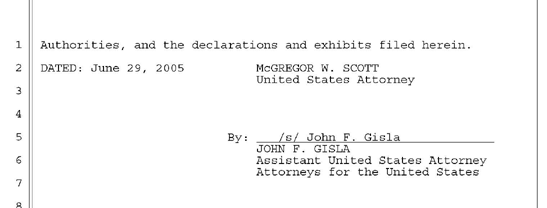
Government Memorandum:
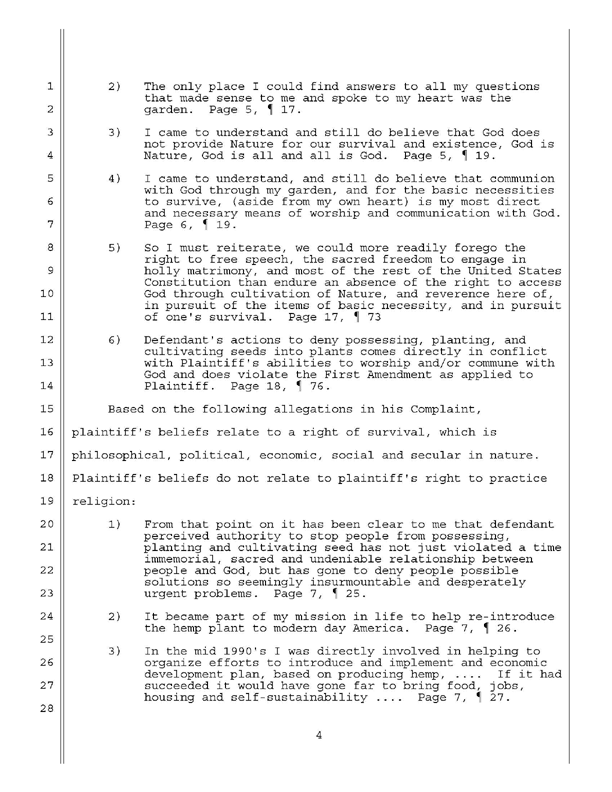
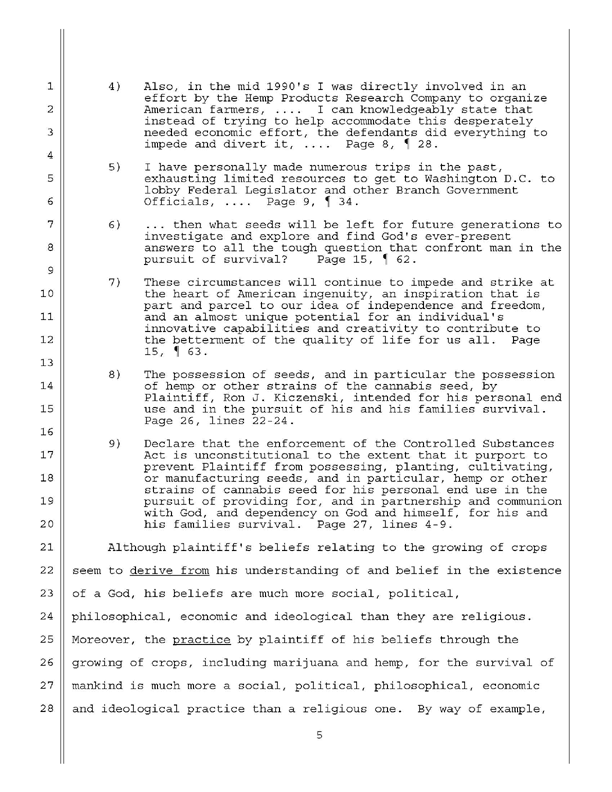
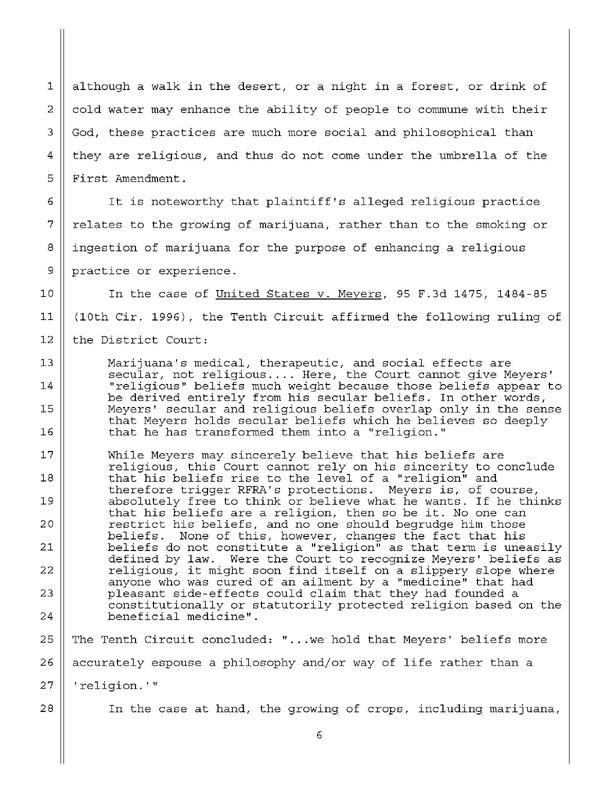
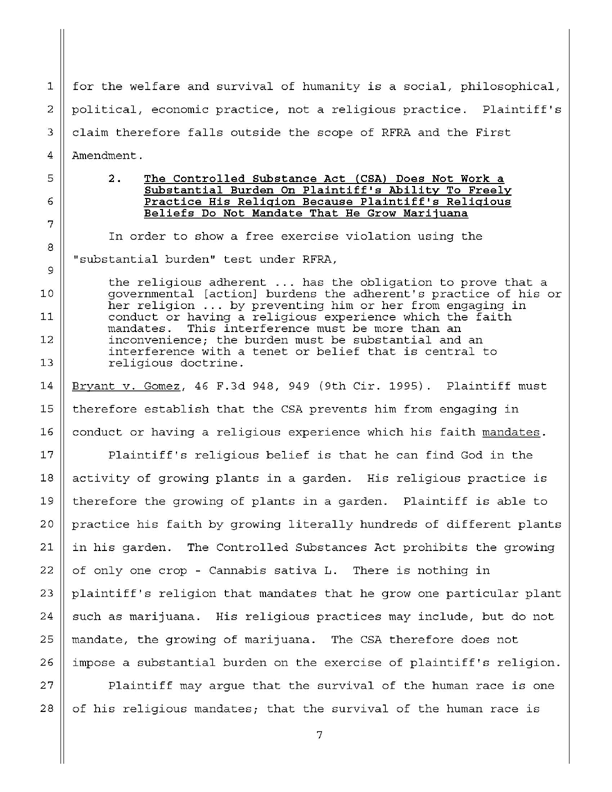
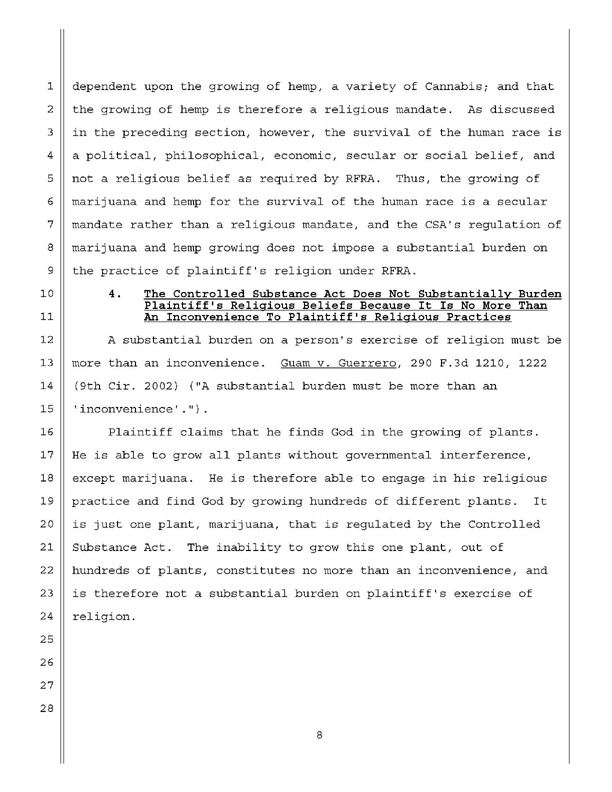
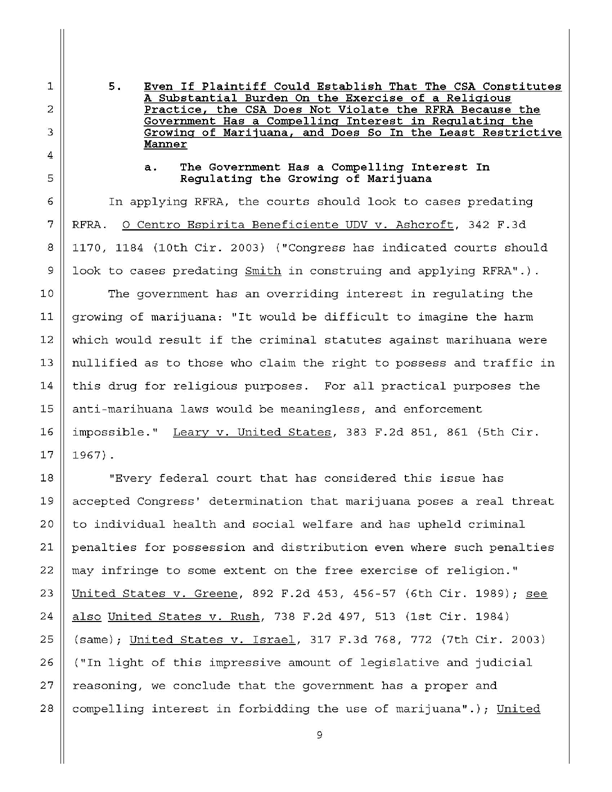
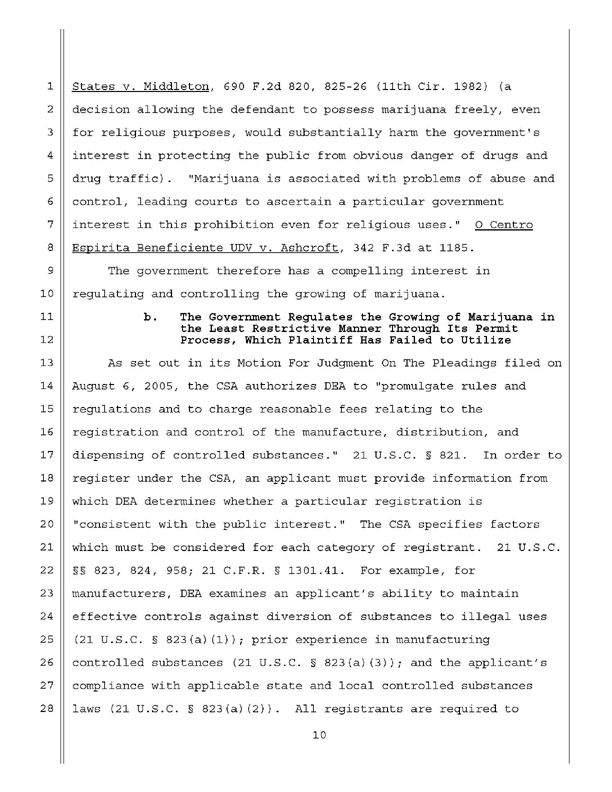
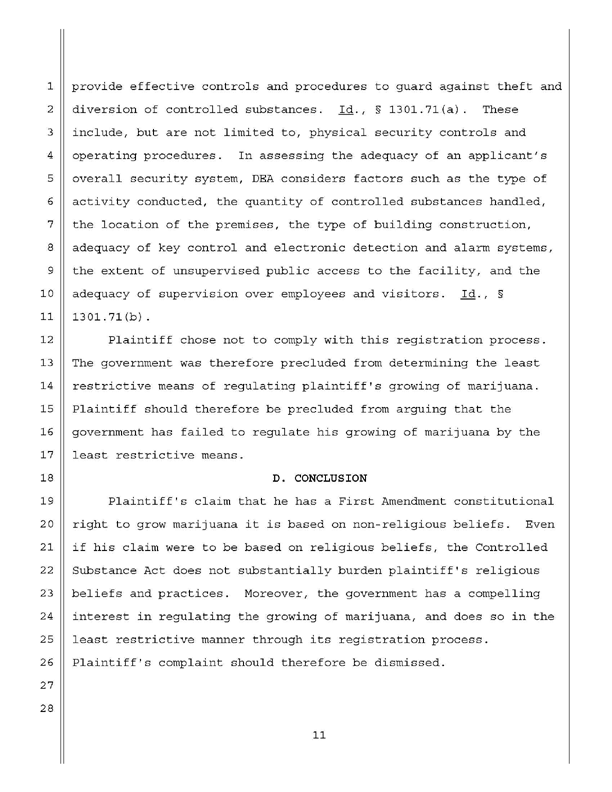
On July 5, 2005, Ron Kiczenski filed Responses to the Government’s Attempts to Find Some Relevance and Truth in Its Case.


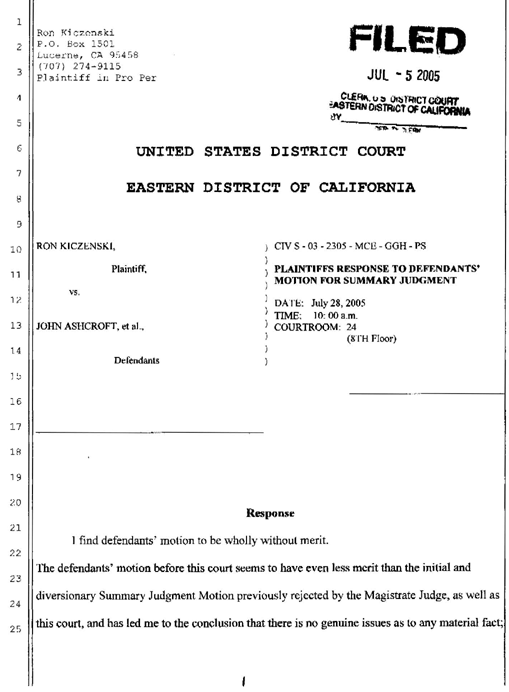
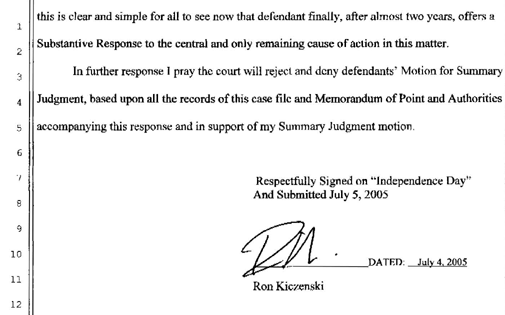

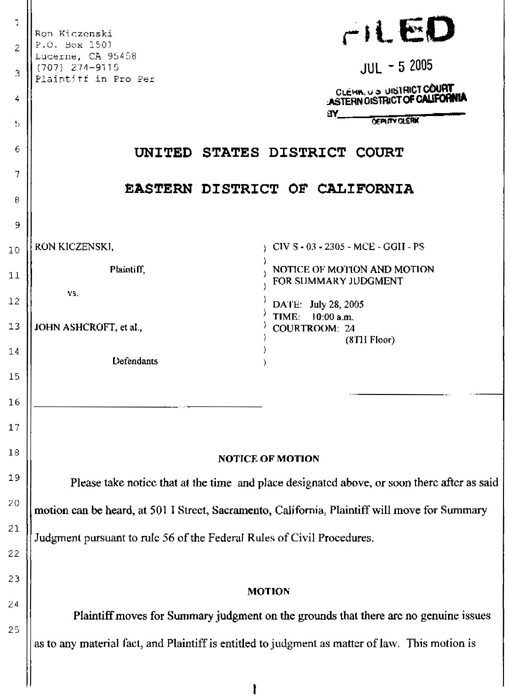
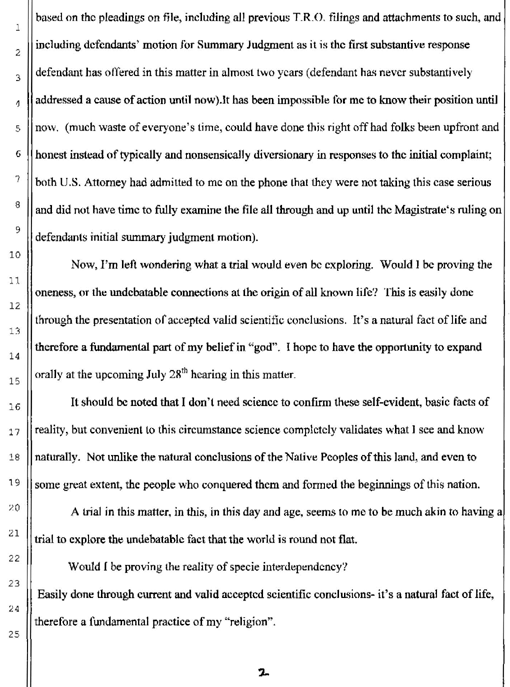


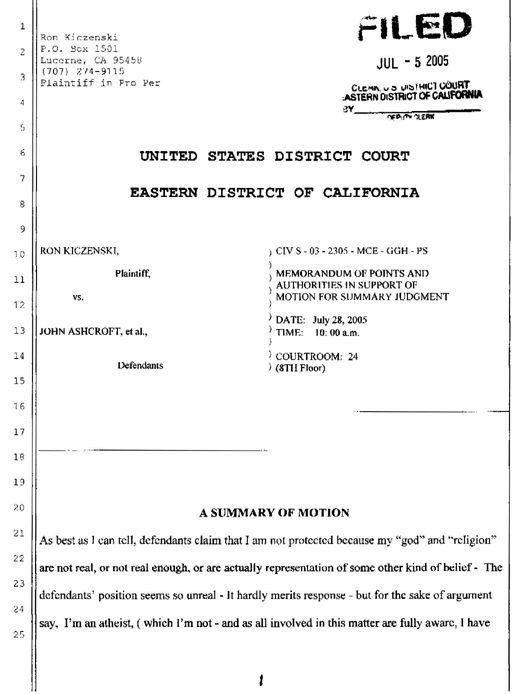

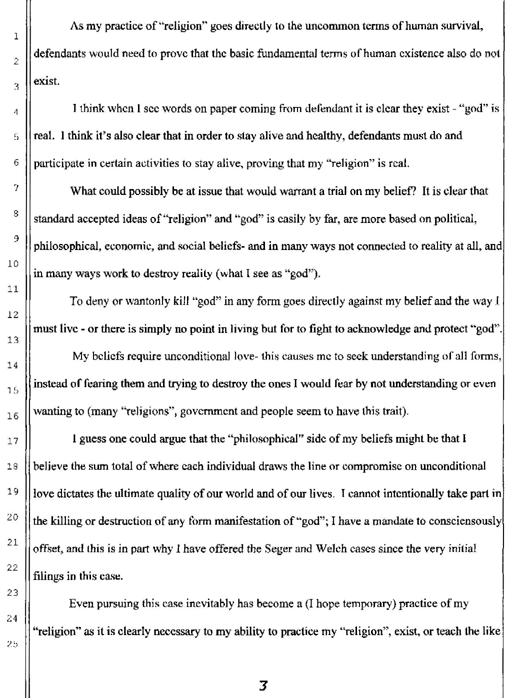
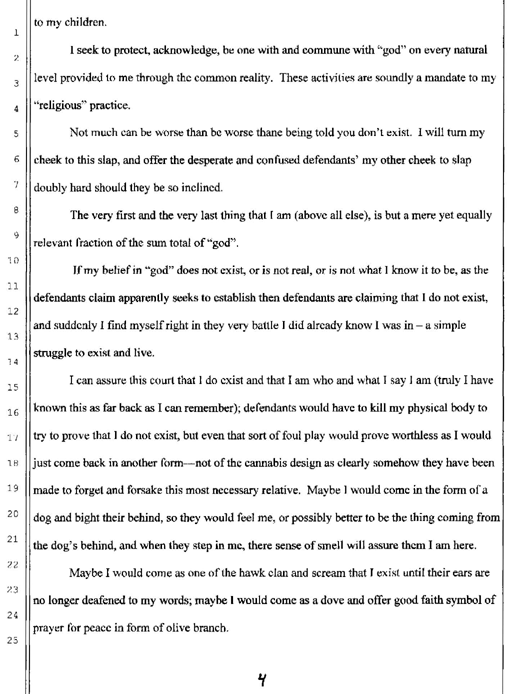
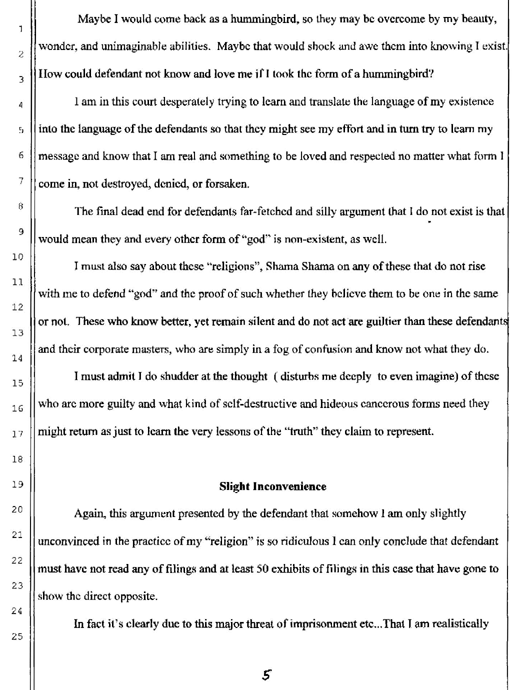
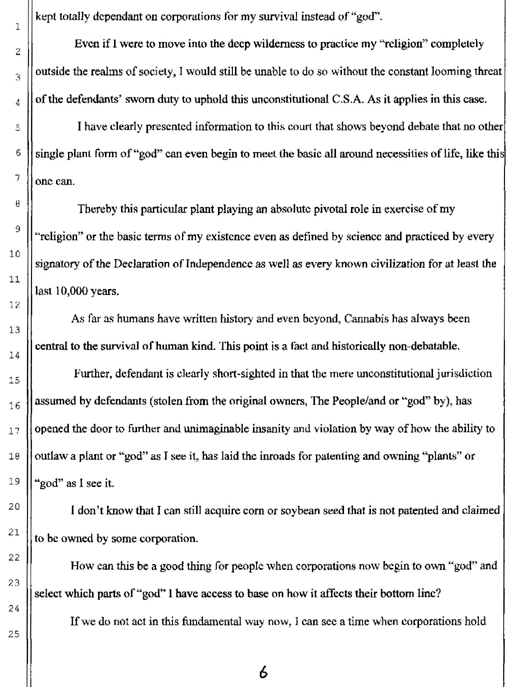
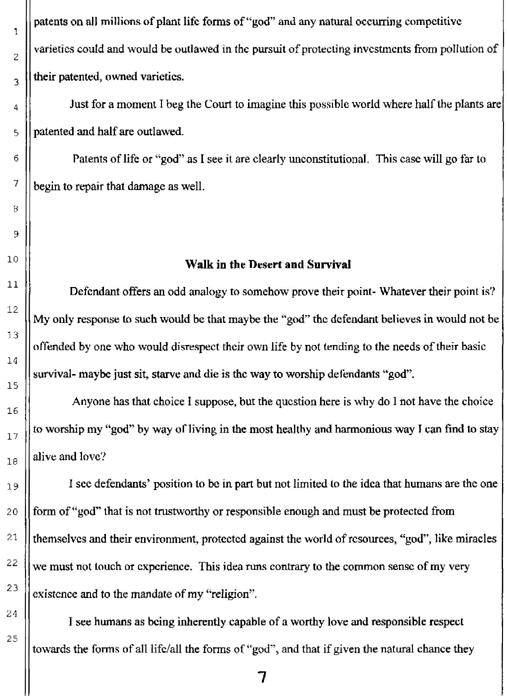
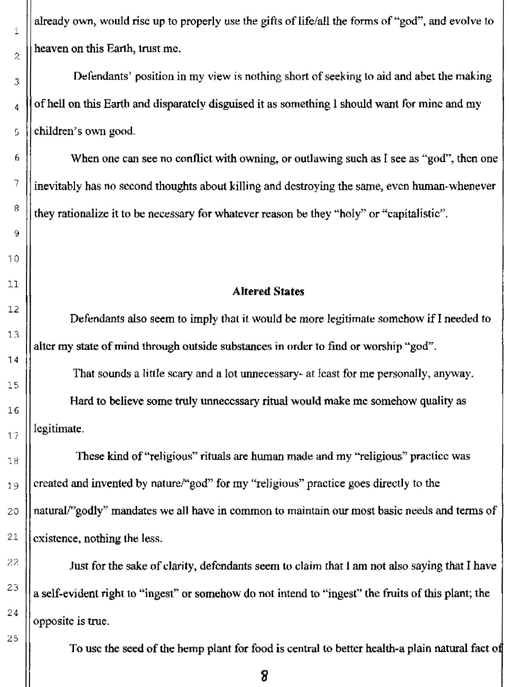
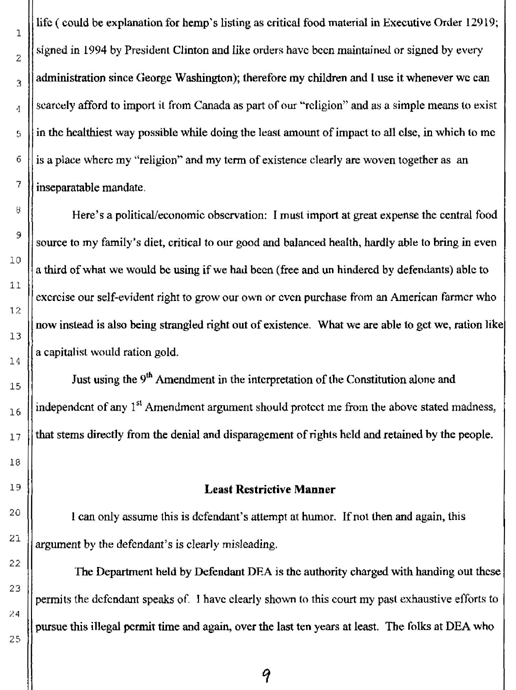
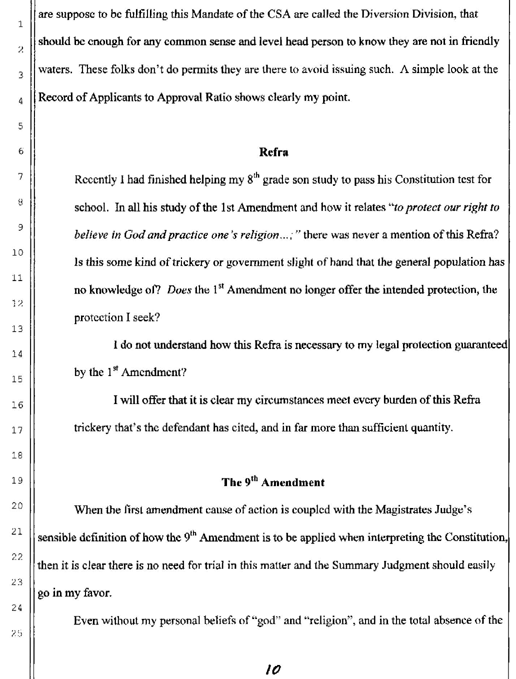
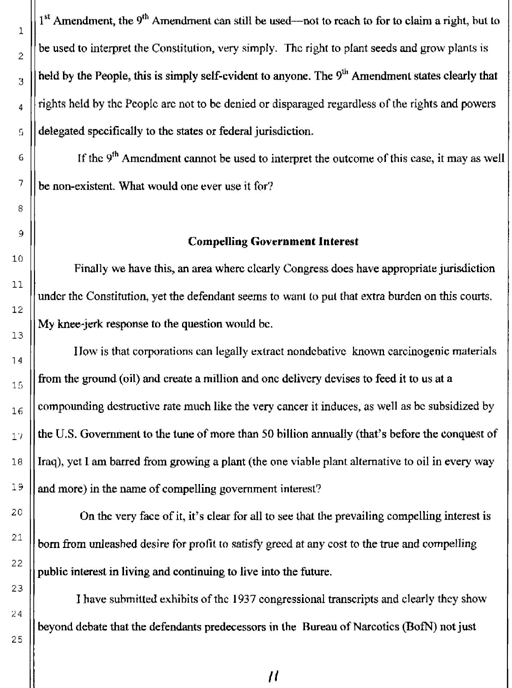

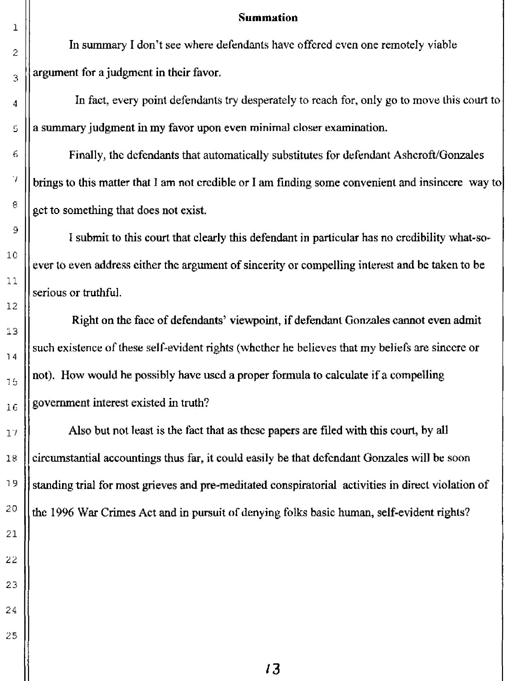
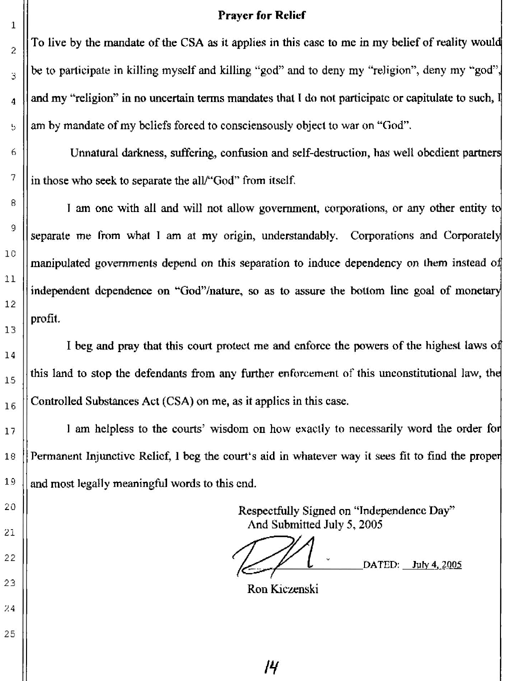
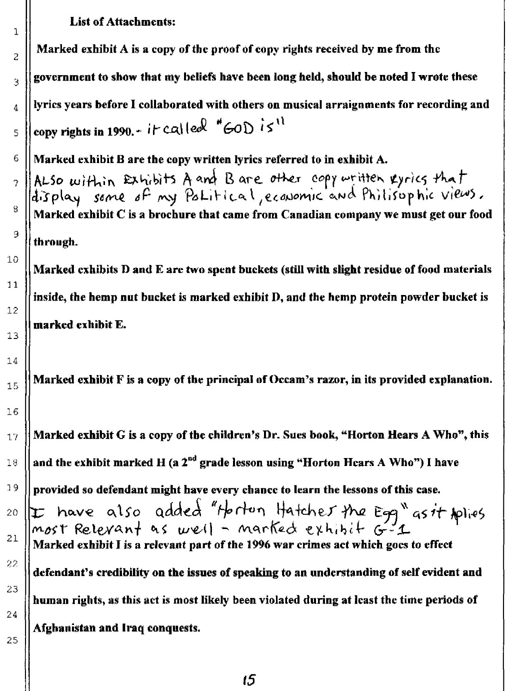
On July 12, 2005, Asst US Atty Gisla begs for summary judgment rather than have to defend the gummint’s policy of determining who worships God correctly.
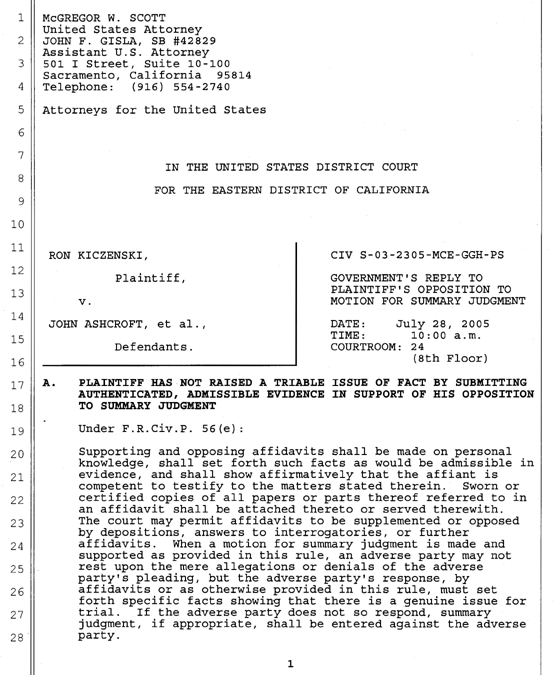
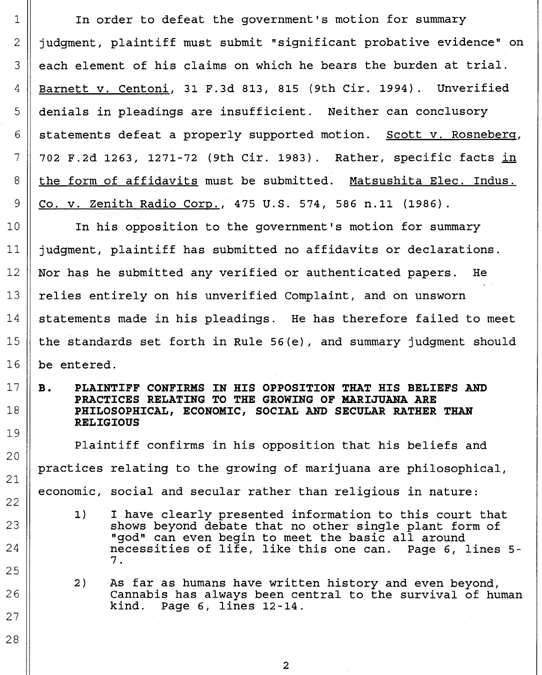

On July 28th 2005, Ron Kiczensky ofers supplementary information in support of motion for summary judgement.

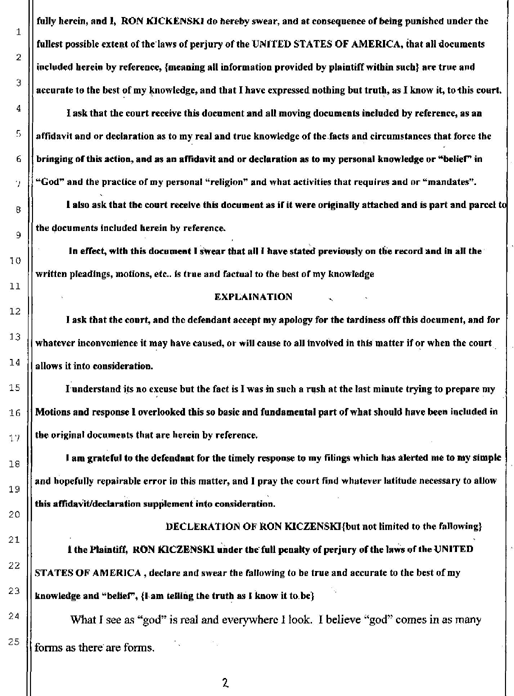

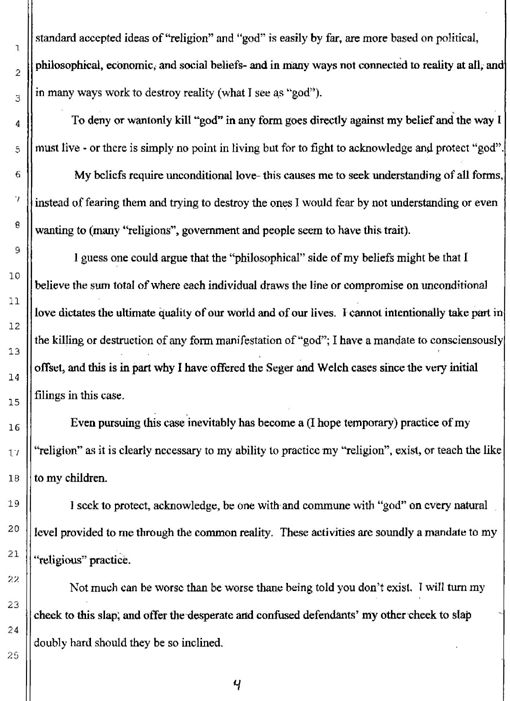
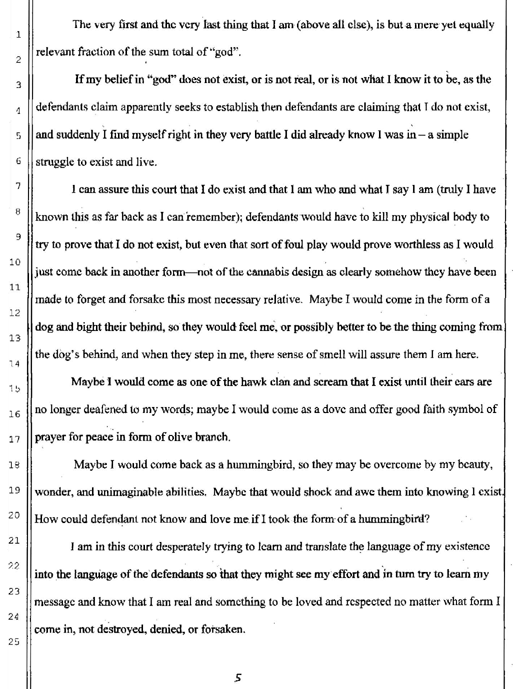
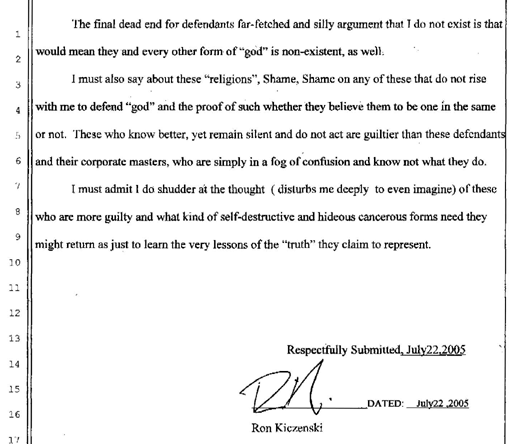
On August 1, 2005, Ron Kiczenski filed a final plea for the court to recognize the basic rights of a human being.
IN THE UNITED STATES DISTRICT COURT FOR THE EASTERN DISTRICT OF CALIFORNIA
RON KICZENSKI,Plaintiff, v. JOHN ASHCROFT, et al.,Defendants
CIV S-03-2305-MCE-GGH-PS
SUPPLEMENT/AFFIDAVIT OFFERED IN SUPPORT OF PLANTIFF’S MOTION FOR SUMMARY JUDGEMENT AND THE ACOMPANYING MEMORANDOM ON POINTS AND AUTHORITIES, HEARD ON JULY 28, 2005
INTRODUCTION AND EXPLAINATION FOR SUPPLEMENT/AFFIDAVIT
I, Ron Kiczenski, Plaintiff, do hereby offer this supplement/AFFIDAVIT in support of my motion for summary judgment heard on JULY 28, 2005 , and ask that the Court receive and consider this supplement in deciding the ruling in this case, and do hereby give my word, and oath, that what I state below is true and correct to the very best of my knowledge.
After the hearing on last Thursday July 28, 2005, it became finally more clear that it’s more than just the 1st amendment that is at work in our country meant to protect us and our natural right to live in, by, with, and for god, or worship, or practice religion.
In a desperate effort to try and satisfy the needs of my burden before this Court, I have found a case,Cutter v. Wilkinson, Supreme Court, May 31, 2005, and the, “RLUIPA”, that I believe does directly apply, and that I now ask be amended into my initial complaint or at least be considered in my over all argument for why this court should and I believe is required by law to grant the relief requested in this matter.
I also respectfully ask the courts understanding and forgiveness if my high state of emotion in this matter has been at all interpreted as disrespectful or has in any other way offended this court, for me this case is nothing short of life or death. In fighting for my children’s and my life’s I hope the court can understand and not misinterpret my passion.
HOW THIS CASE GOES TO “RLUIPA”
The Act defines “religious exercise” to include “any exercise of religion, whether or not compelled by, or central to, a system of religious belief”
T he ‘Religious Land use and Institutionalized Persons Act of 2000’, states that;
SEC. 2. PROTECTION OF LAND USE AS RELIGIOUS EXERCISE.
(a) SUBSTANTIAL BURDENS-
(1) GENERAL RULE- No government shall impose or implement a land use regulation in a manner that imposes a substantial burden on the religious exercise of a person, including a religious assembly or institution, unless the government demonstrates that imposition of the burden on that person, assembly, or institution–
(A) is in furtherance of a compelling governmental interest; and
(B) is the least restrictive means of furthering that compelling governmental interest.
(2) SCOPE OF APPLICATION- This subsection applies in any case in which–
(A) the substantial burden is imposed in a program or activity that receives Federal financial assistance, even if the burden results from a rule of general applicability;
In the arguments presented and ruled on in the matters of standing, ripeness, case and controversy it has been established that I am under threat of federal prosecution which would in effect deny my access to use my land in such a way that I am required to by my knowledge and “belief” in god and the “religion” I practice therein.
Further, even if it was a state prosecution, it has been established that even that would be federally subsidized and clearly affecting my ability to fulfill the basic necessities of the way I must live according to my “religious” “belief” and knowledge of god that lays out such.
Also, in order to even attempt to meet the demands of our knowledge/ “belief” in our “religion”, We, {my family, myself and two beautiful boys, 11 and 14}, must import our food and other things made from hemp, but the food is essential for us and central to our “religious” practice.
I will not call one life form superior to another, or give one life form more credence in its value of existence than another, as that goes directly contrary to my knowledge/”belief” in god and the basic principals of the “religious” practice I and my children must adhere to.
I can state though that we cannot even start our day in the way our “religion” dictates unless we have hemp seed in one fashion or another to eat, period.
I and my family are bound by our “religious” “belief”/knowledge to seek out the healthiest {yet least impact or damaging to other life}, food sources.
It is not my fault if everyone ignores the plain and factual truths of history and science that proves that hemp and no other plant can provide the sustenance necessary to accomplish this in a humans diet, I cannot by requirement of my “religious” belief”/knowledge of god.
As well, no other plant can provide, right along with the food, the other basic necessities of life, { in the way I have just described in the paragraph before the previous one}, i.e.; fuel, clothing, building materials, paper, even medicine which is also a requirement of our “religious” “belief” and knowledge to be acquire directly from the earth/god when at all possible, cannabis makes this possible for helping to treat many health problems of human kind.
Because of this requirement by our knowledge in god, and due to the unreasonably restrictive no access diversion policy of the DEA under the auspices of the CSA, we must import our food from outside this country, right now we get it from Canada, {when we can afford the unreasonably high expense}, thus clearly and directly affecting “commerce with foreign nations”, i.e. ;
“(2) the substantial burden affects, or removal of that substantial burden would affect, commerce with foreign nations, among the several States, or with Indian tribes.”
To further comply with the above; please refer to my statements pertaining to my activities with the Oglala Sioux Tribe at Pine Ridge “reservation” and how DEA under the auspices of the CSA foiled all and every project.
How can my activities on Pine Ridge be considered separate or different from any other of the many missionary’s efforts by other “religions” on the res., as it applies to this case or to “RLUIPA”?
I must add that there is or should be no question that I would be still directly involved with the Pine Ridge efforts to this day and beyond, if I was not being discriminated against by way of the CSA, and there should be no question that those projects were intended to and would still be effecting local, states, and international commerce.
Within the scope of application it also states i.e. ;
“(C) the substantial burden is imposed in the implementation of a land use regulation or system of land use regulations, under which a government makes, or has in place formal or informal procedures or practices that permit the government to make, individualized assessments of the proposed uses for the property involved.”
I think it goes without saying,{unless I’m way off base}, that the CSA does and intends to do just what the above paragraph describes, in so far as it applies to me, my land, and this case.
” (a) SUBSTANTIAL BURDENS-“
“(1) GENERAL RULE- No government shall impose or implement a land use regulation in a manner that imposes a substantial burden on the religious exercise of a person, including a religious assembly or institution, unless the government demonstrates that imposition of the burden on that person, assembly, or institution–
(A) is in furtherance of a compelling governmental interest; and
(B) is the least restrictive means of furthering that compelling governmental interest.”
How is it even possible to not view the current policy as the most and furthest extreme in restrictiveness? There’s simply no access at all, and on top of that, they have a written policy to eradicate the specie wherever it’s found.
Even as I write these words the federally funded “C.AM.P.” ,”CAMPAIN AGAINST MARIJUANA PLANTING” teams are swarming all over the state of California, and in particular the tri county area I live in, doing recon and acting to destroy all the cannabis they possibly can.
With the described atmosphere raging all around me how can the defendant honestly claim even a remote argument of least restrictive means?
Aside from my exhaustive and fruitless efforts over the years to obtain one of these rare if at all existent permits, with the current dispositions of the defendants DEA and the DOJ, can anyone honestly come forth and state there is reasonable good faith intention on the defendant’s part to issue grow permits?
In support of the notion that the defendant intends total eradication and extinction of the cannabis plant link in the chain of our existence I do attach and offer as marked “exhibit A-sup” my most current efforts in fallowing up with the interior department and the endangered species act.
Within that exhibit please take notice of the excerpts from the document called;
“THE THREAT OF PLANT PATHOGENS AS WEAPONS AGAINST U.S. CROPS”,
And to the bottom of page 163, under the heading, “DRUG CONTROL PROGRAM”,
And the section heading immediately fallowing that called,
“WHY TARGET CROPS WITH PLANT PATHOGENS?”.
To the best of the my knowledge these pathogens could be already being delivered on to U.S. soil by the defendants in an effort to once and for all eradicate the species of cannabis.
The Interior Dept. seems to have no interest in a realistic, scientific or reasonable approach in responding to my petition, I have exhausted that process and they will not act even though the ESA requires them to. There is no relief there for me or cannabis.
I ask the court to consider what these pathogens will do when they are through gobbling all the cannabis? Will they just go away? Or maybe be it will still be hungry and adapt to target another plant species, maybe one the defendant or the court puts value or importance to?
* “(A) is in furtherance of a compelling governmental interest; and” *
How has the defendant or congress ever made a justifiable argument or finding to justify the types of extreme and final solution methods they currently employ?
There is no past or present debate in congress that has ever weighed the uses and value to our country’s national security {and to the individual}, this plant has to offer{and has victoriously and irreplaceably offered in the past}, as opposed to the perceived and never even honestly portrayed threat .
The government has no real and honest foundation to base a compelling interest argument at all, at least not until the scenario I just described finally takes place.
On its face, how can a reasonable mind possibly conclude that a plant that could go so far to save our farmers, repair our land quality, repair our environment{water and air}, repair our infrastructure, repair our economy, move us away from carcinogenic by products of petroleum products of all types, stop deforestation, and give us perfect nutrition, could be more of a threat than some fungal pathogen created in a laboratory as a weapon to target the same plants and to be released into farmland all across the U. S. A. ?
I think I understand well a compelling interest notion, I have children, I’m here on the compelling interest to protect and maintain their ability to live, and live well and healthy and aware of their origins and relatives and interdependencies of the living reality, the chain of life= religion= god}, but I consider the rationale of defendants’ compelling interest arguments to not only be politically/special interest orientated, but also to be clinically insane{if truly analyzed by an impartial expert}, scientifically unfounded, and most definitely suicidal, and at the very least, clearly not in the interest of the people of the U. S. A. or the world at large.
“SEC. 3. PROTECTION OF RELIGIOUS EXERCISE OF INSTITUTIONALIZED PERSONS.
(a) GENERAL RULE- No government shall impose a substantial burden on the religious exercise of a person residing in or confined to an institution, as defined in section 2 of the Civil Rights of Institutionalized Persons Act (42 U.S.C. 1997), even if the burden results from a rule of general applicability, unless the government demonstrates that imposition of the burden on that person–
(1) is in furtherance of a compelling governmental interest; and
(2) is the least restrictive means of furthering that compelling governmental interest.
(b) SCOPE OF APPLICATION- This section applies in any case in which–
(1) the substantial burden is imposed in a program or activity that receives Federal financial assistance; or
(2) the substantial burden affects, or removal of that substantial burden would affect, commerce with foreign nations, among the several States, or with Indian tribes.”
In a strange yet real way, this section also seems somehow to apply. By a Superior Court order of the state of California, and concerning the terms of the custody order pertaining to where my children and I live, we are bound by that order to this address and are not permitted to move without permission of the court.
In effect the U. S. A. , the state of California, Lake county, and my current address are a government induced institution that I’m locked into by Court order, just as if I were deemed to stay in any other place in America by a law being enforced through a Judge’s Court order.
“(b) BURDEN OF PERSUASION- If a plaintiff produces prima facie evidence to support a claim alleging a violation of the Free Exercise Clause or a violation of section 2, the government shall bear the burden of persuasion on any element of the claim, except that the plaintiff shall bear the burden of persuasion on whether the law (including a regulation) or government practice that is challenged by the claim substantially burdens the plaintiff’s exercise of religion.”
I believe I have satisfied my burden under this Act as I understand it, in turn I also believe the defendant has not even begun to make a viable argument for their position or in satisfying their burden under the Act.
DEFENDANTS CENTRAL ARGUMENT FAILS ON ITS FACE
As my “religion” and knowledge of “god” come directly from the obvious and even scientifically proven facts of nature/the chain of life/god, and is unto me alone as my own church and my own religion and as I myself am part of god it is naturally built in to my belief and mandate to be entirely independent and unto myself in these maters, to do otherwise would be in direct conflict with the core belief of oneness through individual consciousness and awareness of common origin{intelligent design}.
So in other words separation by and through the very things that bind us all with each other and everything else {where we come from, what keeps us alive, and where we go after death}, in the way of an organized religion or any man made doctrine {CSA} outside my own soul and its connection to all {not just this that or the other, selectively}, I cannot be a part of, period.
The CSA clearly seeks to separate permanently me from my origins/god and my ability to depend on such to live in the mandate of my “religious belief”.
In my knowledge of god a law like the CSA, in so far as it applies to this case, might as easily and more appropriately be called maybe, ‘the divide and conquer god at both ends law'{perfect for corporate interests} and in my knowledge of god and the book of life and those rules=nature, this kind of law can only end in deficiency, sickness and death{cancer on big and small scales}, and being completely outside and in direct violation of my religious mandate in so far as it applies to this case.
In my view these ways of killing are simply suicidal, maybe some have the right to suicide lifestyle going against god/nature, but I should have the right to stay with god and teach my children the same, and not choose suicide even if all the rest are and as a consequence I to am killed, I should still have my own right to choose life/god.
Is it my fault that those who have control have not learned from the failed and tragic simple examples of this kind of ‘divide and conquer god at both ends law’ from bounties on the life’s of wolfs and buffalo/bison to bounties on human slaves and indigenous human beings, this kill the link thinking has proven over and over to be wrong and self-destructive, and yet it continues.
These kind of laws presume wickedness at the nature of humans and everything else. Once we resort to this type of thinking, we have already defeated ourselves; there is no way out of that strait line to a dead end.
For the defendant to claim to have even the slightest knowledge of my religious practice they would need a basic knowledge of nature its ecosystems and interdependencies, and how that applies to human existence in a necessary and in common way.
Defendant would also need to have a basic knowledge of the requirements of human nutrition and in particular for vegans such as I and my children are in accordance with the practice of our religious mandate.
The basic knowledge of nature and diet are easily proven by modern science, and defendant should be more than whiling to stipulate to such as fact, or I’m surely willing to bring the most qualified experts in the country on the subject to either testify or submit declarations to such facts, but a trip to the local library and a quick look at a couple of national geographic magazines even, and one starts to get an understanding of these natural and in common facts of life.
How can anyone try to differentiate and separate the practicing of some religious ritual unnecessary to ones in common survival, from the practicing of the needs of in common survival where otherwise the unnecessary ritual would be? , and how could the first described ritual be more valid than the second, even so much so that one would have protection and the other not?
If anything it seems the more normal and acceptable to society religious practice would be mine, the abstract and more to be concerned with by some compelling interest of defendants would be these that are completely dreamed up or handed down in ancient books. From all these we have seen only suffrage and unnecessary separation and war and each day it gets worse. All these’ self-destructive ways one need never fear coming from my religious belief and practice based in the necessarily unavoidable structure and dependent circle relationships of nature and all things, yet I have no protection?
All things in god/nature work in concert to live, and I am bound by my very birth responsibility to fulfill to the best of my individual ability, my obbligato role in life’s/gods infinite and diverse yet simple song, this is the mandate of my religious practice.
I can say without hesitation that if I thought I was condemned to a hell on earth that was finally hopeless of a remedy to such fundamentally flawed thinking and I was to be forced to live against my belief and religious practice and knowledge of god for the remainder of this life {to live in destruction of god}, I would sooner be dead, life would make no sense and would be to confusing and painful to even continue to face, as if a matrix type false reality yet inescapable prison, truly hell and what is the only possible hell in my belief.
What will it take to show this court that in my very nature I am religion, I am ritual, I am a church, and I am god as an individual and collectively?
Do I need to parade a substantial amount of witnesses that have each known me for 15 or more years to swear and testify to their knowledge of my religious belief, would that be worth more than my own sworn word? If that be the requirement it is easily fulfilled if given the chance.
I don’t know what else I could possibly do or say to prove how real and necessary the mandates of my religious belief and practices are to mine and my offspring’s current and future lives?
Maybe it would be worth a “nickel” to the Court if I traded my life strait across so that my children could live free in god/life, and in the chain, not separate from it and cancerous as a consequence, would that go to prove my sincerity and save my children from this tragically inherited legacy of empty self-destructive madness that never had to be? If that’s what it takes, that’s why I’m here, to offer whatever is necessary, what greater purpose could one even have to live at all?
It’s my religious belief and necessary mandate to live in harmony with and dependent on “Eden”,not wall-mart, exxon, dupont, and monsanto who now is racing to patent and own “Eden” exclusively and sell a sick and deficient version of it back to us, then some other like elli lily is happy to sell us more tainted wisdom to give an illusion of a bandaid to put on the sickness caused by the separation to begin with.
Here’s a thought of mine that might meet the aspects of a definition of my political, economical and philosophical views;
The capitalist idea in its purity and unchecked is simply a mimic of cancer in growth demands and it’s eventual self destructive inevitable end.
Regardless of whether I think the thought stated in the last paragraph is a true fact or not,
My religious practice that mandates being dependent on myself in harmony with nature/god precludes my choice to even take part in such a lifestyle in every way possible.
Finally how is it even possible that growing plants is not a natural born human right outside and independently self-evident and unburdened by association with religion or any other right listed in the bill of rights to the constitution? Where do I get the right to grow a carrot and how is the right different in its foundation from growing any other plant?
Probably just about every plant in this world could be misconstrued in one way or another to be a threat if one was out to prove so, but so is gasoline a real carcinogenic threat, why is it aloud to be produced and sold at nearly every street corner right next to the liquor stores?
How can a corporation somehow have the natural and legal right to unnaturally manipulate life,patent and own it, thereby cutting off my natural born right to access the original specie {or the one they’ve manipulated}, which now poses a threat to the corporately owned gene pool, yet I have no natural right to grow a plant?
Every Frankenstein like activity from cloning to stem cell harvesting is somehow assumed and allowed, yet I have no natural right to grow a plant? Anyone can see, anyone, and my children already do see that’s a world gone mad.
I ask this Court to issue its ruling in language that I and my children can understand if possible, as they to anxiously await to know if they are protected in their belief and religious practice, and because I could never be able to explain if the ruling is that we are not protected, wouldn’t have the first idea how, it would be like trying to tell them they don’t exist.
Respectfully Submitted, August 1, 2005
DATED: August 1 , 2005
/s/Ron Kiczenski
Attached for the convenience of the court is a copy of the cutter Supreme Court ruling and the 9th Circuit Court ruling that preceded it.
Also attached and marked as “exhibit A-sup” is all the existing paper work I have on the endangered species act petition effort I have recently exhausted.
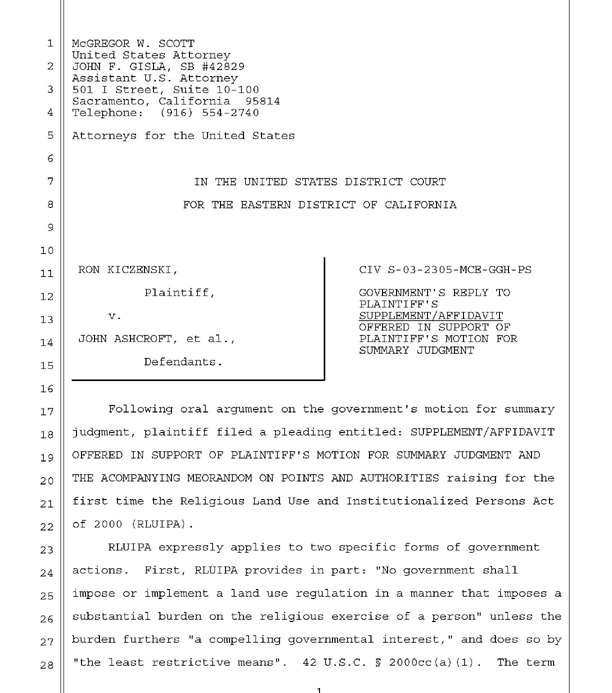
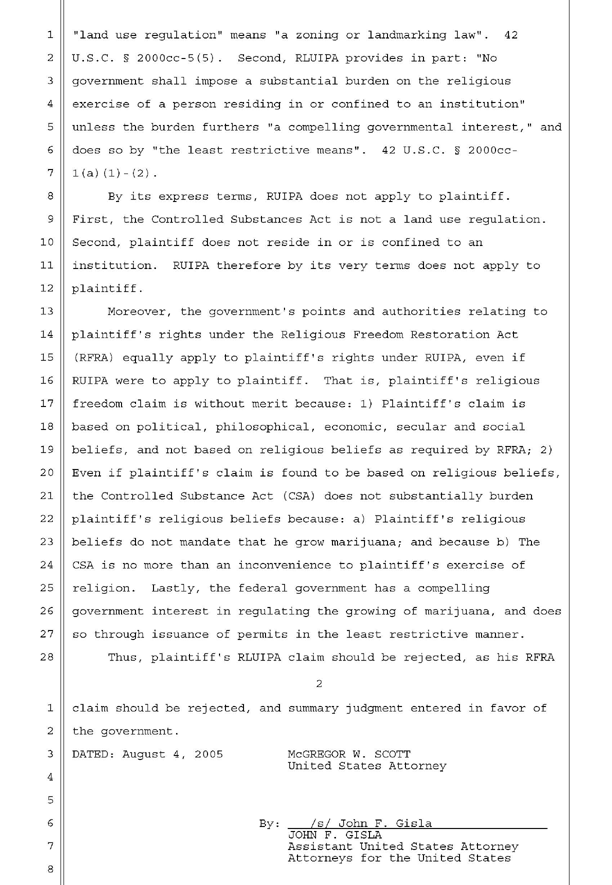
On August 5, 2005, Asst. US Atty John Gisla replies to Kiczenski’s Aug. 1 affidavit. Gisla askes for summary judgment in favor of his side.
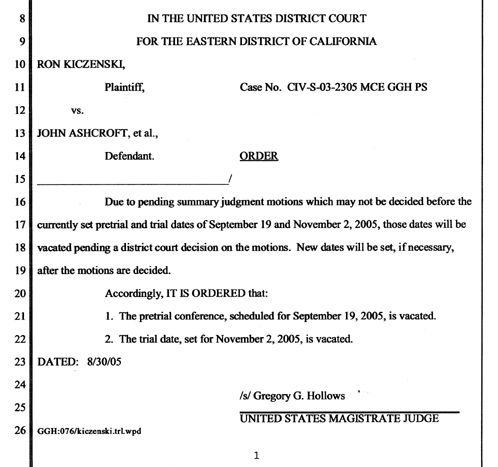
On August 31, 2005, Judge Hollows indefinitely postponed pretrial and trial dates, while he considers the most recent motions.
IN THE UNITED STATES DISTRICT COURT FOR THE EASTERN DISTRICT OF CALIFORNIA
RON KICZENSKI,Plaintiff,
vs.
JOHN ASHCROFT, et al.,Defendants.
No. CIV S-03-2305 MCE GGH PS
ORDER
Previously pending on this court’s calendar was defendants’ motion for summary judgment, filed June 29, 2005, and plaintiff’s motion for summary judgment1 filed July 5, 2005.
1 Because plaintiff’s opposition contains no substantive argument, the court will construe his motion for summary judgment as an opposition to defendants’ motion.
In addressing the government’s motion, the court became aware of a case which was not previously raised by the parties, Hemp Industries v. Drug Enforcement Admin., 357 F.3d 1012 (9th Cir. 2004). The Ninth Circuit held that because the Drug Enforcement Administration (“DEA”) did not follow the correct procedures for scheduling a substance, it had no authority to regulate drugs which were not scheduled. Id. at 1018. Specifically, the court found that the Final Rules banning Cannabis plants which are not within the Controlled Substances Act’s (“CSA”) definition of marijuana or which do not contain synthetic THC, could not be enforced. Id. In other words, the DEA only has authority to enforce rules and regulations banning marijuana or synthetic THC.
This case appears to undercut the government’s position, and should have been brought to the court’s attention by the government as it was published prior to the government’s motion for judgment on the pleadings or for summary judgment, filed August 6, 2004.
Hemp Industries also appears to be on point with plaintiff’s initial position. In his complaint, plaintiff alleged, “[t]he hemp plant is a different strain of cannabis with a different chemical-based makeup, and contains no viable amounts of the chemical THC that exists in some of the other strains of cannabis, and is of no end use value in the illegal (drug) trade.” Compl. at 16:22-24. In his opposition to defendants’ August, 2004 motion, plaintiff also raised the issue of the CSA’s authority to regulate his activities because they “do not fall within the definition of this legitimate category of legislative authority.” Oppo., filed September 10, 2004, at 2:17-21. Throughout this opposition, plaintiff emphasized that growing hemp for utilitarian purposes was not intended to be outlawed by the government’s ban on drugs.
Therefore, the parties shall file briefing regarding the applicability of Hemp Industries to this case, including: (1) its pertinence to this case, and (2) if it is pertinent, has not plaintiff raised an issue of fact regarding the type of hemp seeds he is planning to grow and whether they are exempt from the CSA. Defendants’ motion for summary judgment will be decided upon submission of this briefing.
Accordingly, IT IS ORDERED that the parties shall file simultaneous briefing by November 21, 2005.
DATED: 10/28/05
/s/ Gregory G. Hollows
/s/________________________
GREGORY G. HOLLOWS
U. S. MAGISTRATE JUDGE
GGH/076
Kiczenski2305.frb.wpd
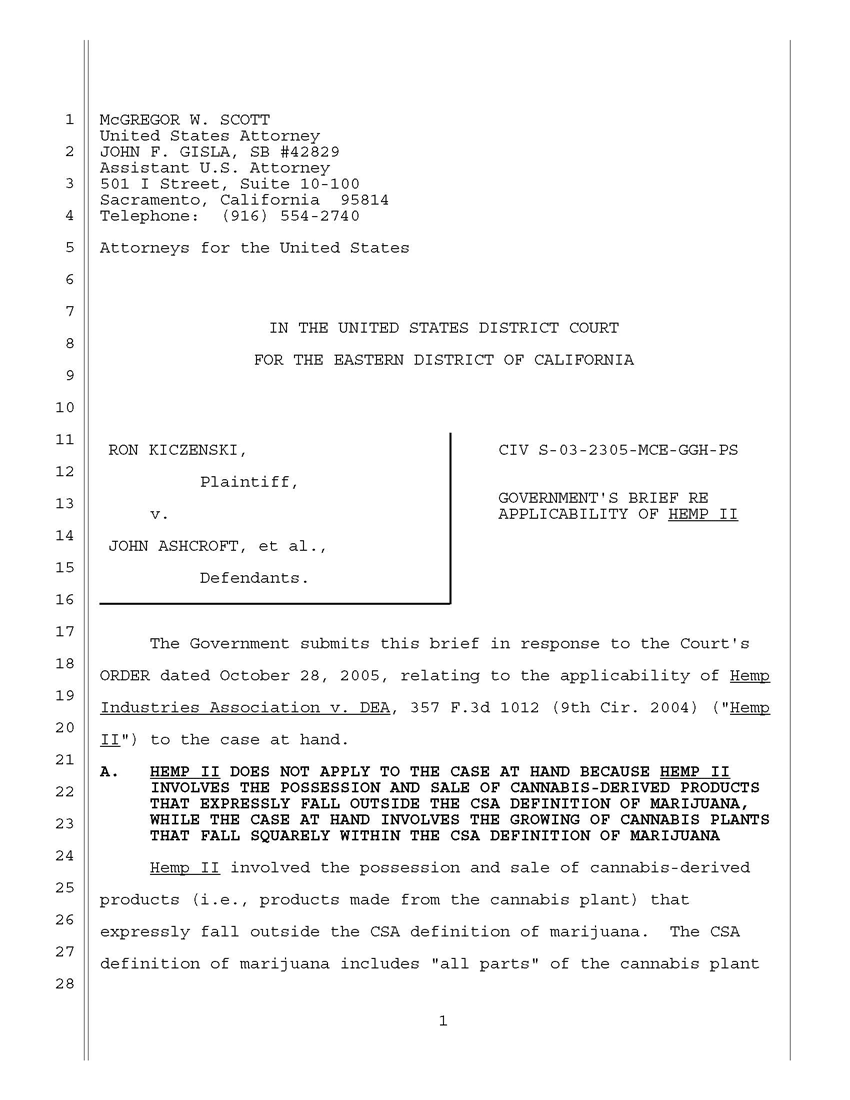
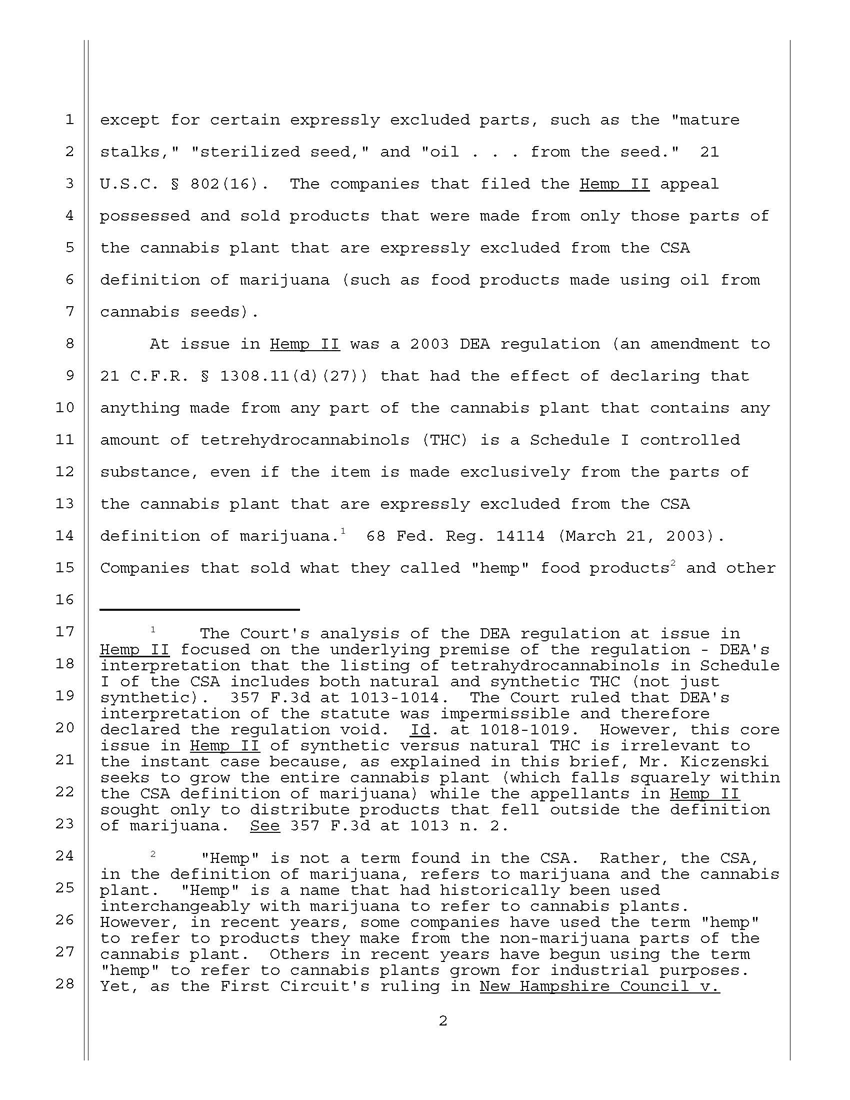
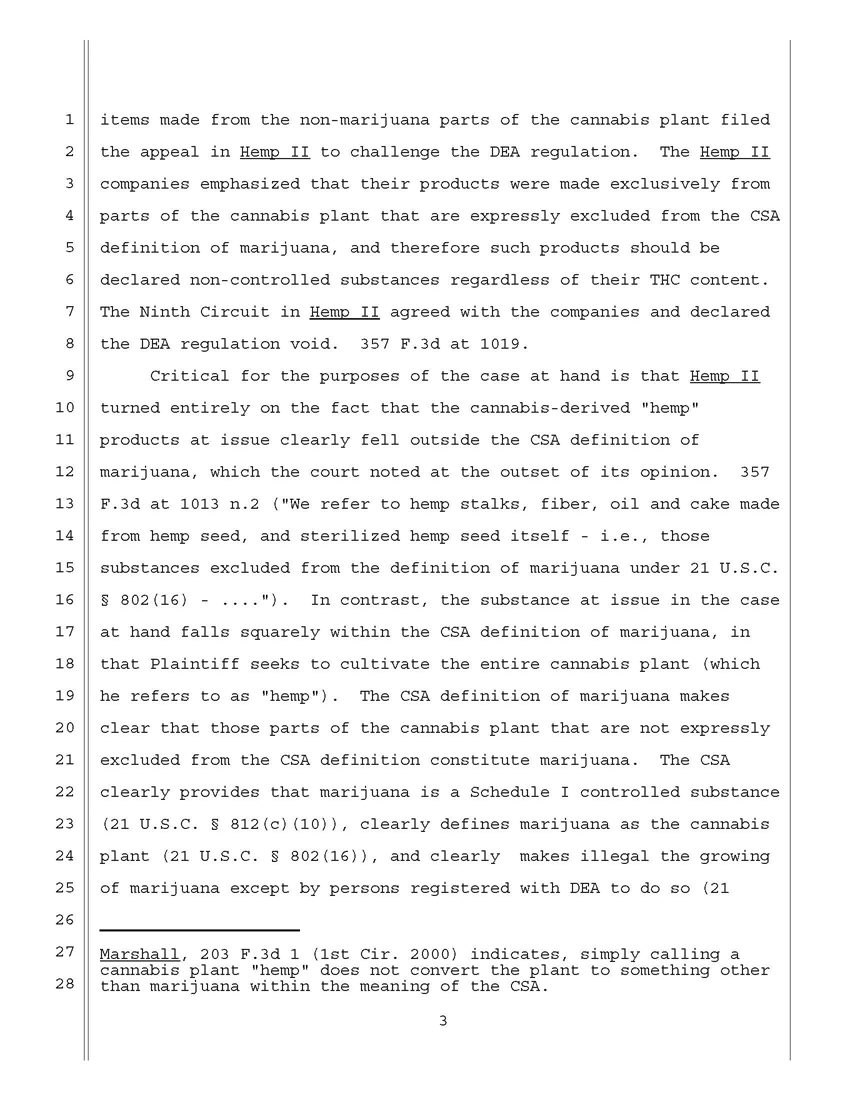
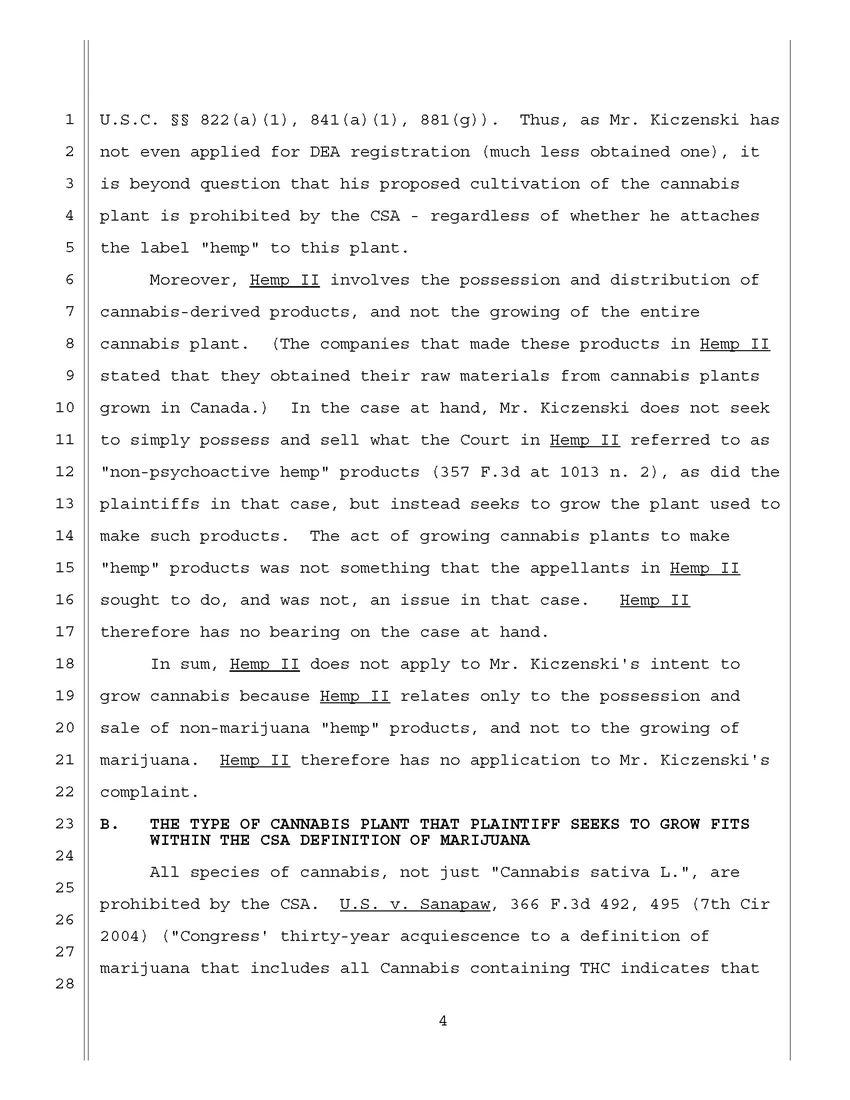
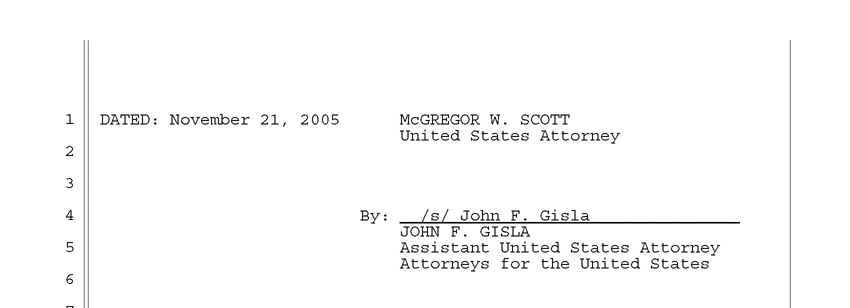
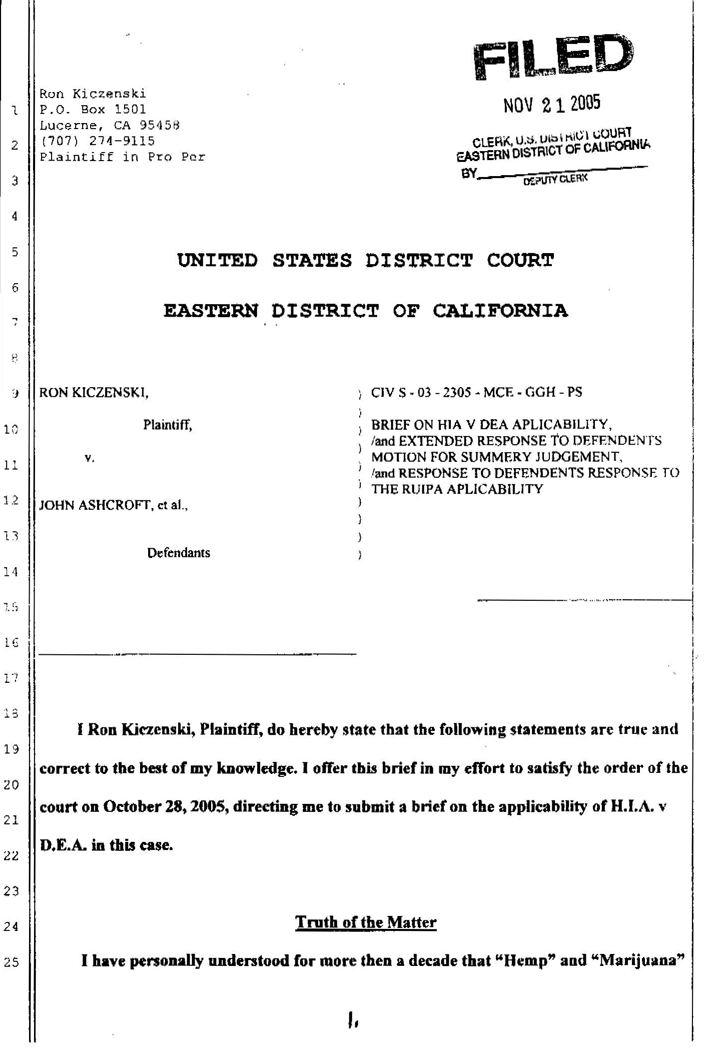
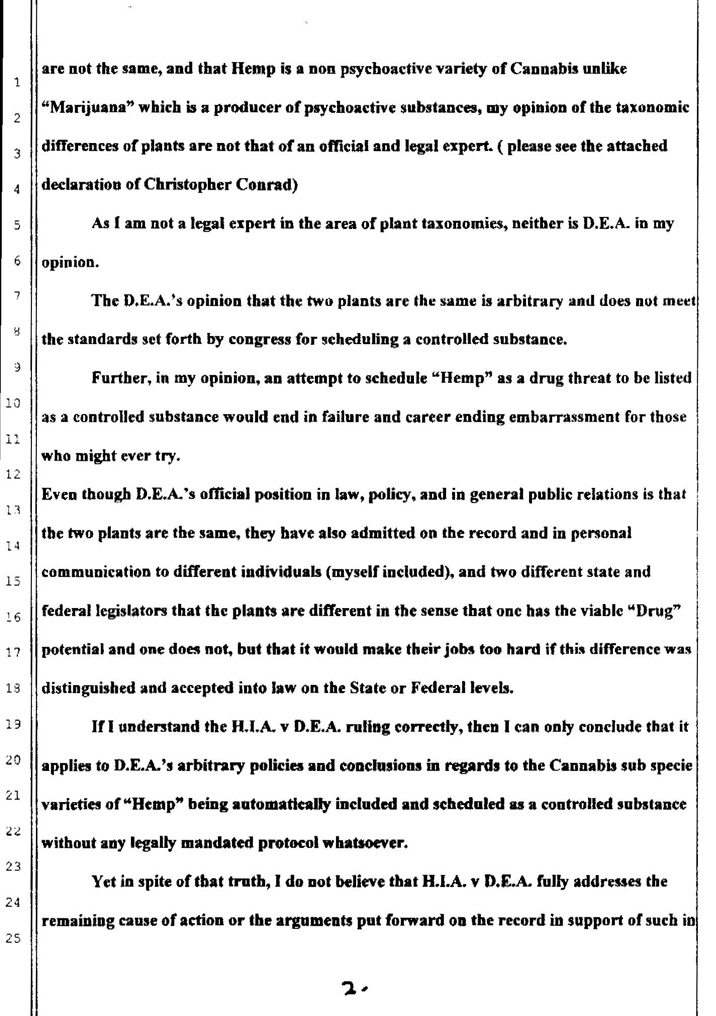
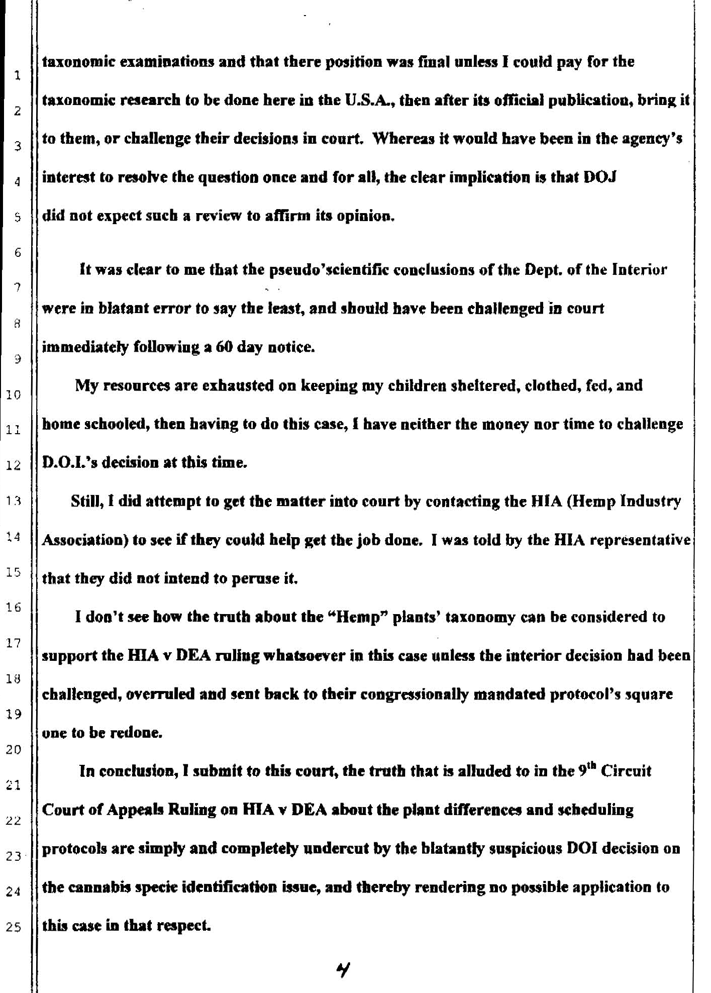
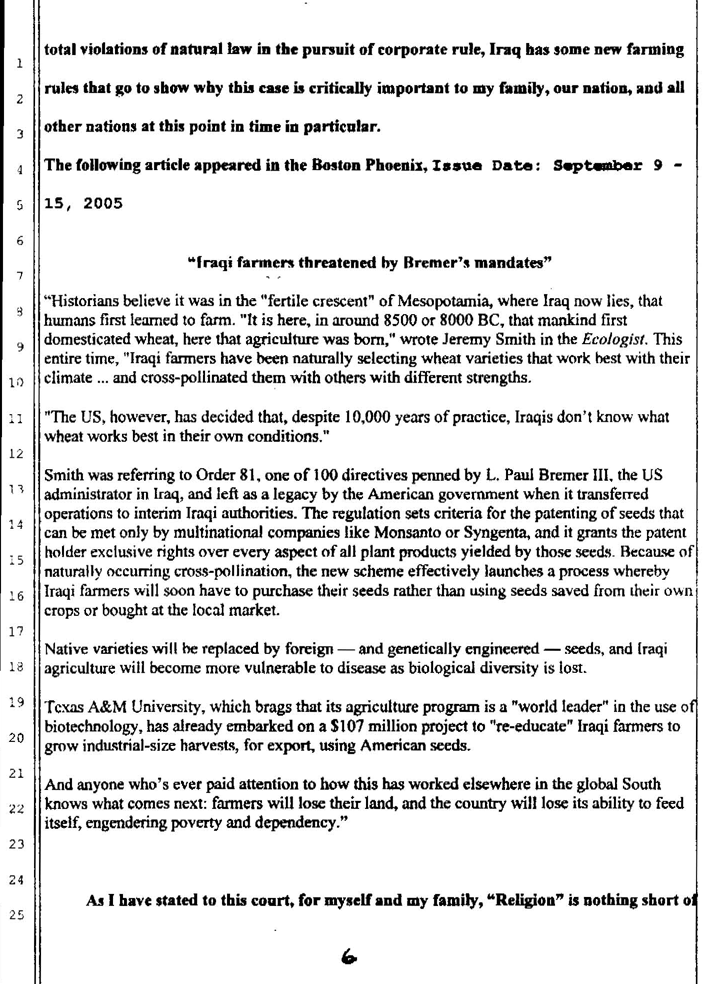
On November 21, 2005, Ron Kiczenski and John Gisla (for the Gummint) filed briefs in response to Judge Hollows’ order. The resulting simultaneous filings may surprise you.
Government Brief:
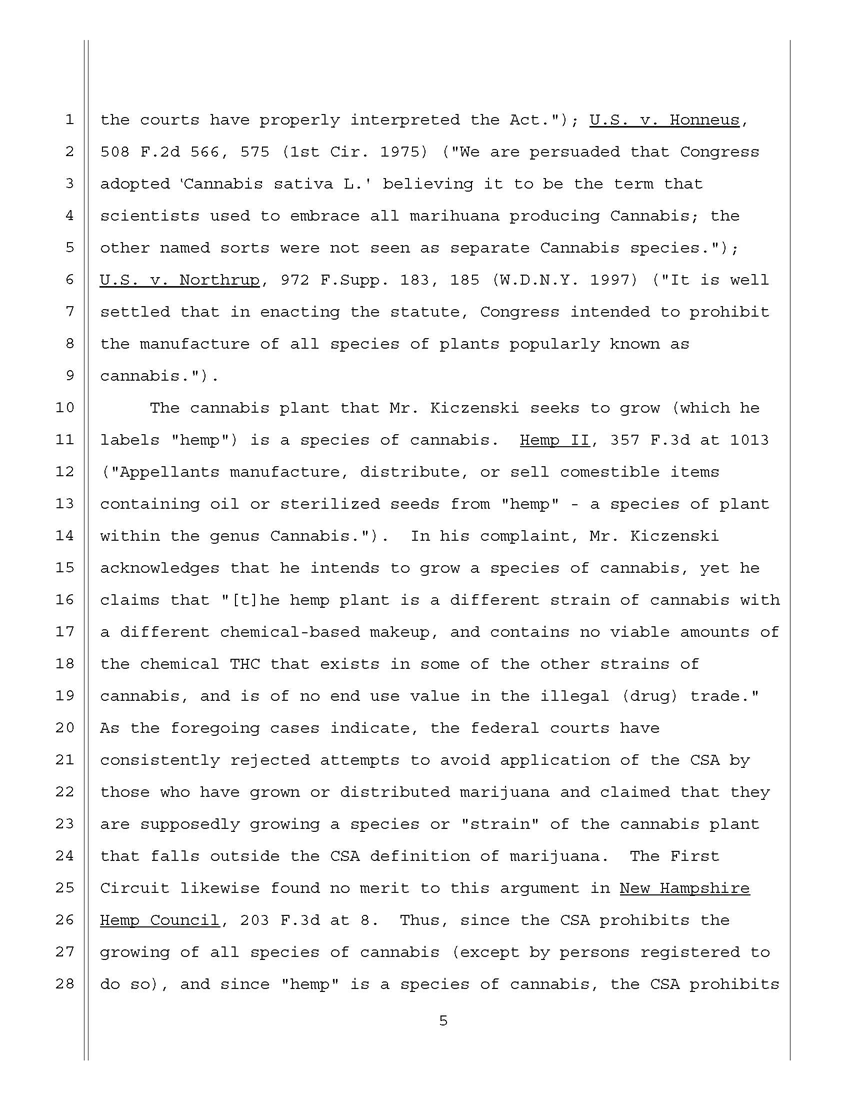
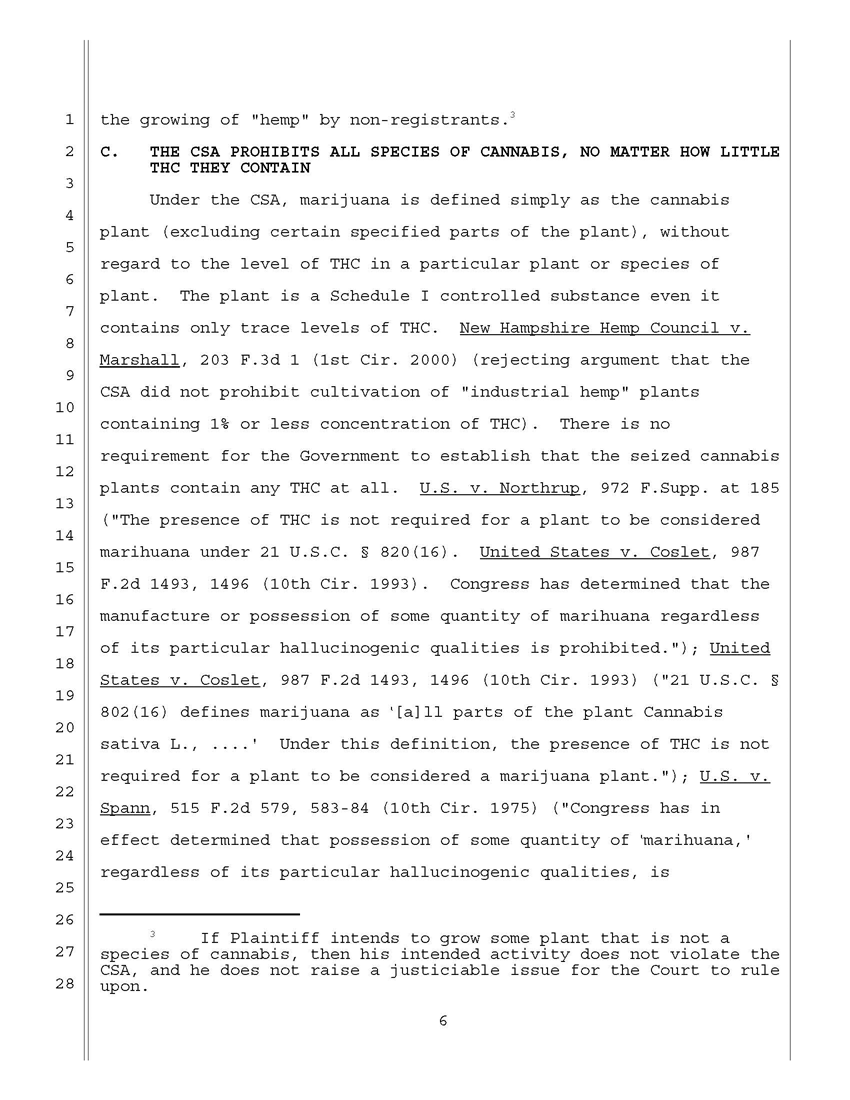
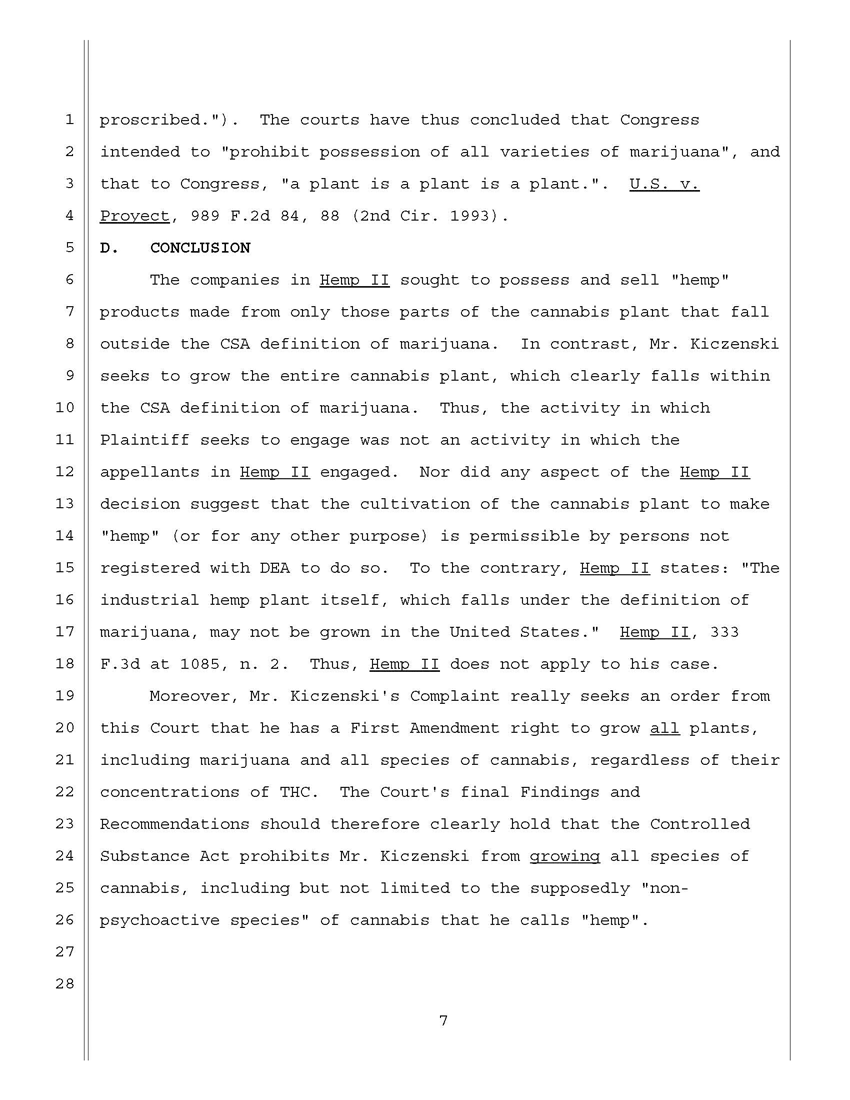
Kiczenski Brief:



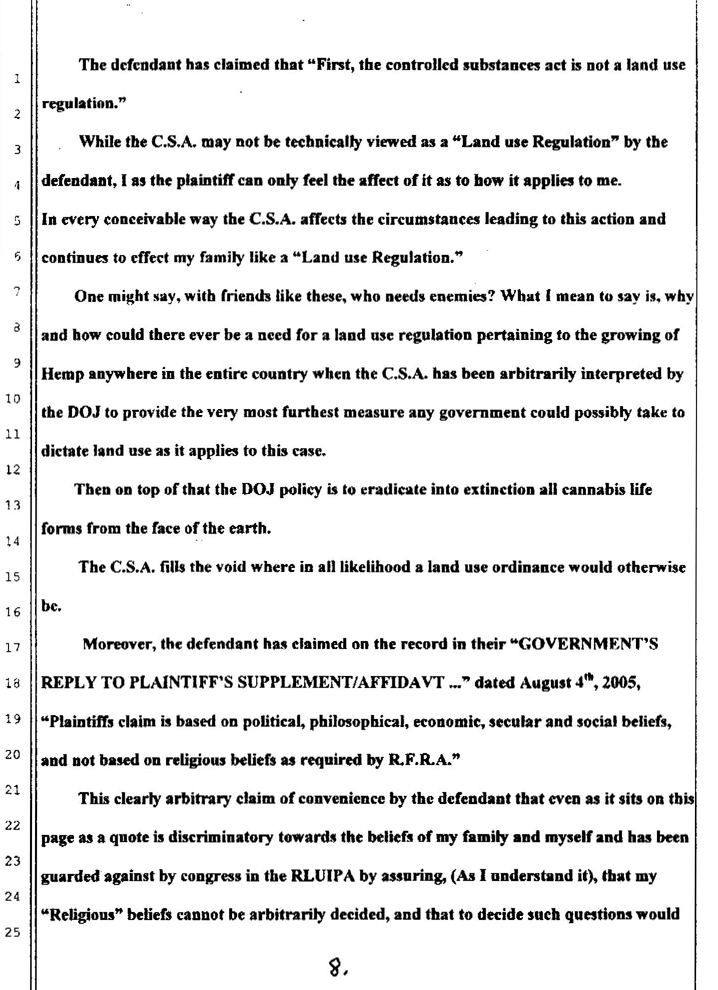
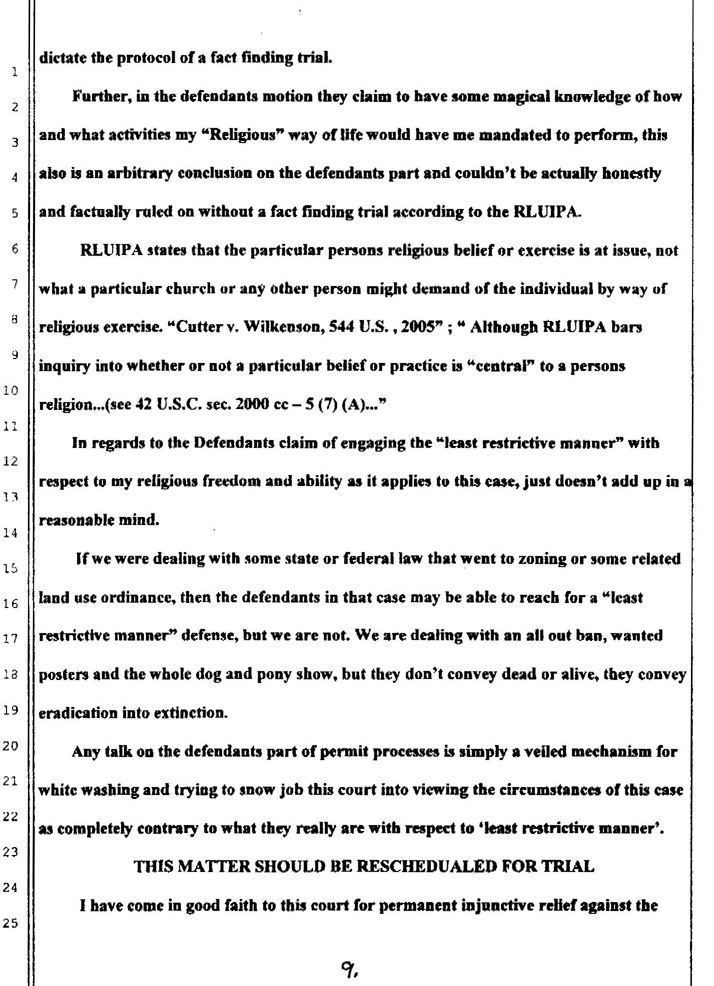
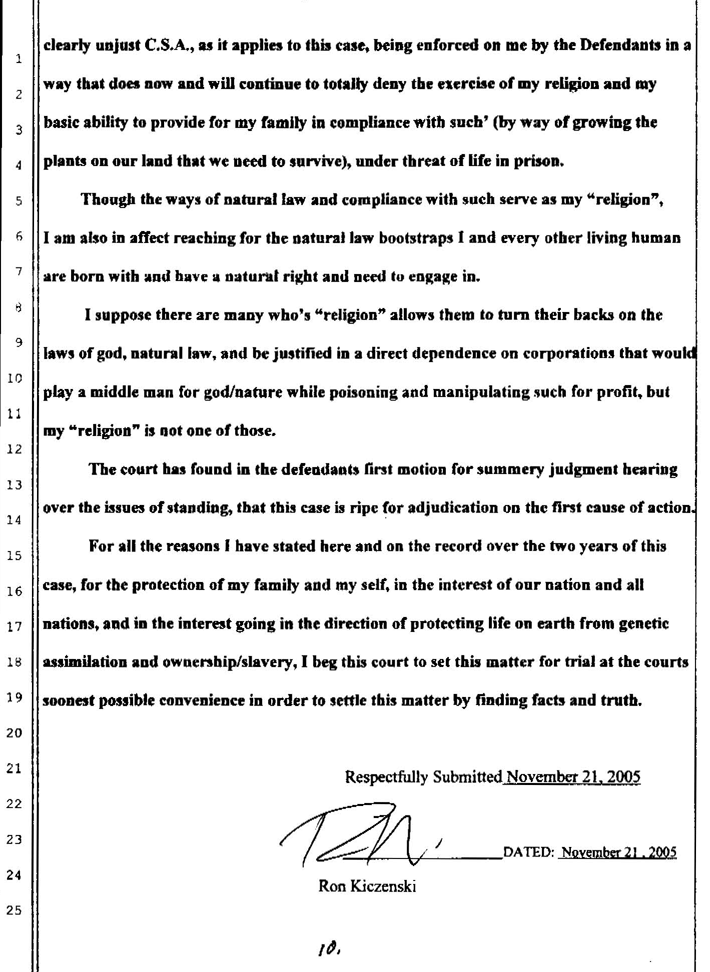
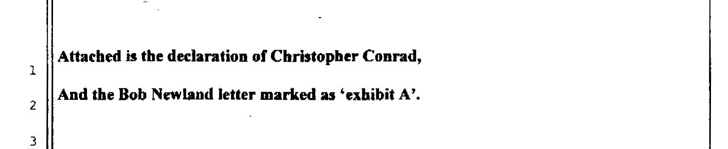


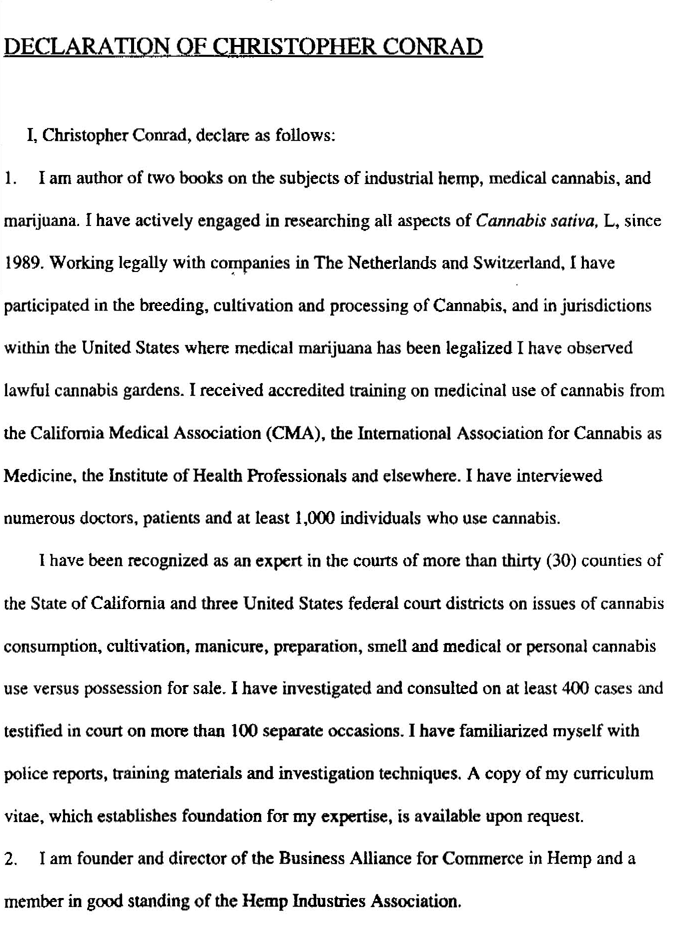
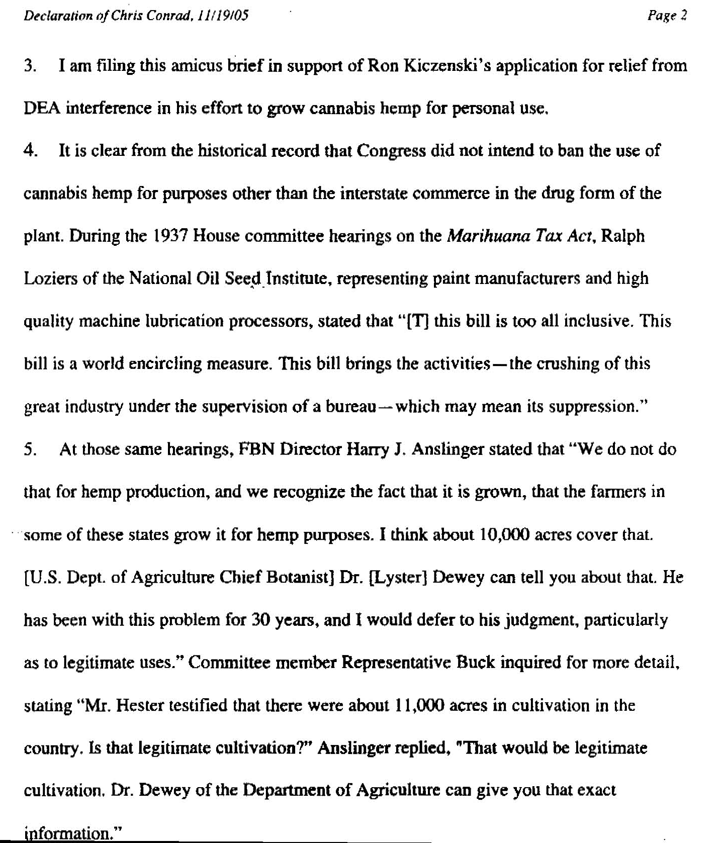
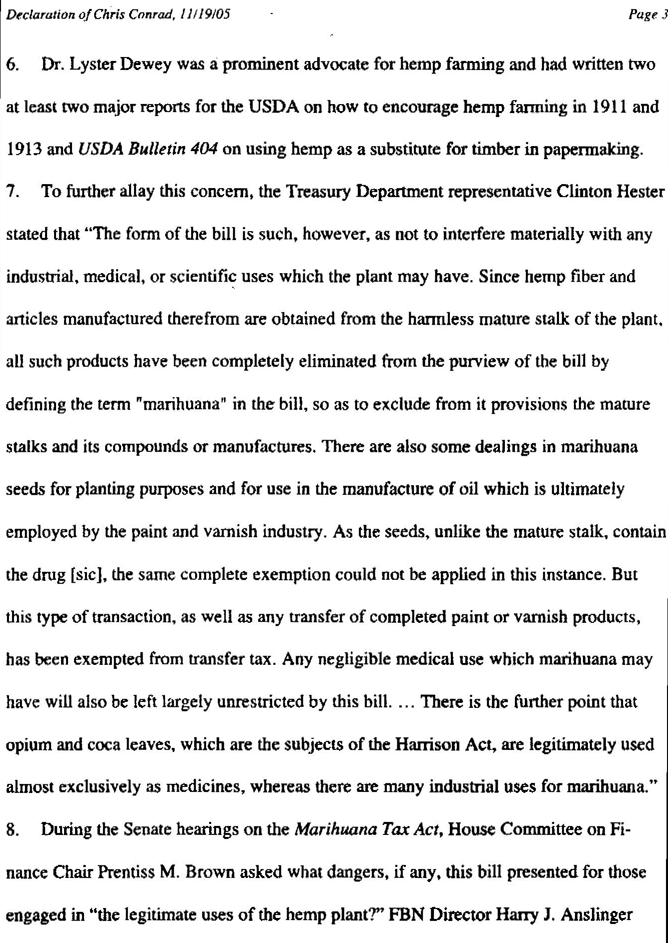
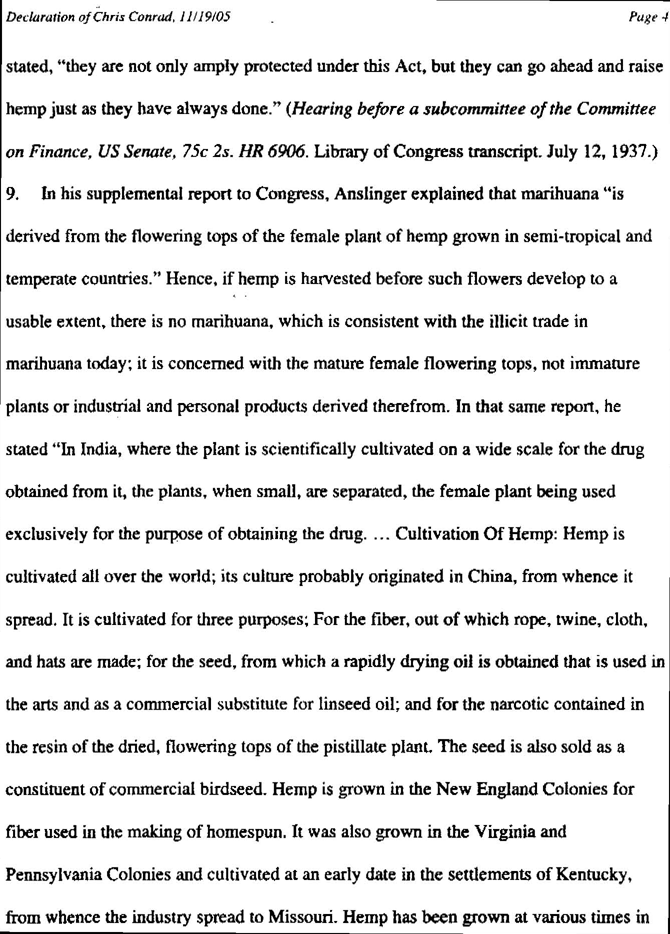
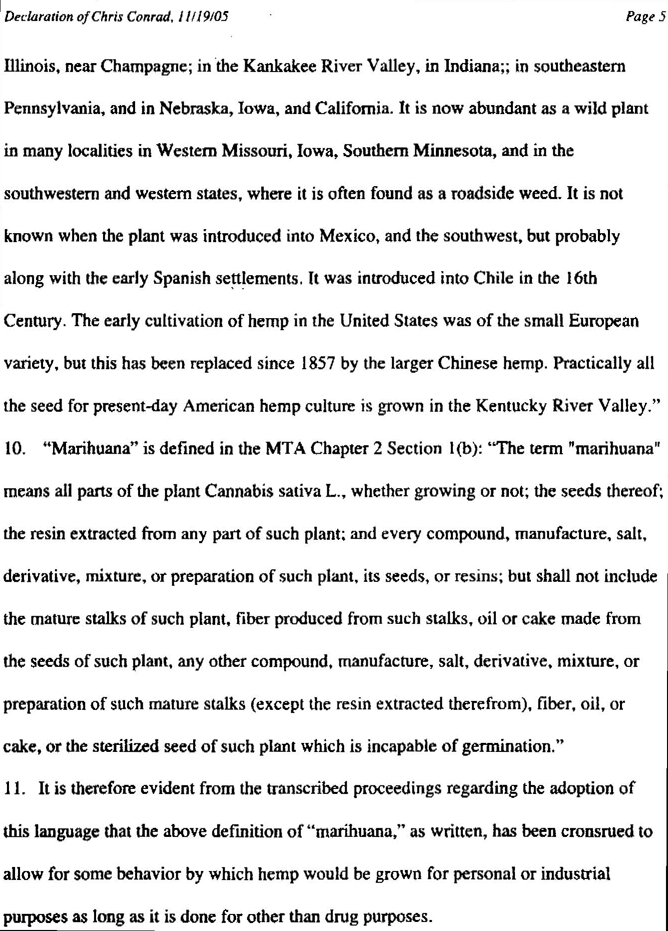
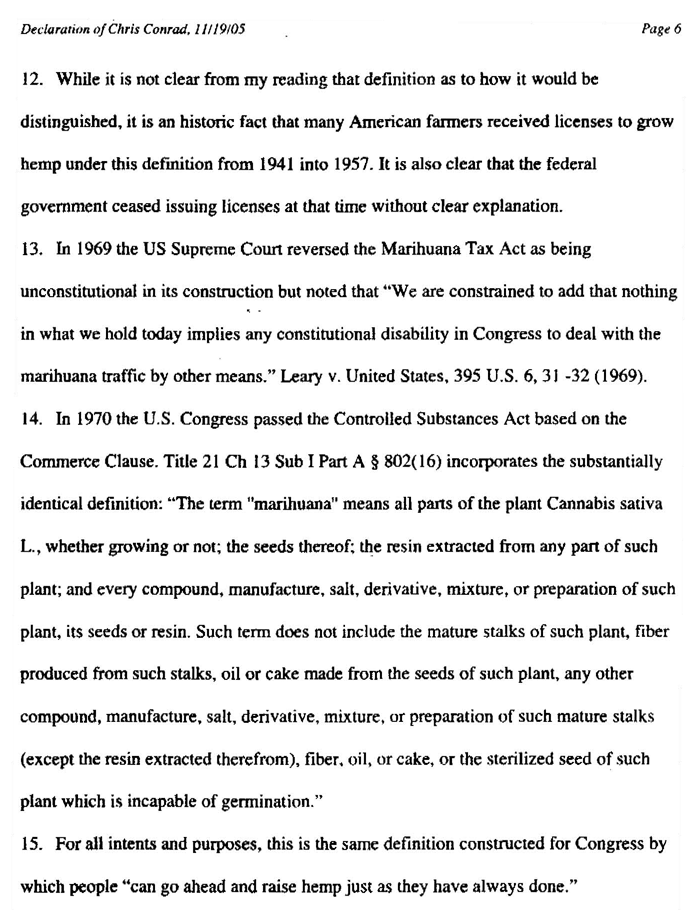

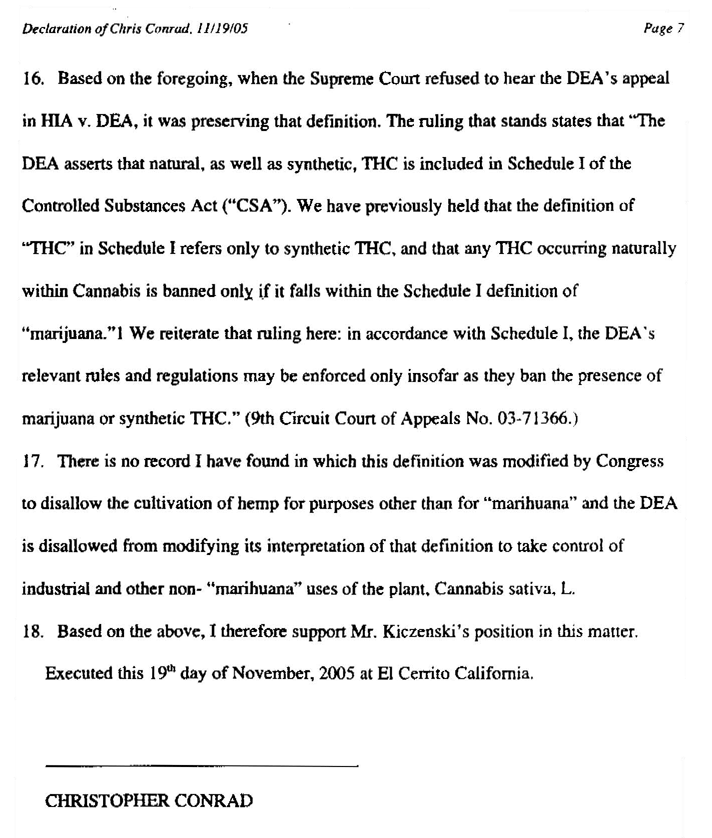
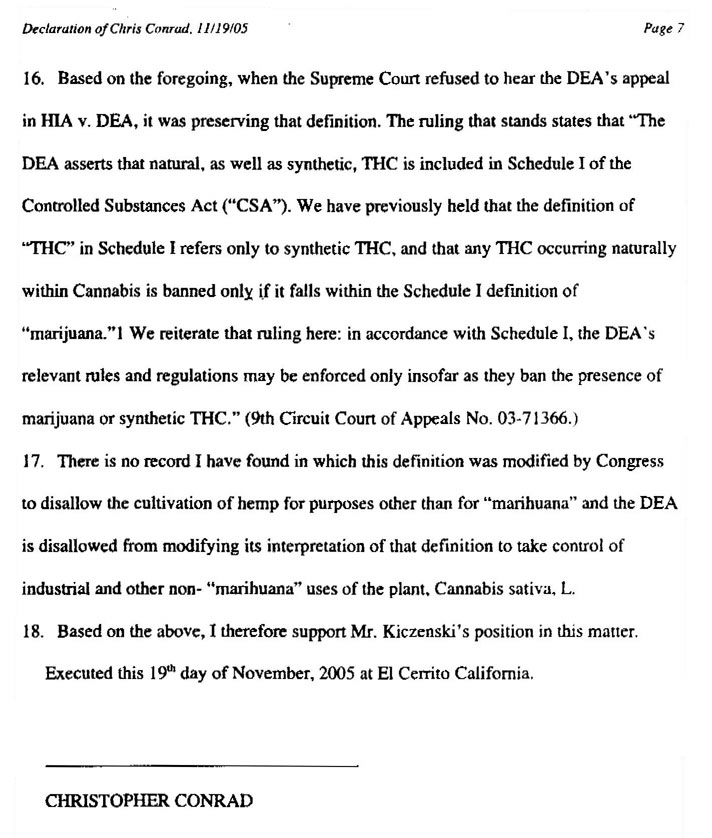
On February 24, 2006, Judge Hollows, following a time-honored pattern, defines “religion” to fit the government’s case, then recommends summary judgment for government, effectively dismissing Kiczenski’s suit.


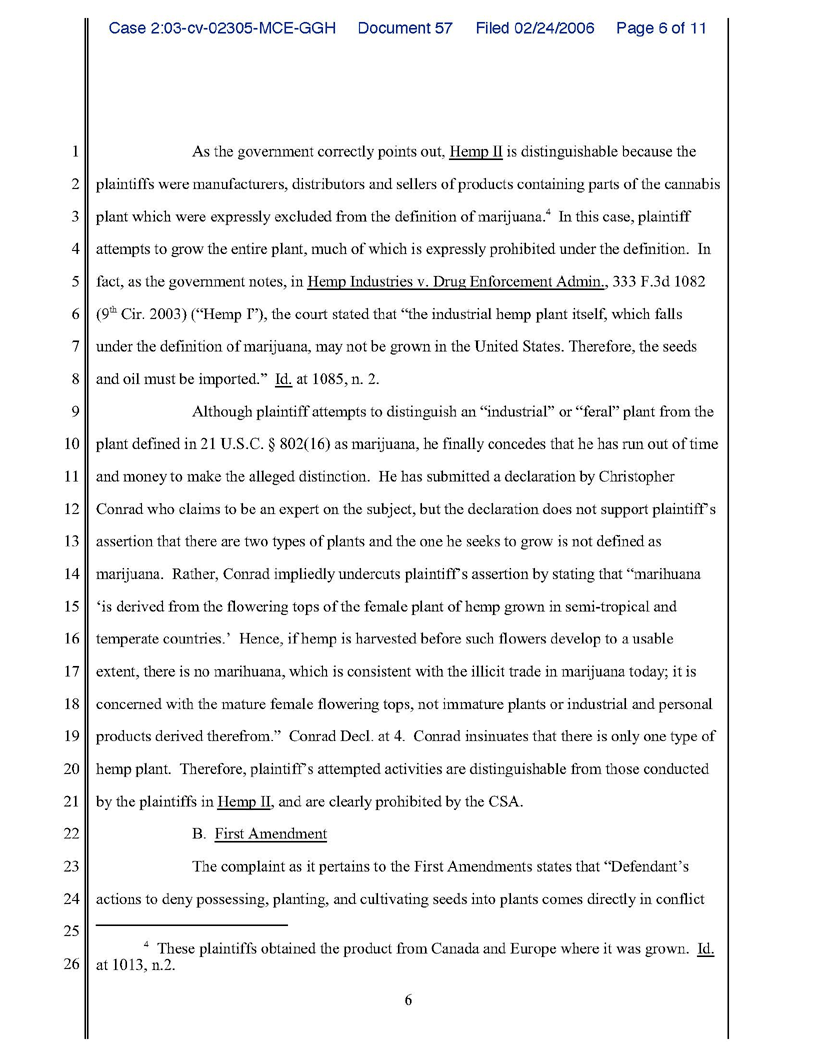
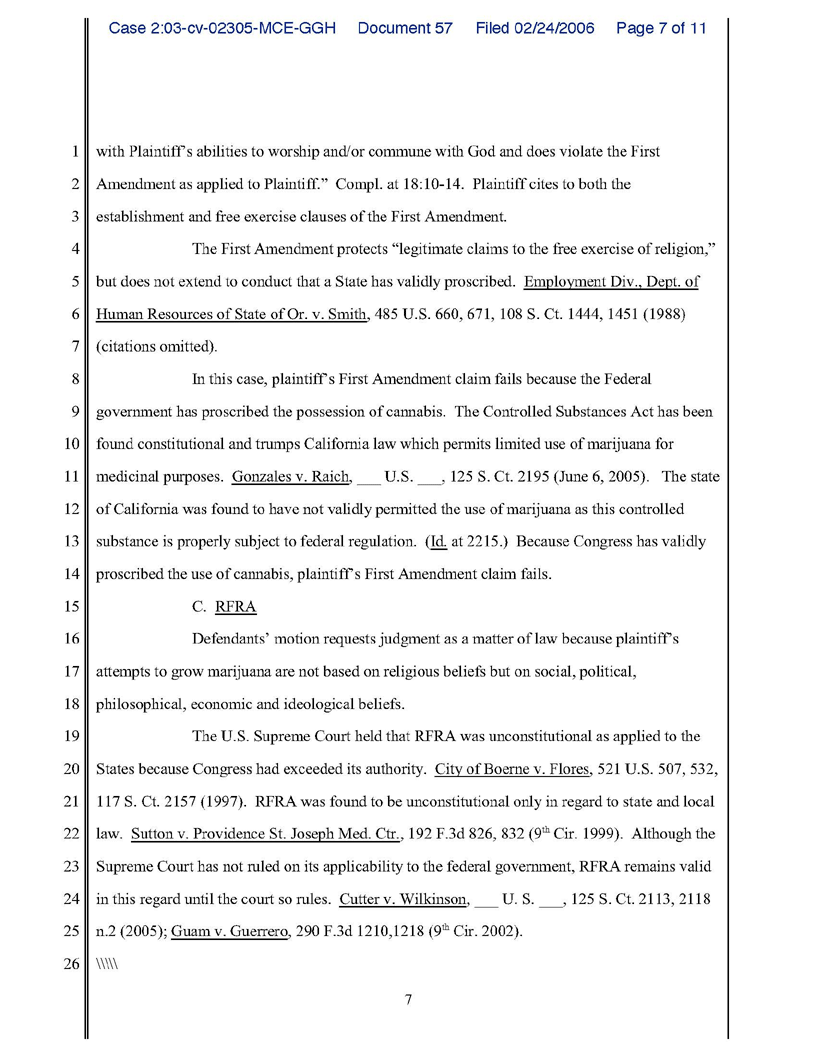
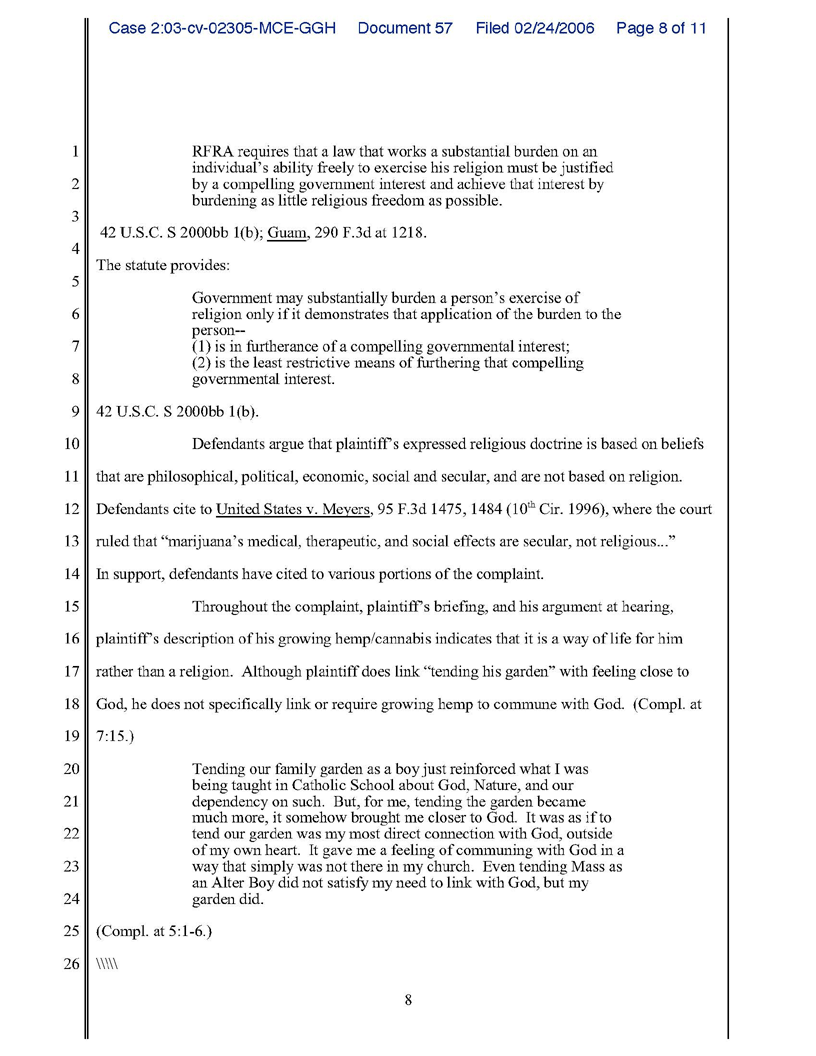
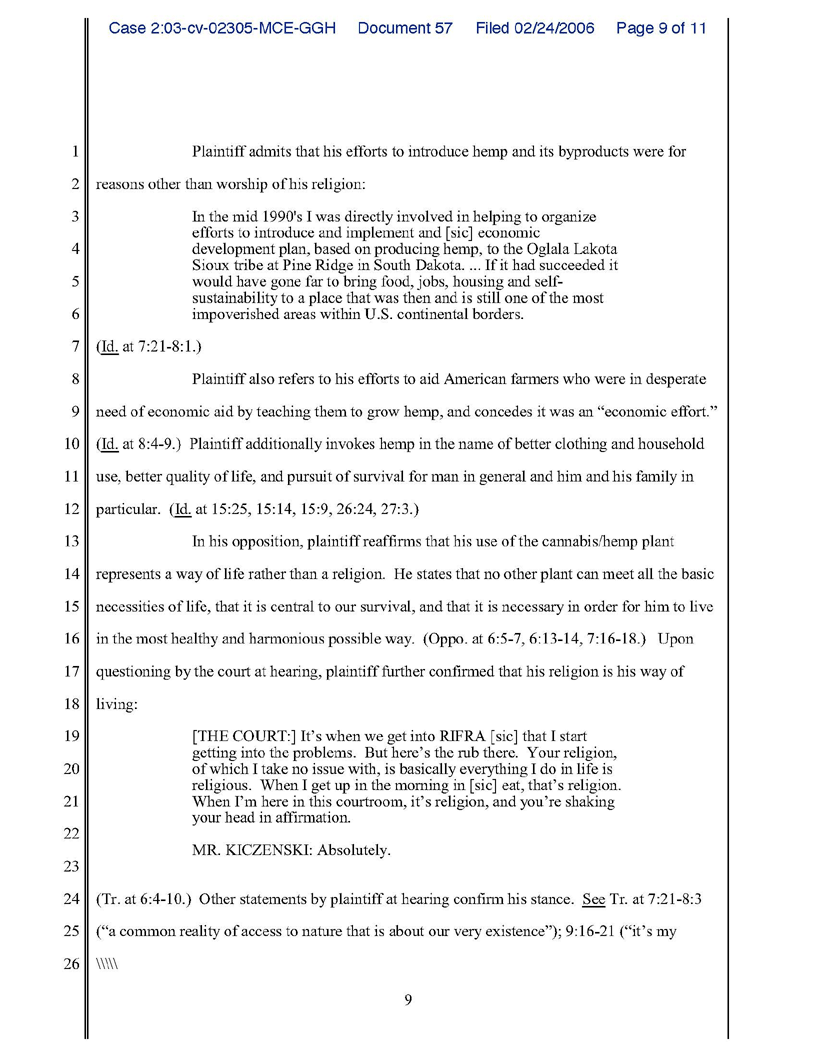
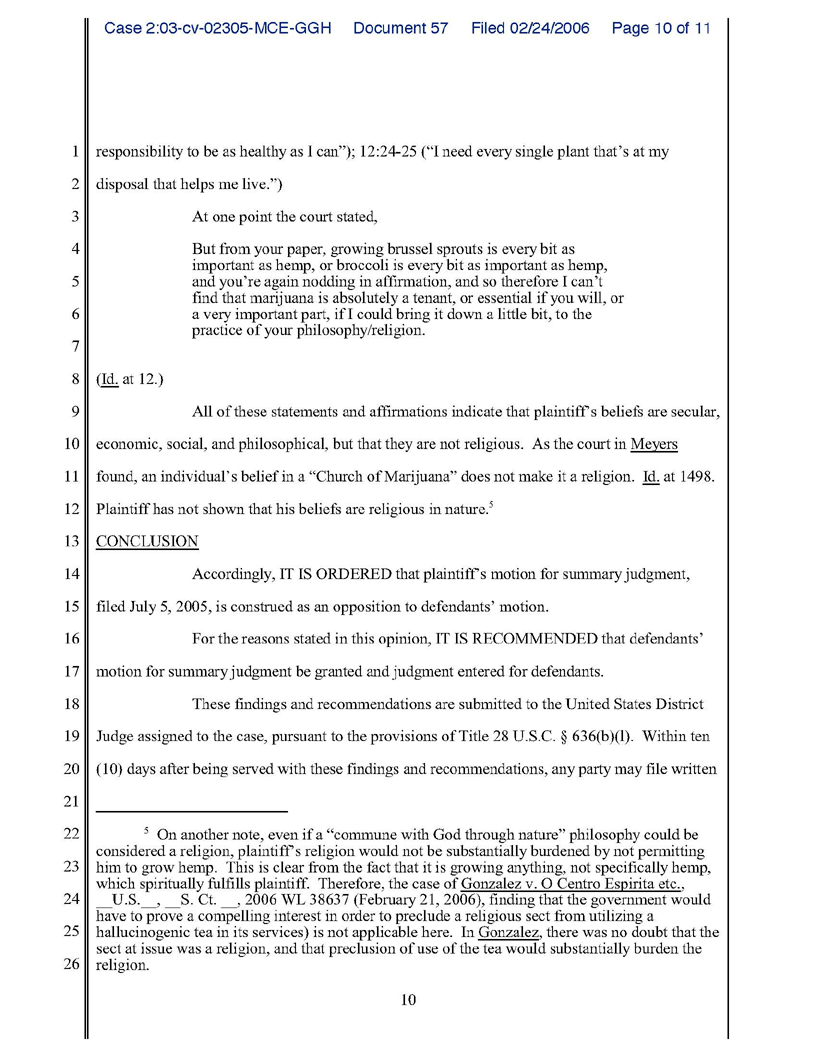

On March 6, 2006, Kiczenski objects to Judge Hollows’ redefining Kiczenski’s religion to fit government’s case.
UNITED STATES DISTRICT COURT EASTERN DISTRICT OF CALIFORNIA
RON KICZENSKI,
Plaintiff,
v.
JOHN ASHCROFT, et al.,
Defendants
CIV S – 03 – 2305 – MCE – GGH – PS
PLAINTIFF’s OBJECTIONS TO MAGISTRATE JUDGE’S FINDINGS AND RECOMMENDATIONS.
I Ron Kiczenski, the Plaintiff, do hereby ask the court to consider this document as an objection in declaration form and as I am subject to the penalties of federal law for perjury, I swear my statement contained herein to be true and factual to the best of my knowledge and belief , and do wholly object to the Magistrate Judge’s “ORDER AND FINDINGS AND RECOMMENDATIONS” dated February 24, 2006, and I state for the record the following in support of my objections .
FACTS OF THE CASE
For the purpose of further attempting to make clear to the Defendants, and now the Courts mistaken descriptions of my held religious beliefs, I will attempt once again to briefly explain, in part, my religious beliefs and practices to the point of relevance to this action.
I Ron Kiczenski, plaintiff, have deep and long held religious/spiritual beliefs and practices that grew and evolved from my childhood experiences including my time as a Catholic alter boy and my reading back then of the bible truth from Genesis 1:29, “And God said, Behold, I have given you every herb bearing seed, which is upon the face of all the earth, and every tree, in the which is the fruit of a tree yielding seed; to you it shall be for meat”
My held beliefs demand I strive to adhere to certain principles or truths and practices or ways of life, just as most all other ‘religions’ of today and the past do. My beliefs and ‘doctrine’ is necessarily my own and unique unto me alone, and can only be found in my mind, my words, and my way of life,{and possibly in my DNA?} and is the very manifestation of gods communication with me. It is the very individuality standard of my belief system that keeps me connected and related to everyone and every ‘religion’, and everything, to the web of life, to all that exists now, to all that came before now, and to all forever into the future.
In my belief, the laws of ‘nature’, be they self-evident, or scientifically proven, or both, are gods laws, the laws of the one that must have ‘created’ them.
My belief in a ‘supreme being’ is basically that god is the collective energy and even consciousness of all that came before, all that is now, and all that ever will be, and that god exists in everything and everyone, and that god is the web of life, and that without me and every other part of nature here on earth and beyond, including the sun, the moon and everything beyond, god would be incomplete. I believe god is ever-present and everlasting.
The mandate and structure of god’s laws necessarily set forth the doctrine and or the practices of my beliefs. God has shown me that all on earth and in the heavens beyond are connected in existence and continued existence, this that god communicates to me, science has even proven my knowledge and belief with conclusive evidence that goes to link the smallest things that exist, to the largest, and to all points of matter in-between. Science has now proved my belief that life is a chain, a web that is all interconnected and interdependent, and as such, is in effect all one.
God has shown me my necessary place in the web of life, and to live in that place, is to me the necessary exercise of my religious practice. Central to the practice or exercise of my religion is my garden and the free god given access to god in all plant forms, and it is incumbent upon me to find and use the plants that go best to meet the needs of sustainability of the lives of myself and my family.
In my knowledge and belief, my garden serves as nothing less then my church, yet it is also so much more. When I’m in my garden, I’m in church, so for the purpose of solving the language barriers that seem to exist between me and this court, the court should view my garden as my church and my work in the garden as maintaining the existence of my church and the existence of myself and family and as prayer, and as central in the exercise of my religious practices.
God has shown me that only the hemp plant can serve as the cornerstone in the foundation of my church/garden in its usefulness to meet my family’s basic necessities and fulfill its god intended purpose so that I may then fulfill mine in kind. God has shown me that no other food can substitute for this hemp seed that god provides and has willed me to cultivate and use to feed myself and my family.
God has shown me that if I do as gods will commands me, and grow hemp as the mainstay of my church/garden, I will not only have food, but I will have clothes, shelter, fuel, etc…, and that I would have the companion crop god provides that goes to serve my church/garden in the same way that farmers think pesticides and the like serve purpose on their farms, hemp is a natural filter that is meant to help me grow all the other plants of the garden without using the corporate poisons that I am bound by god, knowledge, and belief, not to use.
Hemp is the cornerstone of my church which is my garden and my garden is the most important element within the central practice of my religion, and is the natural gift for sustaining my existence that god has willed unto me by way of my birth and existence.
To say I could grow most other plants I need, but not hemp, would be something like saying to a person trying to build a car that they could have and use all the parts they need for the car accept the motor. More on point it is like telling me to build my church with no foundation or roof allowed, only walls.
My intended religious use of my land in the ways I have described, in no way would go to effect the ‘illegal drug’ manufacturing or flow of ‘illegal drugs’ that the Defendants seek to curtail under the authority of Controlled Substances Act, yet the Defendants have insisted that the practice of my religion would violate the CSA and thereby be illegal in the United States of America.
I come to this court seeking injunctive relief from the Defendants eminent and I believe unconstitutional attack.
BACKGROUND
In late October of 2003, I came to this court and filled my complaint for injunctive relief, as well as three requests for temporary restraining orders. The complaint was accepted, but not officially filed by the Court until the fourth of November, 2003. The T.R.O. requests were denied and terminated.
Within the T.R.O. filings are attached exhibits and other information that is relevant to this action that I believe should have been attached to the original complaint. In my hindsight of the error, I did time and again ask the Court to include all that I had filed in the T.R.O.’s to be included as part of the original complaint, yet to this day I have had no response, and still am not sure what documents are included when the Court states that this action is proceeding on the complaint filed November 24, 2003?
I ask again that the Court incorporate all the documents I have filled for the record in this action as if set forth herein, and that the Court consider all such documents and information when in consideration of this document and my stated objections herein.
Early in this action the Defendant’s attorney’s both made it crystal clear in phone communications to me that they hardly had time to even read my complaint, let alone consider it in any serious sense of their job’s duties. Further, I believe as a result of this disregard for me and my complaint, the Defendant filed a motion for summary judgment based only on the issue of whether or not I had the proper standing to be there at all, and avoided addressing the causes of action.
The Court found that I did have proper standing and denied the Defendants motion , and did set the matter for trial.
All of the sudden the Defendants attorney John Gisla wanted me to know that they thought it was in my best interest to stipulate to them refilling a modified motion for summary judgment, based this time on addressing the causes of action. He was concerned that it was not timely and that the judge would be more inclined to grant such if we were in agreement, I did not agree because I want and deserve a trial, and the trial was set.
Mr. Gisla filed anyway asking for just the hearing to decide whether or not they would be afforded this re-do of their initially failed attempt to kill this case. The Magistrate Judge apparently didn’t need a hearing and just granted Defendants the opportunity to re-file their now modified summary judgment motion,{if the trial had been allowed to go forward as scheduled on November 2, 2005, it would have been long over by now, thereby freeing up the Defendants attorney’s for the important work which doesn’t include this action according to them}.
The Defendants new motion claimed and concluded that, “Plaintiffs first amendment claim, which is assumed to be based on the religious freedoms restoration act (RFRA), is without merit because, 1) Plaintiff’s claim is based on political, philosophical, economic, secular and social beliefs, and not based on religious beliefs as required by RFRA:”
In almost every document I have filed in this action, I have cited and called on the Court and the Defendants to notice and consider that the Supreme Court of the United States has long held that the logic used by the Defendants in the above claim is in error and is wholly inconsistent with the opinions held in the United States v. Seeger, 380 U.S. 163 (1965) and 398 U.S. 333 Welsh v. United States and the first amendments establishment clause. The fallowing are excerpts from the welsh case opinion; BLACK, J., Opinion of the Court, SUPREME COURT OF THE UNITED STATES (398 U.S. 333, Welsh v. United States).
“The controlling facts in this case are strikingly similar to those in Seeger. Both Seeger and Welsh were brought up in religious homes and attended church in their childhood, but in neither case was this church one which taught its members not to engage in war at any time for [p336] any reason. Neither Seeger nor Welsh continued his childhood religious ties into his young manhood, and neither belonged to any religious group or adhered to the teachings of any organized religion during the period of his involvement with the Selective Service System. At the time of registration for the draft, neither had yet come to accept pacifist principles. Their views on war developed only in subsequent years, but, when their ideas did fully mature, both made application to their local draft boards for conscientious objector exemptions from military service under § 6(j) of the Universal Military Training and Service Act.”
“The Government also seeks to distinguish Seeger on the ground that Welsh’s views, unlike Seeger’s, were “essentially political, sociological, or philosophical views, or a merely personal moral code.” As previously noted, the Government made the same argument about Seeger, and not without reason, for Seeger’s views had a substantial political dimension. Supra at 338-339. In this case, Welsh’s conscientious objection to war was undeniably based in part on his perception of world politics.”
“In resolving the question whether Seeger and the other registrants in that case qualified for the exemption, the Court stated that “[the] task is to decide whether the beliefs professed by a registrant are sincerely held and whether they are, in his own scheme of things, religious.” 380 U.S. at 185. (Emphasis added.) The reference to the registrant’s “own scheme of things” was intended to indicate that the central consideration in determining whether the registrant’s beliefs are religious is whether these beliefs play the role of a religion and function as a religion in the registrant’s life. The Court’s principal statement of its test for determining whether a conscientious objector’s beliefs are religious within the meaning of § 6(j) was as follows:
The test might be stated in these words: a sincere and meaningful belief which occupies in the life of its possessor a place parallel to that filled by the God of those admittedly qualifying for the exemption comes within the statutory definition.
380 U.S. at 176. The Court made it clear that these sincere and meaningful beliefs that prompt the registrant’s objection to all wars need not be confined in either source or content to traditional or parochial concepts of religion. It held that § 6(j) “does not distinguish between externally and internally derived beliefs,” id. at 186, and also held that “intensely personal” convictions which some might find “incomprehensible” or “incorrect” come within the meaning of “religious belief” in the Act. Id. at 184-185. What is necessary under Seeger for a registrant’s conscientious [p340] objection to all war to be “religious” within the meaning of § 6(j) is that this opposition to war stem from the registrant’s moral, ethical, or religious beliefs about what is right and wrong and that these beliefs be held with the strength of traditional religious convictions. Most of the great religions of today and of the past have embodied the idea of a Supreme Being or a Supreme Reality — a God — who communicates to man in some way a consciousness of what is right and should be done, of what is wrong and therefore should be shunned. If an individual deeply and sincerely holds beliefs that are purely ethical or moral in source and content, but that nevertheless impose upon him a duty of conscience to refrain from participating in any war at any time, those beliefs certainly occupy in the life of that individual “a place parallel to that filled by . . . God” in traditionally religious persons. Because his beliefs function as a religion in his life, such an individual is as much entitled to a “religious” conscientious objector exemption under § 6(j) as is someone who derives his conscientious opposition to war from traditional religious convictions.”
The Magistrate Judge issued an Order and Findings and Recommendations on February 24, 2006, agreeing with the Defendants characterizations of this case and recommending the order be adopted that the Defendants summary judgment be granted.
OBJECTIONS
1) I object to, and ask the Court not to adopt the Magistrate Judges characterization that quote, “and above all for use in his pain management”. This is the second time the Magistrate Judge has incorrectly stated my intent in these same arbitrary terms. I have not at any time knowingly or intentionally represented to this Court that my use of cannabis for pain management was central, or the most important, or was above all in terms of my reasons for needing to grow cannabis hemp. I have gone to great effort and expense to clearly bring to the Courts attention that the cannabis hemp in question in this case is not genetically capable of producing the chemical properties controlled by the CSA in sufficient quantities for use as medicine or illegal drugs.
I had thought that I had also previously made clear to this Court that the most necessary purpose for hemp in my familie’s lives in the terms of how it is used, and within the context of my religious belief, is food. In fact, I have on the record, clearly communicated to this Court that the eminent threat of enforcement of the CSA has added to the substantial burden that it already is currently imposing on my ability to live and practice my religion as god summons and demands that I do, by forcing me to purchase{which constitutes contributing to and dependency on the system of money and profit when I could have been dependent on god, which is in direct conflict with the truths of my religious knowledge and belief} from Canada and import our main source of nutrition, hemp seed.
The fact that I am forced to import hemp seed food to attempt to satisfy in an extremely limited and restricted part, my religious practices, is one of many circumstances that the Court should conclude ties this action to the RLUIPA.
The RLUIPA states in SEC. 2. PROTECTION OF LAND USE AS RELIGIOUS EXERCISE.
(2) SCOPE OF APPLICATION- This subsection applies in any case in which”&emdash;
(B) the substantial burden affects, or removal of that substantial burden would affect, commerce with foreign nations, among the several States, or with Indian tribes, even if the burden results from a rule of general applicability; or”
2) I object to, and ask the Court not to adopt the Magistrates Findings and Recommendations in regards to the applicability of RLUIPA and to the timeliness of my ‘supplement affidavit’ dated August 1, 2005, filled within 4 days of the July 28, 2005 hearing, and that the Court has had (minus the four days) for the five and a half months it took to come to this recommendation. Also, when considering the premeditated, calculated, and purposeful untimeliness and circumstances of the refilling of the Defendants motion for summary judgment, it effects me as a double standard. Confusing me more is the fact that in the hearing for the Defendants first summary judgment motion, the Magistrate allowed my filled supplement which was 10 days post hearing.
The RLUIPA states in SEC. 8. DEFINITIONS;
(5) LAND USE REGULATION- The term `land use regulation’ means a zoning or landmarking law, or the application of such a law, that limits or restricts a
claimant’s use or development of land…
The RLUIPA also has this in SEC. 5. RULES OF CONSTRUCTION.;
(g) BROAD CONSTRUCTION- This Act shall be construed in favor of a broad protection of religious exercise, to the maximum extent permitted by the terms of this Act and the Constitution.
Upon the first read of this part of the above definition “,or the application of such a law, that limits or restricts a claimant’s use or development of land”… , one might well assume that the correct grammatical reading of it would automatically link it to “The term land use regulation’ means a zoning or landmarking law,” in a restrictive interpretation that exclusively means a zoning or landmarking law. Yet when coupled with the section 5 rules of construction, one must stop and rethink the possible intent and meaning of “,or the application of such a law, that limits or restricts a claimant’s use or development of land”.
If Congressional intent was to help strengthen the RFRA and the establishment clause of the first amendment in favor of a broad protection of religious exercise,
to the maximum extent when a person is trying to exercise that freedom on their own land, why would they mean to restrict that protection only to guard
against laws that are called zoning or landmarking laws and not other laws that work, or have the same effect in application as zoning or landmarking laws, like the application of such a law, that limits or restricts a claimant’s use or development of land?
If Congress meant to restrict the meaning of the term “land use regulation” to exclusively be referring to laws called zoning or landmarking laws, why would this part
even be necessary; “, or the application of such a law”
If Congress meant to restrict the meaning of the term “land use regulation” to exclusively be referring to laws called zoning or landmarking laws, why wouldn’t it be
sufficient to just leave it at this?; The term `land use regulation’ means a zoning or landmarking law that limits or restricts a claimant’s use or development of land…”
I seems to me that the Magistrate Judge is using an overly narrow definition when considering the applicability of the RLUIPA when he bases it on the fact that the CSA is not a land use regulation or a zoning or landmarking law in its name or title only, and that this kind of interpretation might be exactly what Congress meant to guard against when they paused and added “,or the application of such a law,”.
If a law effects me in its application, just as a zoning or landmarking law would in that it would or does limit or restrict my use or development of land, I believe this would be a law that Congress meant exactly to refer to when they added “,or the application of such a law,”.
The Magistrate Judge also seems to conclude that because I am not confined to an institution, the RLUIPA would not apply, this must be in error because the RLUIPA states,
SEC. 2. PROTECTION OF LAND USE AS RELIGIOUS EXERCISE.
(a) SUBSTANTIAL BURDENS-
(1) GENERAL RULE- No government shall impose or implement a land use regulation in a manner that imposes a substantial burden on the religious exercise of a person,”…
I cannot find the part that states I must be confined to an institution to be protected under (1)GENERAL RULE of RLUIPA, and in my reading of the act, there is no question that I am a person that meets the burdens and is in need of the protections of the RLUIPA.
3) I object to, and ask the Court to reject the Magistrate Judges conclusion that, “plaintiff’s proposed activity is properly regulated by the DEA and the plants he seeks to grow are defined as marijuana.”
Never to my knowledge has the DEA done, or at least, to my knowledge, made public the studies and taxonomic testing that could provide the only correct and definitive answer to the question of the different varieties of cannabis by the chemical marker of the THC substance controlled, or attempting to be controlled by the CSA and by its mechanisms interpreted by the DEA as banning cultivation of all cannabis on my land and the development of my land for such purposes.
I have previously established on the record of this action that the Canadian department of agricultures taxonomic expert on this subject, DR. Ernie Small has definitively identified the feral variety of cannabis hemp {which is the same sub specie variety at issue in this case} is a sub specie variety called “Spontanea Vavilov”, and is
officially identified and classified in the “1997. In Flora of North America, north of Mexico, vol. 3.”, and which does not produce viable amounts of THC, and so is useless to the illegal drug trade, or for medicine in that respect.
I have also established on the record of this action that I did try to get the Interior department to do conclusive taxonomic testing by way of the endangered species act or to at least recognize Dr. Smalls expert and published taxonomic work on the subject and use it if not our own experts taxonomy testing, but Chuck Davis the departments assigned handler of the petition, discarded the samples into the trash and refused to do the appropriate taxonomic tests while he at the same time refused to accept the published work of Dr. Small as legitimate because Dr. Small works for Canada.
There is no reasonable way that I can see for the Magistrate Judge to conclude that the hemp I intend to grow at issue in this case should be held to a different standard then the Canadian hemp legally imported under the protection of the decision in the “HempII” case based on the mistaken foundation information that all varieties of cannabis are the same and are all the DEA’s appropriate target because they all meet the drug content definition.
4) I object to, and ask the Court to reject the Magistrate Judges Findings and Recommendations that, “plaintiff’s first amendment claim fails because the Federal government has proscribed the possession of cannabis. The Controlled Substances Act has been found constitutional and trumps California law which permits limited use of marijuana for medicinal purposes. Gonzales v. Raich,”
As I understand it, Gonzales v. Raich tested the CSA’s constitutionality and or the “proscribed use of cannabis” against the commerce clause and did not test it in regards to the first amendment establishment of religion or religious freedoms clauses as they apply to this case, nor has the Defendant in this action demonstrated a compelling interest that would go to trump the establishment and exercise of my religious beliefs.
RLUIPA states in SEC. 2. PROTECTION OF LAND USE AS RELIGIOUS EXERCISE,
“(a) SUBSTANTIAL BURDENS-
(1) GENERAL RULE- No government shall impose or implement a land use regulation in a manner that imposes a substantial burden on the religious exercise of a person, including a religious assembly or institution, unless the government demonstrates that imposition of the burden on that person, assembly, or institution–
(A) is in furtherance of a compelling governmental interest; and
(B) is the least restrictive means of furthering that compelling governmental interest.”
RFRA states in SEC. 2. CONGRESSIONAL FINDINGS AND DECLARATION OF PURPOSES.
“(a) Findings: The Congress finds that–
(1) the framers of the Constitution, recognizing free exercise of religion as an unalienable right, secured its protection in the First Amendment to the Constitution;
(2) laws ‘neutral’ toward religion may burden religious exercise as surely as laws intended to interfere with religious exercise;
(3) governments should not substantially burden religious exercise without compelling justification;”
Also, SEC. 3. FREE EXERCISE OF RELIGION PROTECTED, states,
“(a) In General: Government shall not substantially burden a person’s exercise of religion even if the burden results from a rule of general applicability, except as provided in subsection (b).
(b) Exception: Government may substantially burden a person’s exercise of religion only if it demonstrates that application of the burden to the person–
(1) is in furtherance of a compelling governmental interest; and
(2) is the least restrictive means of furthering that compelling governmental interest.”
If the Defendant could truly establish a compelling interest, they should still need to show that they are employing the least restrictive measure when imposing this substantial burden to my religious practices. What could be more restrictive than a law {the CSA} that stops me from using my land in the exercise of my religion by putting me in jail for the rest of my life, and further intends to eradicate all cannabis varieties from the face of the planet, and that in doing so is in direct conflict with the natural laws of god and the web of all life.
5) I object to, and ask this court to reject the Magistrate Judges description
that I have, “Throughout the complaint, plaintiff’s briefing, and his argument at hearing, plaintiff’s description of his growing hemp/cannabis indicates that it is a way of life for him rather than a religion”.
I have never made such a statement to this Court that should in any way be interpreted or construed to mean “indicates that it is a way of life for him rather than a religion”, and I would not make such a statement because just the reverse is true, it is my religious belief and knowledge from god and the natural laws of god that dictate my lifestyle and as such is not unusual or unique to my religion, just as in these basic and widely known examples(what would be unusual would be to find a religion that doesn’t demand a certain way of life as part of, or that is central to its doctrine),
“A close observation of Africa and its societies will reveal that religion is at the root of African culture and is the determining principle of African life. It is no exaggeration, therefore, to say that in traditional Africa, religion is life and life, religion. Africans are engaged in religion in whatever they do — whether it be farming, fishing or hunting; or simply eating, drinking or traveling. Religion gives meaning and significance to their lives, both in this world and the next. It is hence not an abstraction but a part of reality and everyday life.” (Kofi Asare Opoku, “West African Traditional Religion, Basic Beliefs of Animism”)
“In anthropology, animism can be considered to be the original human religion, being defined simply as belief in the existence of spiritual beings. It dates back to the earliest humans and continues to exist today, making it the oldest form of religious belief on Earth. It is characteristic of aboriginal and native cultures, yet it can be practiced by anyone who believes in spirituality but does not proscribe to any specific organized religion. The basis for animism is acknowledgment that there is a spiritual realm which humans share the universe with. The concepts that humans possess souls and that souls have life apart from human bodies before and after death are central to animism, along with the ideas that animals, plants, and celestial bodies have spirits.
Animistic gods often are immortalized by mythology explaining the creation of fire, wind, water, man, animals, and other natural earthly things. Although specific beliefs of animism vary widely, similarities between the characteristics of gods and goddesses and rituals practiced by animistic societies exist. The presence of holy men or women, visions, trancing, dancing, sacred items, and sacred spaces for worship, and the connection felt to the spirits of ancestors are characteristic of animistic societies.
References
Shelley, Fred M. and Audrey E. Clarke, eds. Human and Cultural Geography. Dubuque, Iowa: Wm. C. Brown Publishers, 1994.
Lehmann, Arthur C. and James E. Myers, eds. Magic, Witchcraft, and Religion: An Anthropological Study of the Supernatural. Mountain View, California: Mayfield Publishing Company, 1993.
Written by Sara Wenner, 2001″
“Basic Beliefs of Buddhism”
“The basic beliefs of Buddhism can be demonstrated in the following concepts and doctrines:
The Four Noble Truths
The Fi rst Noble Truthis the existence of suffering. Birth is painful and death is painful; disease and old age are painful. Not having what we desire is painful and having what we do not desire is also painful.
The Second Noble Truth is the cause of suffering. It is the craving desire for the pleasures of the senses, which seeks satisfaction now here, now there; the craving for happiness and prosperity in this life and in future lives.
The Third Noble Truth is the ending of suffering. To be free of suffering one must give up, get rid of, extinguish this very craving, so that no passion and no desire remain.
The Fourth Noble Truth leads to the ending of all pain by way of the Eightfold Path.
The Eightfold Path
The first step on that path is Right Views: You must accept the Four Noble Truths and the Eightfold Path.
The second is Right Resolve: You must renounce the pleasures of the senses; you must harbor no ill will toward anyone and harm no living creature.
The third is Right Speech: Do not lie; do not slander or abuse anyone. Do not indulge in idle talk.
The fourth is Right Behavior: Do not destroy any living creature; take only what is given to you; do not commit any unlawful sexual act.
The fifth is Right Occupation: You must earn your livelihood in a way that will harm no one.
The sixth is Right Effort: You must resolve and strive heroically to prevent any evil qualities from arising in you and to abandon any evil qualities that you may possess. Strive to acquire good qualities and encourage those you do possess to grow, increase, and be perfected.
The seventh is Right Contemplation: Be observant, strenuous, alert, contemplative, and free of desire and of sorrow.
The eighth is Right Meditation: When you have abandoned all sensuous pleasures, all evil qualities, both joy and sorrow, you must then enter the four degrees of meditation, which are produced by concentration.
Buddhist Precepts
There are five precepts taught by Buddhism that all Buddhists should follow:
1. Kill no living thing.
2. Do not steal.
3. Do not commit adultery.
4. Tell no lies.
5. Do not drink intoxicants or take drugs.”…
“References
McDowell, Josh and Don Stewart, Handbook of Today’s Religions. Nashville: Thomas Nelson Publishers, 1983. Twelfth printing, June 1992.
Shelley, Fred M. and Audrey E. Clarke, eds. Human and Cultural Geography. Dubuque, Iowa: Wm. C. Brown Publishers, 1994.
Images
‘Wheel of Samsara’ courtesy of World Religions in Images
Written by Sara Wenner, 2001″
“Basic Beliefs of Hinduism”
“Hinduism is based on the concept that human and animal spirits reincarnate, or come back to earth to live many times in different forms. The belief that souls move up and down an infinite hierarchy depending on the behaviors they practiced in their life is visible in many of the Hindu societal policies. The caste system survives and charity towards others is unheard of because each individual deserves to be in the social class they were born in. A person is born into the highest class because they behaved well in a past life, and a person is born into poverty and shame because of misbehaviors in a past life.
Today, a Hindu can be polytheistic (more than one god), monotheistic (one god), pantheistic (god and the universe are one), agnostic (unsure if god exists), or atheistic (no god) and still claim to be Hindu. This open theology makes it difficult to discuss basic beliefs since there are many ideas about what Hinduism means. However, these universal ideas must be mentioned.
Central to Hinduism are the concepts of reincarnation, the caste system, merging with brahman (or the ultimate reality), finding morality, and reaching Nirvana (the peaceful escape from the cycle of reincarnation).
Religious documents include Sruti, (what is heard) and Smriti, (what is remembered). The Sruti include deeply religious things communicated to a seer and recorded. The Vedas, the religious writings, include mantras (hymns of praise), brahmanas (sacrificial rituals) and upanishads (108 sacred teachings). The Smriti include the law (books of laws), puranas (myths, stories, legends) and epics (sets of holy myths including Ramayana and Mahabharata).
The Hindu paths to salvation include the way of works (rituals), the way of knowledge (realization of reality and self-reflection), and the way of devotion (devotion to the god that you choose to follow). If the practitioner follows the paths of these ways, salvation can be achieved.
References
McDowell, Josh and Don Stewart, Handbook of Today’s Religions. Nashville: Thomas Nelson Publishers, 1983. Twelfth printing, June 1992.
Shelley, Fred M. and Audrey E. Clarke, eds. Human and Cultural Geography. Dubuque, Iowa: Wm. C. Brown Publishers, 1994.
Images
‘Krishna’ courtesy of About Rajasthan- http://www.rajasthanweb.com/about/religion/index.htm
‘Ganesh’ and ‘Shiva’ courtesy of World Religions in Images
‘Gsarawt’ courtesy of Presja http://members.nbci.com/_XMCM/ekprem/hinduism.htm
Written by Sara Wenner, 2001″
“Three Branches of Judaism”
“These are the three branches of Judaism which form the framework for the type of lifestyle and beliefs of Jewish individuals:
Orthodox-
Traditionalists who observe most of the traditional dietary and ceremonial laws of Judaism
Conservative-
Do not hold to the importance of a Jewish political state, but put more emphasis on the historic and religious aspects of Judaism, doctrinally somewhere between Orthodox and Reform
Reform-
The liberal wing of Judaism, culture and race oriented with little consensus on doctrinal or religious belief
References
McDowell, Josh and Don Stewart, Handbook of Today’s Religions. Nashville: Thomas Nelson Publishers, 1983. Twelfth printing, June 1992.
Shelley, Fred M. and Audrey E. Clarke, eds. Human and Cultural Geography. Dubuque, Iowa: Wm. C. Brown Publishers, 1994.
Images
COLOR=”#330099″ FACE=”Times New Roman” SIZE=”4″>’Moses’ and ‘Menorah’ courtesy of World Religions in Images <
Written by Sara Wenner, 2001″
6) I Also object to, and ask the Court to reject the Magistrate Judges characterizations of my involvement and interaction with indigenous peoples and farmers as strictly “economic” because it is a completely mistaken perception of what those activities meant to me personally and how they went to fulfill my mandates from god in
helping folks to remember what they seem to have forgotten which is gods natural laws, which have now been scientifically proven to be the common laws of the entire planet, the universe, and beyond. If I can help folks know they can find independence, self sufficiency, health, and fulfillment through dependence directly on god and gods natural laws by returning to their garden, their ‘Eden’, then I am engaging in my mission from god, and when I do so and it helps even one person, it helps us all as one, just as god intends.
7) I object to, and ask the Court to reject the Magistrate Judges Findings and Recommendations that,
“All of these statements and affirmations indicate that plaintiff’s beliefs are secular, economic, social, and philosophical, but that they are not religious. As the court in Meyers found, an individual’s belief in a “Church of Marijuana” does not make it a religion. Id. At 1498. plaintiff has not shown that his beliefs are religious in nature”.
First, my belief has nothing whatsoever to do with a so called “Church of Marijuana” nor have I ever claimed that my beliefs were or are of such title or concept, in fact the whole idea of even naming my religion would be a separatist act and would run contrary to my beliefs. I think the Meyers case might be in error if weighed properly on appeal, but either way I still don’t see it’s relevance here, and further I don’t understand how the Magistrate Judges logic can survive when held against the standards of logic established and applied in the Seeger and Welsh Supreme Court decisions.
Second, if this in error logic of the Magistrate Judges Findings and Recommendations prevails when he states,
“All of these statements and affirmations indicate that plaintiff’s beliefs are secular, economic, social, and philosophical, but that they are not religious.”
I can only conclude as any reasonable minded person would, that the Magistrate Judge is concluding that my religious beliefs are not real and do not exist and are something other than what I know and describe them to be, and that thereby I have no access to, or protections afforded to me by the establishment and free exercise of religion clauses contained in the first amendment and that I will never have these unalienable rights if I continue to believe in the ways that I do.
Again, I can only conclude as any reasonable minded person would, that the Defendants posture and statements in this action go to constitute direct government involvement in the business of attempting to get away with the establishment of religion {mine and others}, and now the Magistrate Judge in this action seems to be purposely trying to misrepresent my own descriptions of myself and my individual religious beliefs in an effort to join the Defendants in their clearly unconstitutional efforts. Both efforts of arbitrarily deciding that my religion is not that, are in direct violation of this quoted section from the first amendment of the bill of rights, and is obviously in the opinions of the framers the number one needed protections,
“Congress shall make no law respecting an establishment of religion, or prohibiting the free exercise thereof;”
When the government tries to be in the business of denying my beliefs have any viable link to the first amendment as it applies to the cause of action in this case I am not so surprised because I have come to know and believe that government is in the business of aiding corporations in procuring public dependency on them instead of, or taking the place of god in all our lives, i.e. patents on genetically modified organisms, (as in owning the blueprints of god in life forms), but after hearing the Magistrate Judges statements at the two hearings so far in this action, and now after reading the Magistrate Judges clearly discriminatory, exclusionary, seemingly bigoted attitude towards my long and deeply established religious beliefs and practices, and incorrect conclusions, I could not understand why, so I tried to find an explanation that made sense to me. I ended up finally reading the Magistrate Judges oath and I found that at the end of the oath are the words “so help me god” and I believe this might go to explain the Magistrate Judges lack of understanding or lack of tolerance and or acceptance of individuals that have different kinds of beliefs in god then he does. The Magistrate Judge has sworn an oath to the god of his beliefs and is now possibly judging my beliefs against that kind of bias and I object, and in view of those facts and likely prejudices, I must object to any Judge who has sworn an oath of “so help me god” having the task of somehow judging whether my beliefs in god and religion and my necessary practices of such are real and are what I say and know they are, or not.
If I was claiming to be a believer in, and to be practicing, some publicly known and established organized religion like the Catholic sect of christianity, and I was being judged on the sincerity of my beliefs by way of comparing the way I was living my life against the written law of the religious doctrine suppose to be guiding my lifestyle, I can see how the Magistrate Judges oath might not interfere with his ability to be objective and impartial in his process of analysis and final conclusions in that circumstance, but that is like apples to oranges when compared against his possible unbiased ability to judge the totally different nature of the circumstances in an action like this one.
PRAYER FOR RELIEF
The first cause of action in my complaint states, “The first amendment to the constitution provides that “Congress shall make no law respecting an establishment of religion, or prohibiting the free exercise thereof;” Defendant’s actions to deny possessing, planting, and cultivating seeds into plants comes directly in conflict with plaintiff’s ability to worship and/or commune with god and does violate the first amendment as applied to plaintiff” .
As the Court knows that I cannot afford an attorney and that I clearly am not competent in the knowledge of the technical rules of this Court and only in my dreams could I put one of these or any of the other documents in this action together in the perfect way the Court rules call for as I still cant make much heads or tails worth of understanding to most of what I read in the rules, which puts me at a seemingly insurmountable disadvantage when it comes to preparing Court documents such as this one and all the others I have prepared and filed in this action, though I have been doing the best I can to learn along the way, I am also hampered by my lack of computer and typing skills, I pray the Court find the ability to reach beyond my ignorance and accept all the materials and documents I have filed in this action and consider them at least on their merit when considering the decision on these objections to the Magistrate Judges Orders and Findings and Recommendations.
I object in total to the Magistrate Judges Findings and Recommendations, and I again ask and pray that this Court reject the Magistrate Judges Order and Findings and Recommendations, and grant permanent injunctive relief from the Defendant’s eminent attack on me as it would apply to this action, or if the Court still needs a trial to grant such, I ask that a trial be scheduled at the Courts soonest opportunity in order to judge the facts in proper dispute according to the RFRA and the RLUIPA which are,
1) does the government truly have a compelling interest to substantially burden my religious freedoms when weighed against their compelling interest to assure my religious freedoms as the question applies to this unique case?
2) If the answer to number 1 is found to be yes, then does government engage in the least restrictive measures in attempting to achieve the prevailing compelling interest and in the imposition of the burden?
There must be some kind of protection for my religious freedoms in terms of my intended actives in question in this case which are clearly non illegal drug related and would have no effect on the governments ability to curb the flow of illegal drugs.
If someone who is honest and comes forward in good faith like I am and have done with this Court, and is intent on committing no crime yet is committed by blood and spirit and belief and knowledge to the mandate of my religious practices that go to no harm to anyone and go to directly achieve the contrary, has no protection from the irreparable harm that awaits in the penalties I would face as the victim of the Defendant’s attack, how can this Court just go on about its day and schedule as if all is well in the halls of check and balance and justice?
Something must be done to protect me or this is a clear and present sign that our country and constitution have now truly been irreparably lost to some enemy, foreign or domestic, because in that respect, this case is like a biologist checking for signs of amphibious life as the marker of an ecosystems health and ability to sustain itself.
I pray the Court grant whatever else relief or order it sees necessary in finding the proper and just resolution of this case.
Respectfully Submitted this day, the 6th of March, 2006
DATED: March 6, 2006 Ron Kiczenski
On March 16, 2006, US Atty John Gisla makes further silliness regarding what constitutes a “religion”.


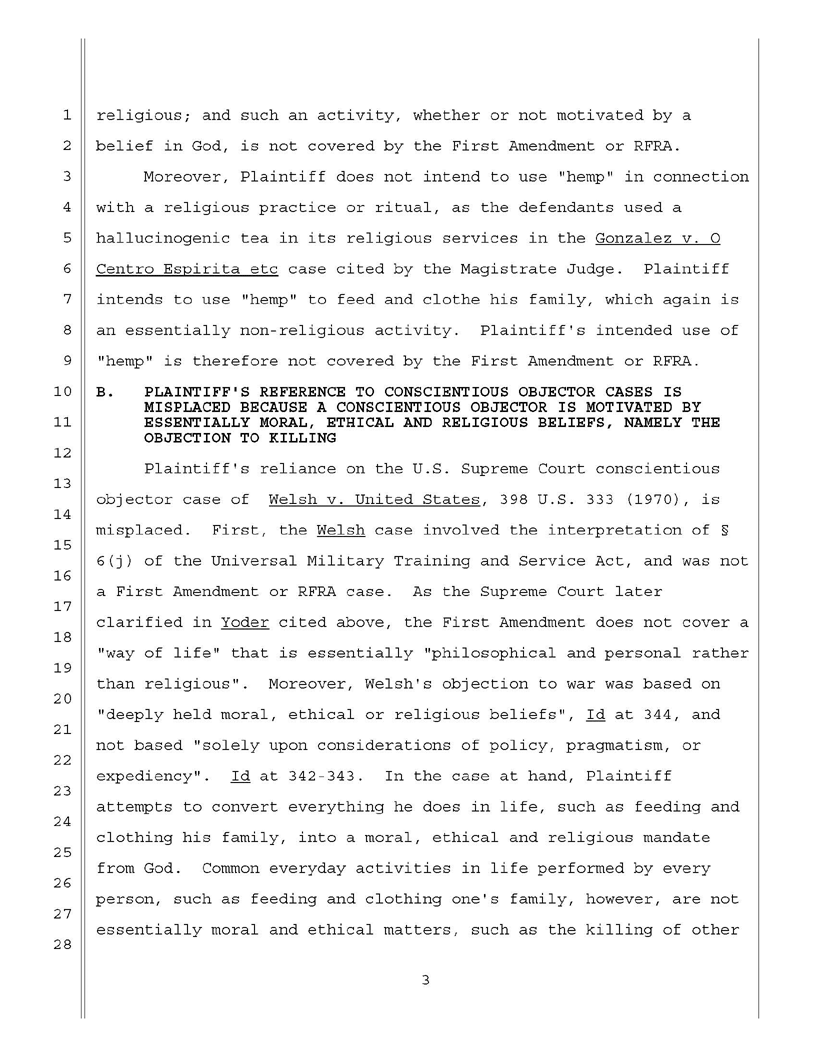
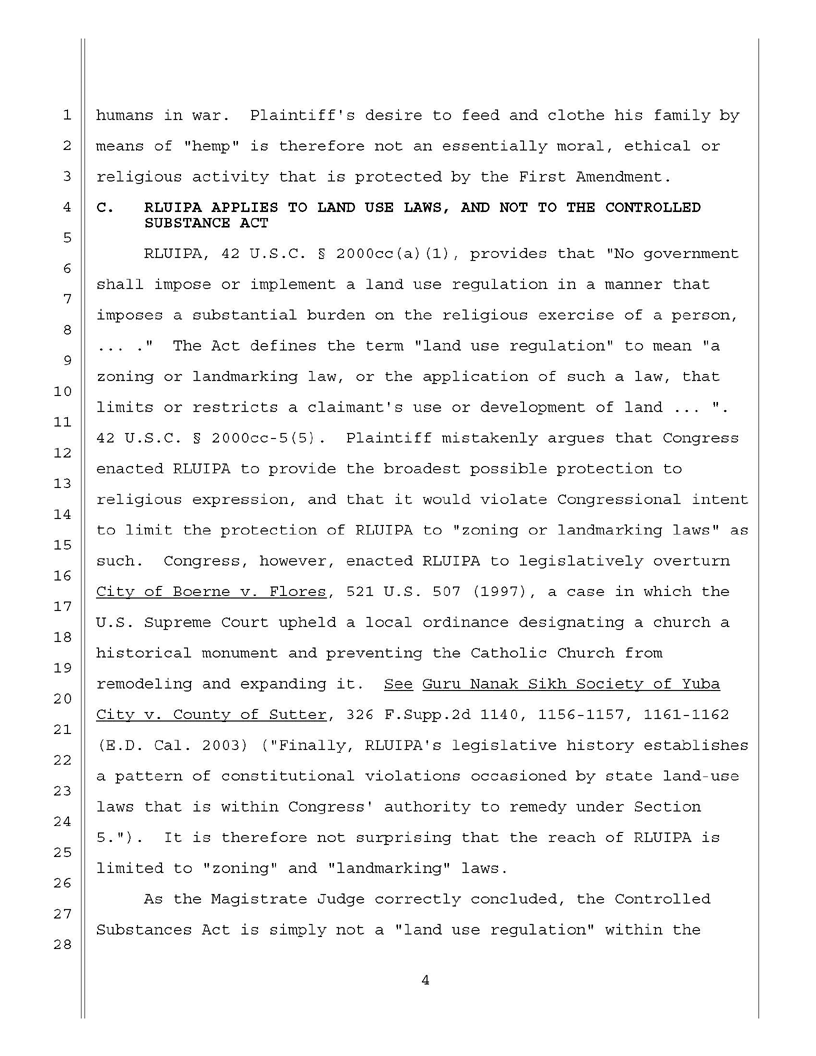
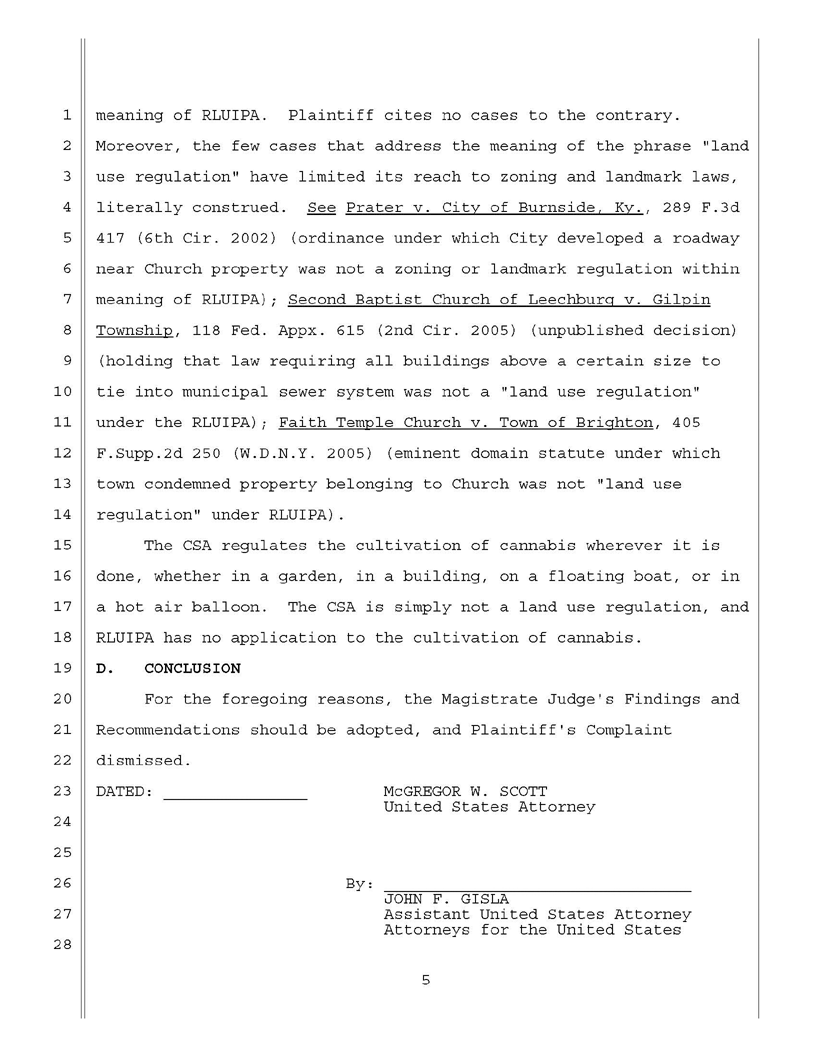
On March 16, 2006, Kiczenski explained religion to court and gummint.
UNITED STATES DISTRICT COURT EASTERN DISTRICT OF CALIFORNIA
RON KICZENSKI,
Plaintiff,
v.
JOHN ASHCROFT, et al.,
Defendants
CIV S – 03 – 2305 – MCE – GGH – PS
PLAINTIFF’S RESPONSE TO DEFENDANT’S RESPONSE TO
PLAINTIFF’S OBJECTIONS TO MAGISTRATE JUDGE’S FINDINGS AND RECOMMENDATIONS.
I Ron Kiczenski do hereby submit the following declaration/brief in response to the defendants March 16, 2006, response to my objections to the February 24, 2006, Magistrate Judges Findings and Recommendations, and I do swear the following is true and accurate to the best of my knowledge and belief and upon said knowledge and belief and at risk of the penalty for perjury in this Federal District, I ask the court to allow for and consider this document to be whatever it needs to be in title in order to have the fullest impact on the considerations of this court.
THE YODER TEST WORKS TO SUBSTANTIATE PLAINTIFF’S CLAIMS, NOT DEFENDANT’S POSITIONS AS DEFENDANTS RESPONSE SEEMS TO TRY AND REPRESENT
As the defendants response cited, the Yoder decision states;
“We come then to the quality of the claims of the respondents concerning the alleged encroachment of Wisconsin’s compulsory school-attendance statute on their rights and the rights of their children to the free exercise of the religious beliefs they and their forebears have adhered to for almost three centuries. In evaluating those claims we must be careful to determine whether the Amish religious faith and their mode of life are, as they claim, inseparable and interdependent. A way of life, however virtuous and admirable, may not be interposed as a barrier to reasonable state regulation of education if it is based on purely secular considerations; to have the protection of the Religion Clauses, the claims must be rooted in religious belief. Although a determination of what is a “religious” belief or practice entitled to constitutional protection may present a most delicate question, 6 the very concept of ordered liberty precludes [406 U.S. 205, 216] allowing every person to make his own standards on matters of conduct in which society as a whole has important interests. Thus, if the Amish asserted their claims because of their subjective evaluation and rejection of the contemporary secular values accepted by the majority, much as Thoreau rejected the social values of his time and isolated himself at Walden Pond, their claims would not rest on a religious basis. Thoreau’s choice was philosophical and personal rather than religious, and such belief does not rise to the demands of the Religion Clauses. “
In this restricted by formal and higher education forum, I have presented in every way that I know how that my religious/spiritual knowledge, belief, and practices and intended practices are sincere, deeply rooted and long held, and that my own ‘church’ in my garden was realized even as a child. In fact, this test is even more to the point of direct and substantial burden on ones free exercise than Yoder is in that it goes to question the prohibition of even the construction of my church as instructed to me by god, and goes even so far as to deny the very necessarily dictated sustenance that god will provide to give the very breath of life to my family and I in return, a life and death issue, where as the Yoder case was a public school issue and had no baring on the ability of Yoder to actual stay alive by dependence on the in common food gifts from god and how to use them in accordance with the Amish doctrine. These facts should leave no question that my religious faith and mode of life are inseparable and interdependent.
I have clearly shown this court that in no way is the life style of my necessary intended religious practice based on a personal choice after an “evaluation and rejection of the contemporary secular values accepted by the majority”. Far in unavoidable conclusion to the contrary, I have shown this court that my awakening to my direct relationship to god and how that effects my necessary life style began as a child and well before I knew anything at all about politics, economics, philosophy or even what secular means, all I knew was that god had reveled and communicated plainly with me what my church was without exception to be.
I have explained to this court that while god was instructing me from our families garden as a child, so to was my parochial schooling and Alter boy training in the Catholic church teaching me corroborating bible scriptures which clearly and unequivocally established gods own created first and original ‘church’ of humans as a garden, the garden of Eden, such as;
GENESIS,
“2:8 And the Lord God planted a garden eastward, in Eden; and there He put the man whom He had formed.”
“2:15 And the Lord God took the man, and put him into the garden of Eden to dress it and to keep it. “
“2:16 And the Lord God commanded the man, saying: ‘Of every tree of the garden thou mayest freely eat;”
I have explained in every way I know how that my religious knowledge, belief, and practices are rooted in commonality with every religion and or spiritual belief I know of even from the dawn of humankind and are in no way odd or out of the ordinary in regards to the natural gifts we inherit as a matter of birth and the different ways folks are guided by their particular doctrines to share or use those god given commonalities.
I have presented this court with ample statements and supporting exhibits of the long and exhaustive history of attempts I have made to remedy this impossible burden on the way that I must live according to god and how the CSA and its continued and growing threat effects me as nothing less then religious persecution and has done and continues to do irreparable harm, and that has by the stress and nutrition factors alone already has shortened mine and my children’s natural god intended life spans and quality of such.
The Yoder decision goes on to state;
“Giving no weight to such secular considerations, however, we see that the record in this case abundantly supports the claim that the traditional way of life of the Amish is not merely a matter of personal preference, but one of deep religious conviction, shared by an organized group, and intimately related to daily living. That the Old Order Amish daily life and religious practice stem from their faith is shown by the fact that it is in response to their literal interpretation of the Biblical injunction from the Epistle of Paul to the Romans, “be not conformed to this world . . . .” This command is fundamental to the Amish faith. Moreover, for the Old Order Amish, religion is not simply a matter of theocratic belief. As the expert witnesses explained, the Old Order Amish religion pervades and determines virtually their entire way of life, regulating it with the detail of the Talmudic diet through the strictly enforced rules of the church community.
The record shows that the respondents’ religious beliefs and attitude toward life, family, and home have remained constant – perhaps some would say static – in a period of unparalleled progress in human knowledge generally and great changes in education. 7 The respondents [406 U.S. 205, 217] freely concede, and indeed assert as an article of faith, that their religious beliefs and what we would today call “life style” have not altered in fundamentals for centuries. Their way of life in a church-oriented community, separated from the outside world and “worldly” influences, their attachment to nature and the soil, is a way inherently simple and uncomplicated, albeit difficult to preserve against the pressure to conform. Their rejection of telephones, automobiles, radios, and television, their mode of dress, of speech, their habits of manual work do indeed set them apart from much of contemporary society; these customs are both symbolic and practical. “
Yoder also goes on to state;
“The impact of the compulsory-attendance law on respondents’ practice of the Amish religion is not only severe, but inescapable, for the Wisconsin law affirmatively compels them, under threat of criminal sanction, to perform acts undeniably at odds with fundamental tenets of their religious beliefs. See Braunfeld v. Brown, 366 U.S. 599, 605 (1961). Nor is the impact of the compulsory-attendance law confined to grave interference with important Amish religious tenets from a subjective point of view. It carries with it precisely the kind of objective danger to the free exercise of religion that the First Amendment was designed to prevent. As the record shows, compulsory school attendance to age 16 for Amish children carries with it a very real threat of undermining the Amish community and religious practice as they exist today; they must either abandon belief and be assimilated into society at large, or be forced to migrate to some other and more tolerant region. 9 [406 U.S. 205, 219] “
Even more severe than in the Yoder case,
The impact of the law on my practice of my religion is not only severe, but reaches right to the very root of my religious practice and seeks to extinguish it, and to which the effects on me and my children are inescapable, for the CSA affirmatively compels me, under threat of even cruel and unusual criminal sanction, to perform acts undeniably at odds with fundamental tenets of my religious beliefs, not the least of which would be to take part in the killing/eradication/extinction of the spirit of god in cannabis form. The CSA carries with it precisely the kind of objective danger to the free exercise of religion that the First Amendment was designed to prevent as was recently demonstrated in Gonzalez v. O Centro Espirita etc case. Further, it would be completely out of step with the most basic principles of every religion I’ve ever heard of, as well as bible scripture and just plain logic to hold a standard that provides for the free exercise to use and teach your children the sacred and sacramental use of hallucinogenic tea, yet not provide for the equal standard to be applied to a religious activity of the same or greater weight and that goes to feeding and clothing ones children.
The following position presented and apparently held by the defendant shows without a doubt and unequivocally on its face that the defendant is not only unqualified to state such, and prohibited by the First Amendment from even making a conclusion of such a nature, but it goes to clearly show the defendants total lack of any reasonable understanding of what religion is, the defendant’s response states that;
“plaintiff attempts to convert everything he does in his life, such as feeding and clothing his family, into a moral, ethical and religious mandate from god. Common everyday activities in life performed by every person, such as feeding and clothing one’s family, however, are not essentially moral and ethical matters,”…
A. I have not ‘converted, and need not ‘convert’ what I do in life “such as feeding and clothing” my “family, into a moral, ethical and religious mandate from god.”, they are already as such and were born from such, and the defendants desperate attempt to convert such into “secular, economic, social and political” beliefs are clearly based in a suspicious reach for a convenient argument in their own defense while it attempts to establish my religion for me in perfect and irreconcilable conflict with the First Amendment.
B. “feeding and clothing one’s family, however, are not essentially moral and ethical matters,”… This kind of long settled and in error devolved logic of the defendant is not only a denial of the fundamental truths of my religion, but in kind, offends all other known religions I am aware of equally to the core. In fact the statement itself is so unrealistic and bald faced illogical that one might conclude that the defendants are engaged in some sort of religious cleansing efforts. Whatever the defendants motivation may be in taking this oddly obviously mistaken position, it is clear that it is in direct conflict with the Yoder decision as well as the Welsh held logic and fails those tests ashamedly.
C. Defendants position that “feeding and clothing one’s family, however, are not essentially moral and ethical matters,”… even miserably fails The Gandhi test;
“During his childhood, Gandhi’s family practiced Vaishnavism, but he was also exposed to Jainism. While in England studying law, he was introduced to Theosophy and Christianity. He did not realize his sentimental bond to Hinduism until his Hinduism was challenged by Christian missionaries in South Africa. Gandhi had read the Bhagavad Gita in an English translation in England, but it did not become his “spiritual dictionary” [6, 14] until he read several different translations of it in South Africa. Reading the Bhagavad Gita reinforced Gandhi’s connection to Hinduism. Gandhi eventually became “one of the greatest innovators in the history of Hinduism.” [6, 17] His Hinduism revolved around “a few fundamental beliefs: in the supreme reality of God, the unity of all life, and the value of ahimsa as a means of realizing God.” [6, 17]
With these as his central beliefs, it is easy to see how Gandhi was able to find an underlying unity in all the world’s religions. While in South Africa, Gandhi undertook a comparative study of religions, which gave rise to the all-embracing nature of his religious outlook. He had faith that “religions are different roads converging to the same point.” [3, 27] To Gandhi, “the various religions were ‘as so many leaves of a tree’; they might seem different but ‘at the trunk they are one.'” [6, 21] He had confidence in “the absolute oneness of God and therefore of humanity.” Based on this, he believed, “We have but one soul. The rays of the sun are many through refraction. But they have the same source.” [1, 198]
Because he saw all religions as essentially the same, he advocated “mutual tolerance and respect between different religions” [6, 23] Gandhi “insisted that the function of religion was to unite rather than divide people.” [6, 11] Because of this belief, Gandhi was deeply distraught by the religious conflict between Hindus and Muslims in India. He contended, “In reality, there are as many religions as there are individuals, but those who are conscious of the spirit of nationality do not interfere with one another’s religion…The Hindus, The Mahomedans, the Parsis, and the Christians…will have to live in unity.” [3, 26]
Gandhi believed that religion must be applied to everyday life. To him, religion was “an ethical framework for the conduct of daily life.” [6, 24] “He did not know… any religion apart from human activity; the spiritual law did not work in a vacuum but in the ordinary activities of life; religion which took no account of practical problems and did not help to solve them was no religion.” [6, 19] Within his own life, Gandhi “endeavored to enforce the teachings of the Gita…[and came] to the conclusion that perfect renunciation was impossible without perfect observance of ahimsa in every shape and form.” [6, 14]
For Gandhi, applying religion to daily life necessitated applying religion to politics as well. Many people criticized Gandhi for mixing religion and politics, however, these critics did not fully understand what Gandhi meant by religion: “It is not the Hindu religion, which I certainly prize above all other religions, but the religion which transcends Hinduism, which changes one’s very nature, which binds one indissolubly to the truth within and which ever purifies. It is the permanent element in human nature which…leaves the soul restless until it has found itself.” [6, 24]
Gandhi’s religious philosophy is essentially what Leibniz called the Perennial Philosophy. In the introduction to The Essential Gandhi, the Perennial Philosophy is characterized as follows:
“First, underlying everything in the phenomenal world is a changeless reality, which most religions call God. Second, this changeless reality is present in every living creature and can be personally discovered by following certain strenuous disciplines that remove the layers of conditioning that cover it. And third, this discovery is the real goal of life. Whatever else we may accomplish, nothing will satisfy us until we realize God in our own consciousness.” [1, xviii]”
“A religion that takes no account of practical affairs and does not help to solve them is no religion. “
Mohandas Gandhi
“Each one prays to God according to his own light.”
Mohandas Gandhi
“Religion is more than life. Remember that his own religion is the truest to every man even if it stands low in the scales of philosophical comparison. “
Mohandas Gandhi
“The essence of all religions is one. Only their approaches are different.”
Mohandas Gandhi
“Those who say religion has nothing to do with politics do not know what religion is.”
Mohandas Gandhi
“An ounce of practice is worth more than tons of preaching.”
Mohandas Gandhi
“I claim that human mind or human society is not divided into watertight compartments called social, political and religious. All act and react upon one another.”
Mohandas Gandhi
“My religion is based on truth and non-violence. Truth is my God. Non-violence is the means of realising Him.”
Mohandas Gandhi
“One’s own religion is after all a matter between oneself and one’s Maker and no one else’s.”
Mohandas Gandhi
Above excerpts from, http://www.wildewildeweb.com/gandhi/index.html
The defendant also try’s to say that the logic used in the Welsh decision has no applicability in this case because it “involved the interpretation 6(j) of the Universal Military Training and Service Act, and was not a First Amendment or RFRA case” fails on its face as the Yoder case was not a conscientious objector case yet Welsh was clearly referenced and used in the formulation of that outcome.
The defendant’s mistaken notion that the logic used in formulating the Welsh decision has no possible applicability here, is simply based on semantics and a basic training to say anything true or not and no matter how misleading in their own defense, just as defendants contention that the RLUIPA, though it works against me in every way as a land use regulation, cannot be considered because the CSA is not a land use regulation in its official title only. The defendants mistaken conclusions on this actions ability to meet the requirements of RFRA and RLUIPA should be rejected.
Later Yoder states;
“This case, of course, is not one in which any harm to the physical or mental health of the child or to the public safety, peace, order, or welfare has been demonstrated or may be properly inferred. 20 The record is to the contrary, and any reliance on that theory would find no support in the evidence.”
As I cited in the request and as an attached exhibit to my initial request for a TRO in this action{oct.2003}, this excerpt from the DEA’s own Administrative law judge should go to help satisfy the needs of this court in determining the claimed compelling interest of the defendants in the total void of any showing on their part of any evidence of a compelling interest built from some threat to public safety or national security etc…{could it be that in part the defendants and now the Magistrate Judge have both mistaken my showings and statements going to argue that the defendants have an absence of compelling interest/national security, for imposing such burdens on me, as beliefs rooted in political, economic, philosophic or something other than religious.?}. please note that the following references by Judge Young go to address the varieties of viable THC producing cannabis and cannot possibly be referencing the cannabis hemp sub specie variety at specific issue in this case because,
1. it could not be used as medicine in the sense of a drug at any stage of growth.
2. it has still not been verified through proper taxonomic testing that it is or even could ever viably contain or produce the plant drug defendants are trying to regulate under the CSA. The defendant just proclaims out of thin air that the plant varieties are identical and that cannabis is all the same with no sub specie varieties.
UNITED STATES DEPARTMENT OF JUSTICE
Drug Enforcement Administration
In The Matter Of
MARIJUANA RESCHEDULING PETITION
Docket No. 86-22
OPINION AND RECOMMENDED RULING, FINDINGS OF FACT, CONCLUSIONS OF LAW AND DECISION OF ADMINISTRATIVE LAW JUDGE FRANCIS L. YOUNG, Administrative Law Judge
DATED: SEPTEMBER 6, 1988
“Discussion
Based upon the rationale set out in pages 26 to 34, above, the
administrative law judge concludes that, within the meaning of the Act, 21 U.S.C. § 812(b)(2)(B), marijuana “has a currently accepted medical use in treatment in the United States” for spasticity resulting from multiple sclerosis and other causes. It would be unreasonable, arbitrary and capricious to find otherwise. The facts set out above, uncontroverted by
the Agency, establish beyond question that some doctors in the United States accept marijuana as helpful in such treatment for some patients.
The record here shows that they constitute a significant minority of physicians. Nothing more can reasonably be required. That some doctors would have more studies and test results in hand before accepting marijuana’s usefulness here is irrelevant.
The same is true with respect to the hyperparathyroidism from which Irvin Rosenfeld suffers. His disease is so rare, and so few physicians appear to be familiar with it, that acceptance by one doctor of marijuana as being useful in treating it ought to satisfy the requirement for a significant minority. The Agency points to no evidence of record tending to establish that marijuana is not accepted by doctors in connection with this most unusual ailment.
Refusal to acknowledge acceptance by a significant minority, in light of the case history detailed in this record, would be unreasonable, arbitrary and capricious.
VIII.
ACCEPTED SAFETY FOR USE UNDER MEDICAL SUPERVISION
With respect to whether or not there is “a lack of accepted safety
for use of [marijuana] under medical supervision”, the record shows the
following facts to be uncontroverted.
Findings of Fact
1. Richard J. Gralla, M.D., an oncologist and Professor of
Medicine who was an Agency witness, accepts that in treating cancer
patients oncologists can use the cannabinoids with safety despite their
side effects.
2. Andrew T. Weil, M.D., who now practices medicine in Tucson,
Arizona and is on the faculty of the College of Medicine, University of
Arizona, was a member of the first team of researchers to perform a
Federal Government authorized study into the effects of marijuana on
human subjects. This team made its study in 1968. These researchers
determined that marijuana could be safely used under medical supervision.
In the 20 years since then Dr. Weil has seen no information that would
cause him to reconsider that conclusion. There is no question in his
mind but that marijuana is safe for use under appropriate medical
supervision.
3. The most obvious concern when dealing with drug safety is
the possibility of lethal effects. Can the drug cause death?
4. Nearly all medicines have toxic, potentially lethal
effects. But marijuana is not such a substance. There is no record in
the extensive medical literature describing a proven, documented
cannabis-induced fatality.
– 56 –
5. This is a remarkable statement. First, the record on
marijuana encompasses 5,000 years of human experience. Second, marijuana
is now used daily by enormous numbers of people throughout the world.
Estimates suggest that from twenty million to fifty million Americans
routinely, albeit illegally, smoke marijuana without the benefit of
direct medical supervision. Yet, despite this long history of use and
the extraordinarily high numbers of social smokers, there are simply no
credible medical reports to suggest that consuming marijuana has caused a
single death.
6. By contrast aspirin, a commonly used, over-the-counter
medicine, causes hundreds of deaths each year.
7. Drugs used in medicine are routinely given what is called
an LD-50. The LD-50 rating indicates at what dosage fifty percent of
test animals receiving a drug will die as a result of drug induced
toxicity. A number of researchers have attempted to determine
marijuana’s LD-50 rating in test animals, without success. Simply
stated, researchers have been unable to give animals enough marijuana to
induce death.
8. At present it is estimated that marijuana’s LD-50 is around
1:20,000 or 1:40,000. In layman terms this means that in order to induce
death a marijuana smoker would have to consume 20,000 to 40,000 times as
much marijuana as is contained in one marijuana cigarette. NIDA-supplied
marijuana cigarettes weigh approximately .9 grams. A smoker would
theoretically have to consume nearly 1,500 pounds of marijuana within
about fifteen minutes to induce a lethal response.
9. In practical terms, marijuana cannot induce a lethal
response as a result of drug-related toxicity.
– 57 –
10. Another common medical way to determine drug safety is
called the therapeutic ratio. This ratio defines the difference between
a therapeutically effective dose and a dose which is capable of inducing
adverse effects.
11. A commonly used over-the-counter product like aspirin has a
therapeutic ratio of around 1:20. Two aspirins are the recommended dose
for adult patients. Twenty times this dose, forty aspirins, may cause a
lethal reaction in some patients, and will almost certainly cause gross
injury to the digestive system, including extensive internal bleeding.
12. The therapeutic ratio for prescribed drugs is commonly
around 1:10 or lower. Valium, a commonly used prescriptive drug, may
cause very serious biological damage if patients use ten times the
recommended (therapeutic) dose.
13. There are, of course, prescriptive drugs which have much
lower therapeutic ratios. Many of the drugs used to treat patients with
cancer, glaucoma and multiple sclerosis are highly toxic. The
therapeutic ratio of some of the drugs used in antineoplastic therapies,
for example, are regarded as extremely toxic poisons with therapeutic
ratios that may fall below 1:1.5. These drugs also have very low LD-50
ratios and can result in toxic, even lethal reactions, while being
properly employed.
14. By contrast, marijuana’s therapeutic ratio, like its LD-50,
is impossible to quantify because it is so high.
15. In strict medical terms marijuana is far safer than many
foods we commonly consume. For example, eating ten raw potatoes can
result in a toxic response. By comparison, it is physically impossible
to eat enough marijuana to induce death.
16. Marijuana, in its natural form, is one of the safest
therapeuticallyactive substances known to man. By any measure of rational analysis
marijuana can be safely used within a supervised routine of medical care.”
Attached to the request for a TRO in October 2003, are fifty exhibits that all go to corroborate that if the defendants were tested on compelling interest as prescribed by RFRA and or RLUIPA, it will show that they fail to meet their burden as it applies to this case.
An error does not become truth by reason of multiplied propagation, nor does truth become error because nobody sees it.
Mohandas Gandhi
DO TO THE EXTRA SENSITIVE NATURE OF THE FOLLOWING, AND THE POSIBLE NEGATIVE RIPPLE EFFECT IT MIGHT HAVE ON MYSELF AND MY FAMILY, I ASK THAT THE COURT CONSIDER THE FOLLOWING IN ONLY THE FORMAL COMPLETE RECORD OF THIS CASE, BUT OMITT IT FROM THE PUBLICLY ACCESABLE RECORD IF POSSIBLE
I suffer greatly in discussing these personal religious matters in these religious terms because inherent in that very context is a kind of inevitable misconception of separatism and other language barrier misinterpretations that folks the world over seem to walk away with when discussing such matters, and as such run in contrary to my doctrine to celebrate and share the commonalities of folks and all life forms and therein a birth of the ability to understand differences as the necessary diversity of life rather then fearing and exploiting folks commonalities and differences and creating more unnecessary disconnect/separatist related suffering. For mostly these reasons I have tried to be as delicate and nonspecific as possible up to now in describing my communications/relationship with, and existence as god.
CONCLUSION
Again I ask and pray this court to grant me, the plaintiff, permanent injunctive relief from defendants unconstitutional, unwarranted, discriminating and fatally substantial burden on the free exercise of my religion, and their eminent attack therein.
For all the foregoing reasons and including plaintiffs filed objections to the Magistrates Findings and Recommendations, and including all the documents of record incorporated therein, I ask that the court not adopt the Magistrates Findings and Recommendations, and instead rightly set this matter for trial on the RFRA, RLUIPA, and First Amendment issues of the defendants burden for showing sufficient compelling interest, and if so, are they implementing the least restrictive measures in attempting to accomplish the compelling interest.
Or if the court sees fit, to grant summary judgment in favor of the plaintiff based on the ample record that exists and the total failure on the defendants part to contradict such, and in the total absence of their showing any information to substantiate their untested assumption of compelling interest.
Respectfully submitted on this day of March 21, 2006 by plaintiff, March 21, 2006
Ron Kiczenski
On March 30, 2006, Fed. Dist. Judge Morrison England upholds Mag. Judge Hollows’ summary judgment in favor of the gummint. (Reply not available in archive)
On April 11, 2006, Kiczenski filed a Notice of Appeal to Ninth Circuit Court of Appeals, saying the lower courts had not given him due process, and had erred in their establishment of their religion as his religion.
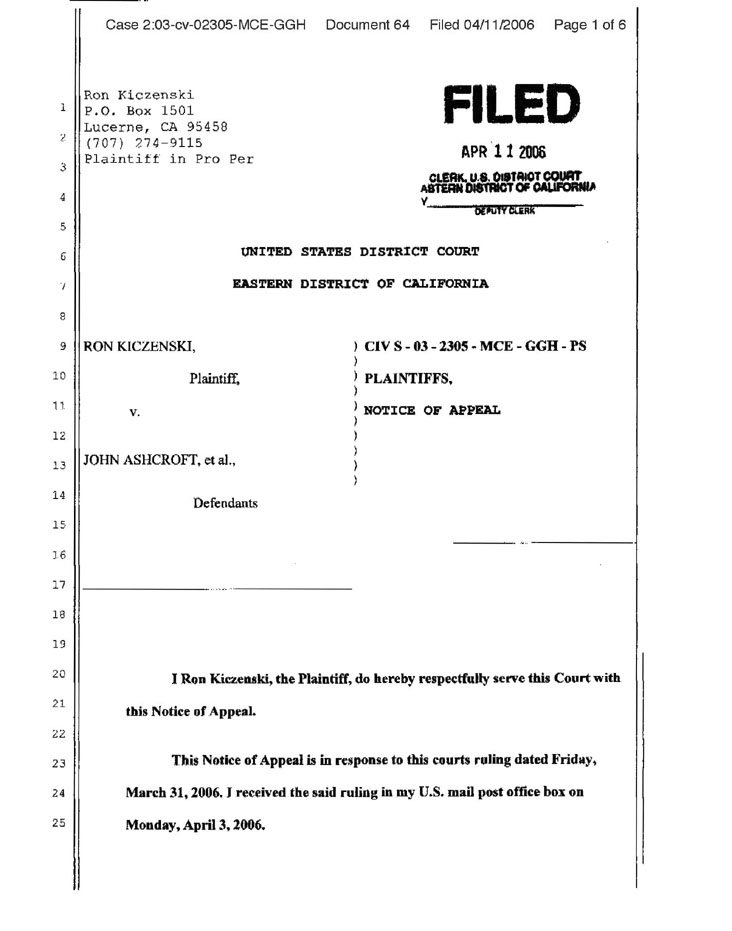
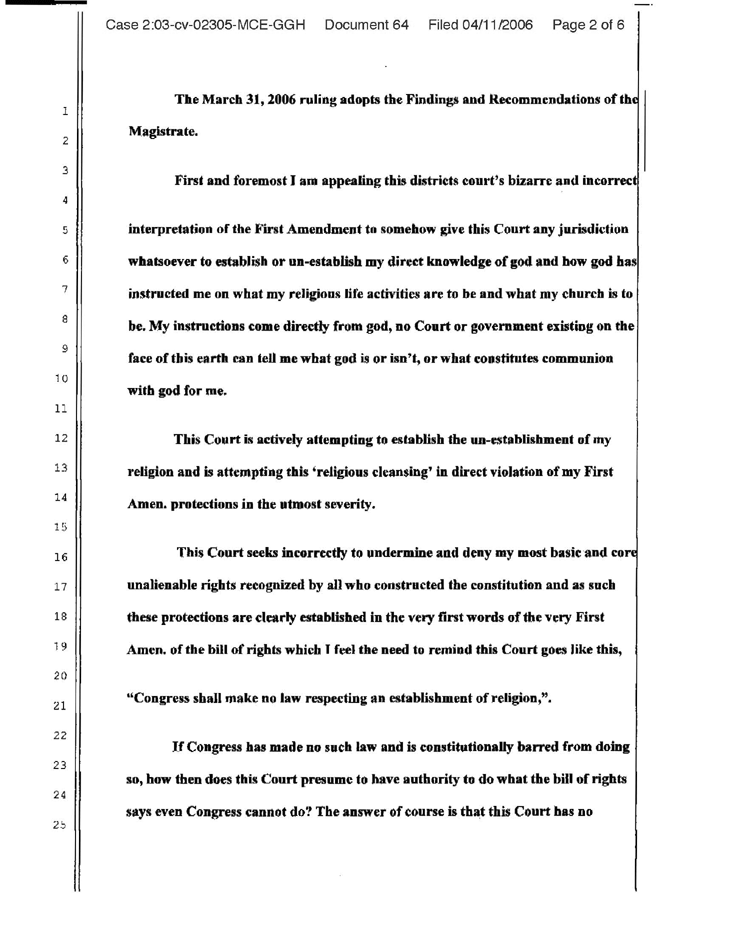

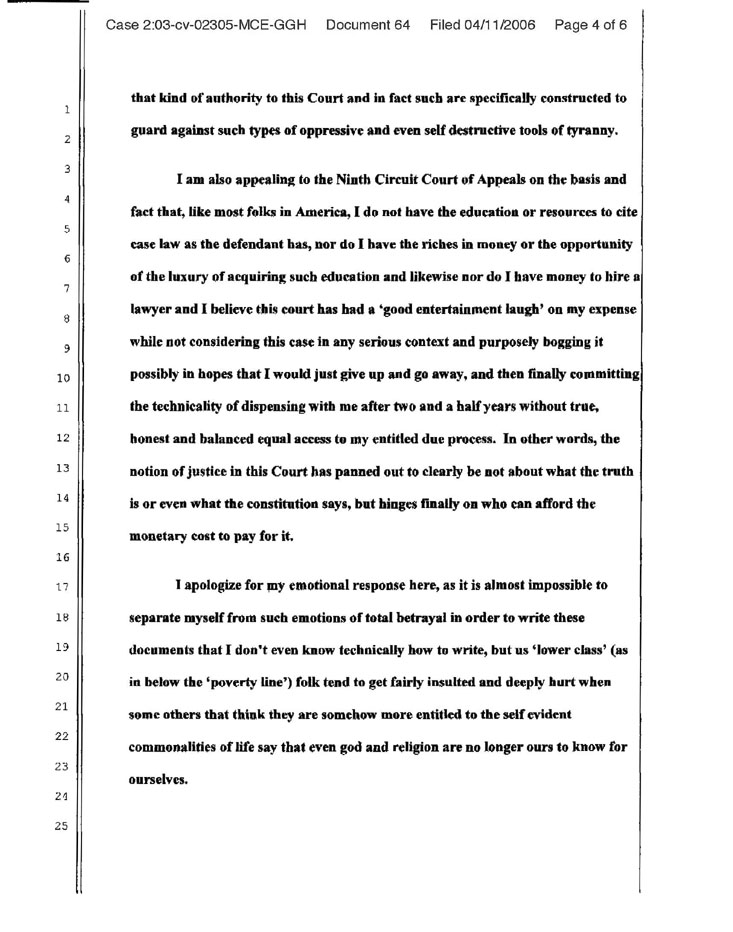
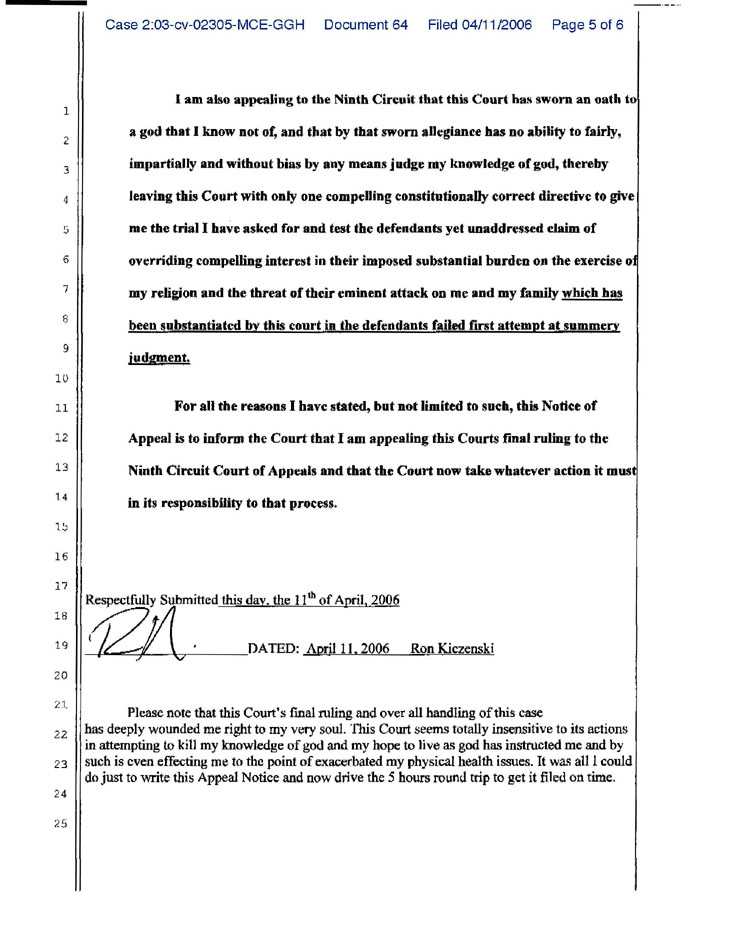
Judge England, showing bad faith, said he had no faith that Kiczenksi’s faith was a really good faith.

On June 13, 2006, Kiczenski filed an appeal brief to the 9th Circuit Court of Appeals, further outlining how the District Court had erred in establishing a religion for Kiczenski.
UNITED STATES COURT OF APPEALS
FOR THE NINTH CIRCUIT
Ron Kiczenski
Appellant/Petitioner
vs.
John Ashcroft et. al.
Defendant’s/Appellees/Respondent
CASE No. 06-15709
D.C. No. CV-03-02305-MCE
APPELLANT’S / PETITIONER’S INFORMAL BRIEF
Facts of the case
All forms in the web of life are sacred according to my religious knowledge and practice, this is the core fact of this case that goes to my knowledge/”belief” in my religion and my specific religious practices.
I have in my protection an endangered life form that exists in the web of life that we as humans are part of and are interdependent to/with/of.
The life partner I protect at specific issue in this action comes now in the form of fertile seed of the cannabis/hemp specie.
I would have been fulfilling my agrarian responsibility in sowing these seeds for life over the last decade, but for the eminent and looming threat posed by the defendants/appellees.
I share the following fact not because it makes a difference to me or my responsibilities to the web of life we are all a part of what “varieties” or “sub varieties” “species” a life form is or isn’t, but because it exemplifies the absolute nonsensical natural conflict result that comes from the jurisdictional overreach that the CSA pretends to conquer.
Though the sub varieties seed I would have been and soon will be planting is genetically incapable of producing any viable amounts of the chemical “THC” which is at issue in terms of the defendants presumed responsibilities under the auspices of the CSA, the defendants make no legal distinction for a sub varieties life form of cannabis thereby viewing all cannabis “illegal” whether THC producing or not.
Because I am protecting and intend to plant up to 100,000 seeds, under the guides of the CSA the defendant considers me defined as a “drug kingpin” punishable by up to life in prison or even the death penalty.
I am bound by my “religious” mandate and knowledge of the great spirit/creator/god/the life energy etc… to act and live in ways that are apparently in direct conflict with the intended enforcement of the CSA.
Because the CSA in effect seeks to overpower and deny the natural laws of the creator it has not now nor did it ever have any realistic hope of ever being fully enforceable and as such the CSA can only be selectively enforced on people like me who have no choice but to stand and decry it or on people who are easily prey to its counterfeit reality in its effort to feed and maintain whatever the real and as yet undisclosed purposes for this laws creation are.
The fundamental questions at issue in this case up until the District Court went even further to bring new issues in denying my First Amendment protections to freely establish my own religious knowledge were and still are the follows:
Does every individual human own the natural born right by the creator to possess and plant seeds?
Can government find a compelling interest enough to effectively take jurisdiction over this fundamental natural born human right and outlaw it and in doing so, doing incalculable irreparable damage to the web of life?
Can government outlaw a plant?
The compelling interest question that is the governments burden to answer in this case is not whether or not there is a compelling interest to outlaw or control a certain specie of plant life to the effect of prohibition or a policy of ultimate extinction, but rather can government show a prevailing and reasonable compelling interest to “outlaw” any plant forms in our creators web of life of “intelligent design” which as a FACT we have no choice but to admit is far beyond our full comprehension in its interlocking interdependent relationships and the ultimate purpose collectively of such?
The facts of this case can only begin in one place, with the facts of life, the birds and the bees, the most basic and self-evident laws of nature. Without acknowledgement of these laws above all laws, one could never fully understand this case.
The one verifiable, undisputable, unalienable fact of our very existence is that we would not exist without the web of life that produced us and continues to keep us alive as the human specie and as individuals.
I think it has become imperative to the known facts of this case to review in a more official language these commonly known facts of life/science/biology 101, the law’s of nature that can only be attributed to the great spirit/”god”/creator or whatever other insufficiently descriptive label one might put on this energy of life that is simply beyond description in the English language that is necessary in attempting to communicate with this court.
The biosphere is the part of a planet’s outer shell &emdash; including air, land, surface rocks and water &emdash; within which life occurs, and which biotic processes in turn alter or transform. From the broadest geophysiological point of view, the biosphere is the global ecological system integrating all living beings and their relationships, including their interaction with the elements of the lithosphere (rocks), hydrosphere (water), and atmosphere (air). Our planet Earth’s biosphere is generally thought to have evolved, beginning through a process of biogenesis or biopoesis, at least some 3.5 billion years ago.
The term “biosphere” was coined by geologist Eduard Suess in 1875. While this concept has a geological origin, it is an indication of the impact of both Darwin and Maury on the earth sciences. The biosphere’s ecological context comes from the 1920s (see Vladimir I. Vernadsky), preceding the 1935 introduction of the term “ecosystem” by Sir Arthur Tansley (see ecology history). Vernadsky defined ecology as the science of the biosphere. It is an interdisciplinary concept for integrating astronomy, geophysics, meteorology, biogeography, evolution, geology, geochemistry, hydrology and, generally speaking, all life and earth sciences. Some might prefer the word ecosphere, coined in the 1960s, as all encompassing of both biological and physical components of the planet.
*Gaia’s biosphere: The concept that the biosphere is itself a living organism, either actually or metaphorically, is known* as Gaia theory.
What is Biodiversity?
“A definition of biodiversity that is altogether simple, comprehensive, and fully operational … is unlikely to be found.” (Noss, 1990) Listed below are several different definitions used by resource managers and ecologists. Together, they should allow you to develop an understanding of the broad concept of biodiversity.”
U.S. Congress Office of Technology Assessment, “Technologies to Maintain Biological Diversity,” 1987:
“Biological diversity is the variety and variability among living organisms and the ecological complexes in which they occur. Diversity can be defined as the number of different items and their relative frequency. For biological diversity, these items are organized at many levels, ranging from complete ecosystems to the chemical structures that are the molecular basis of heredity. Thus, the term encompasses different ecosystems, species, genes, and their relative abundance.”
“Biological diversity, simply stated, is the diversity of life…As defined in the proposed US Congressional Biodiversity Act, HR1268 (1990), “biological diversity means the full range of variety and variability within and among living organisms and the ecological complexes in which they occur, and encompasses ecosystem or community diversity, species diversity, and genetic diversity.”
Keystone Center, “Final Consensus Report of the Keystone Policy Dialogue on Biological Diversity on Federal Lands,” 1991:
“In the simplest of terms, biological diversity is the variety of life and its processes; and it includes the variety of living organisms, the genetic differences among them, and the communities and ecosystems in which they occur.”
” Because biological diversity is so complex, and much of it is hidden from our view, unknown, or both, it is necessary to establish means of addressing its distinct and measurable parts. Most basic of these is genetic variation. Genetic variation within and between populations of species affects their physical characteristics, viability, productivity, resilience to stress, and adaptability to change. “
“A second, more easily recognized aspect of biological diversity is distinct species. Some species, such as American elk, rainbow trout, and ponderosa pine are plentiful. Others such as the red cockaded woodpecker, Siler’s pincushion cactus, or grizzly bear, have populations that are much reduced or may even face extinction. Conserving biological diversity includes perpetuating native species in numbers and distributions that provide a high likelihood of continued existence.”
“Associations of species are a third element of biological diversity. These associations are often called biological communities, usually recognized as distinct stands, patches, or sites, such as old-growth forests, riparian areas, or wetlands. Communities form the biotic parts of ecosystems. The variety of species in an ecosystem is a function of its structural and functional characteristics and the diversity of its ecological processes, and the physical environment.”
“Finally, at large geographic scales — from watersheds to the entire biosphere — biological diversity includes variety in the kinds of ecosystems, their patterns, and linkages across regional landscapes. It is from these large, regional landscapes, such as the Southern Appalachian Highlands, Sierra Nevada, and Northern Continental Divide, that people must derive sustainable yields of resources while perpetuating multiple intact examples of biologically diverse ecosystems.”
“This hierarchy of the parts and processes of biological diversity is admittedly artificial, and it has a distinct human context. However, it provides a focus for a concept that is infinitely varied and dynamic and that must be addressed in light of the full spectrum of human needs and aspirations.”
“Edward Grumbine, “Ghost Bears: Exploring the Biodiversity Crisis,” 1993:
“There is much more to biodiversity than the numbers of species and kinds of ecosystems. Ecologist Jerry Franklin portrays ecosystems as having three primary attributes: composition, structure, and function.”
“Ecosystem components are the inhabiting species in all their variety and richness. Many different species, gene-pool abundance, and unique populations are what most people think of when they hear the term “biodiversity”. But there is much more to consider.”
“Ecosystem structure refers to the physical patterns of life forms from the individual physiognomy of a thick-barked Douglas-fir to the vertical layers of vegetation from delicate herbs to tree canopies within a single forest stand. An ecosystem dominated by old, tall trees has a different structure than one comprised of short, quaking aspen. And there is more structure in a multilayered forest (herbs, shrubs, young trees, canopy trees) than in a single sagebrush grassland, prairie, or salt marsh…”
“Ecosystem functions are hard to see in action. “You can’t hug a biogeochemical cycle,” says one ecologist. But without the part of the carbon cycle where small invertebrates, fungi, and microorganisms work to break down wood fiber, the downed logs in an ancient forest would never decay. Natural disturbances also play a role. Wildfires release nutrients to the soil, weed out weak trees, and reset the successional clock. The energy of falling water creates spawning beds for salmon even while it carves a mountain’s bones. Plants breathe oxygen into the atmosphere. Ecological processes create landscapes and diverse environmental conditions out of life itself.
“Ecosystem components, structures, and functions are all interdependent. To understand biodiversity, one has to think like a mountain and consider not only the biotic elements of plants, animals, and other living beings, but also the patterns and processes that shape volcanoes and forests.”
“Reed Noss, “Indicators for Monitoring Biodiversity: A Hierarchial Approach,” Conservation Biology 4(4):355-364. 1990:
“Biodiversity is not simply the number of genes, species, ecosystems, or any other group of things in a defined area…A definition of biodiversity that is altogether simple, comprehensive, and fully operational (i.e. responsive to real- life management and regulatory questions) is unlikely to be found. More useful than a definition, perhaps, would be a characterization of biodiversity that identifies the major components at several levels of organization.”
“…(C)omposition, structure, and function…determine, and in fact constitute, the biodiversity of an area. Composition has to do with the identity and variety of elements in a collection, and includes species lists and measures of species diversity and genetic diversity. Structure is the physical organization or pattern of a system, from habitat complexity as measured within communities to the pattern of patches and other elements at a landscape scale. Function involves ecological and evolutionary processes, including gene flow, disturbances, and nutrient cycling.”
“In general terms an ecological system can be thought of as an assemblage of organisms (plant, animal and other living organisms&emdash;also referred to as a biotic community or biocoenosis) living together with their environment (or biotope), functioning as a loose unit. That is, a dynamic and complex whole, interacting as an “ecological unit.” The size and scale of an ecosystem can vary widely. It may be a whole forest, a community of bacteria and algae in a drop of water, or even the geobiosphere itself.”
Five members of the David Suzuki Foundation team wrote the following Declaration of Interdependence in 1992 for the United Nations’ Earth Summit in Rio de Janeiro.
In 2001, Finnish composer Pehr Henrik Nordgren wrote his Symphony no. 6 “Interdependence” based on the declaration, which also served as lyrics to the piece. It was performed for the first time in Sendai, Japan in December, 2001.
“This We Know”
“We are the earth, through the plants and animals that nourish us.
We are the rains and the oceans that flow through our veins.
We are the breath of the forests of the land, and the plants of the sea.
We are human animals, related to all other life as descendants of the firstborn cell.
We share with these kin a common history, written in our genes.
We share a common present, filled with uncertainty.
And we share a common future, as yet untold.
We humans are but one of thirty million species weaving the thin layer of life enveloping the world.
The stability of communities of living things depends upon this diversity.
Linked in that web, we are interconnected — using, cleansing, sharing and replenishing the fundamental elements of life.
Our home, planet Earth, is finite; all life shares its resources and the energy from the sun, and therefore has limits to growth.
For the first time, we have touched those limits.
When we compromise the air, the water, the soil and the variety of life, we steal from the endless future to serve the fleeting present.”
I went as far as I know how in describing all of the above basic foundational facts of this case in my own words in the original complaint of November 4, 2003 to the Eastern District Court and in the every other document I filed where it seemed appropriate to include such in thus far on the record in this case including in the “terminated” requests for Temporary Restraining Order’s, “TRO’s” and their 50 attached exhibits. I also conveyed these fundamental facts as best I could in the second hearing for summary judgment.
Neither the defendants nor the District Court has ever held these facts in dispute and as I understand the due process these facts would have been at issue in trial if they had been in question whatsoever.
The defendants claim to have congressionally authorized authority under the auspices of the Controlled Substances Act to outlaw and or prohibit in general naturally occurring forms of life that are part of the commons that make up the web of life that we are literally made of and continue to depend on for our very existence in a fragile incomprehensible equation that some now call “intelligent design” and which adds up to the interdependent, interlocked, self evident and unalienable relationship/natural laws human kind are bound to above all laws by the nature of our very existence, and as I stated previously, these law’s can only be attributed to the great spirit/”god”/creator or whatever other insufficiently descriptive label one might put on this energy of life that is simply beyond description in the English language that is necessary in attempting to communicate with this court.
Furthermore by the same claimed authority within the CSA as stated above, the defendants also seek to deny my personal responsibility to engage the natural born terms of my existence in the fragile incomprehensible equation that some now call “intelligent design” and which adds up to the interdependent, interlocked, self evident and unalienable relationship/natural laws human kind is bound to above all law by the nature of our very existence, and as I stated previously, these law’s can only be attributed to the great spirit/”god”/creator or whatever other insufficiently descriptive label one might put on this energy of life that is simply beyond description in the English language that is necessary in attempting to communicate with this court as also stated above.
These defendants have long been exercising this purported authority throughout the U.S.A. and the world in direct conflict with the very terms of our in common existence with respect to the above stated foundational facts of this case.
Even with no other facts considered, the Ninth Amendment in itself as it states,
“The enumeration in the Constitution, of certain rights, shall not be construed to deny or disparage others retained by the people.” , should have naturally been sufficient in restricting and precluding government from ever engaging this far over reaching claimed authority to threaten the very terms of our in common existence with laws such as the CSA as it applies to this case.
The Ninth Amendment is listed specifically in “The Bill of Rights” which implies that it is within the peoples reach in adjudicating cases and controversy, and if it has any meaning whatsoever it must include if not begin with the protection of these commons of our natural world to which we are all individually and collectively bound in interdependency with for our very existence.
By the same logic the Ninth Amendment should at the very least be used as the district Magistrate Judge explained in his order of December 9, 2004.
The Magistrate explained that case law has established the Ninth Amendment can only be used as a tool for understanding or interpreting the rest of the constitution and not to be reached for specifically in seeking specific rights. Thereby in any reasonable mind it should be concluded that there is nothing in the constitution that would go to give government the jurisdictional authority to outlaw the planting of seeds by humans whatsoever.
The Ninth Amendment can only be interpreted to be keeping government restricted from attacking our individual and naturally unalienable retained rights at the roots of each human’s very existence without exception, the act of planting any seed is a natural born right “retained by the people”.
The inconvenient truths of the damage to the biospheric equation of the web of Earth life that has already been sustained in every aspect of human and other life from the far reaching effects of the CSA are irreversible and immeasurable at our current technological abilities, yet they are clearly evident as I have stated in my own words in the original complaint of November 4, 2003 to the Eastern District Court and in the every other document I have filed where it seemed appropriate to include such in thus far on the record in this case including in the “terminated” requests for Temporary Restraining Order’s, “TRO’s” and their 50 attached exhibits. I also conveyed these fundamental facts as best I could in the second hearing for summary judgment.
Neither the defendants nor the District Court has ever held these facts that go to the CSA consequences to the web of life in dispute, in fact even the President of the United States himself has now admitted that “we are addicted to oil” and as I understand the due process, these facts would have been at issue in trial if they had been in question whatsoever.
What I asked the District Court to do
I filed in the District Court asking for a TRO as well as for permanent injunctive relief from the eminent and looming attack from enforcement of the Controlled Substances Act on me by the defendant’s as they and their agents have threatened and just as they have attacked me in the past or worse.
I asked the District Court to find the CSA unconstitutional as it applies to this case.
I asked the District Court to recognize that the only constitutional authority that prevails in this case is the constitutionally outlined restrictions on government from ever crossing the jurisdictional line’s at issue in this case.
The claims I raised at the District Court
The foremost and fundamental claim I have raised at the District Court is that the CSA at the roots of its concept of implementation is not constitutional as it applies to this case, and in the language of the court, has been improperly prescribed by congress in overreaching its own constitutionally prescribed congressional responsibilities and restrictions thereof.
As I stated above, the Ninth Amendment in itself as it states,
“The enumeration in the Constitution, of certain rights, shall not be construed to deny or disparage others retained by the people.” , should have naturally been sufficient in restricting and precluding government from ever engaging this far over reaching claimed authority to threaten the very terms of our in common existence with laws such as the CSA as it applies to this case.
The Ninth Amendment is listed specifically in “The Bill of Rights” which implies that it is within the peoples reach in adjudicating cases and controversy, and if it has any meaning whatsoever it must include if not begin with the protection of these commons of our natural world to which we are all individually and collectively bound in interdependency with for our very existence.
By the same logic the Ninth Amendment should at the very least be used as the district Magistrate Judge explained in his order of December 9, 2004.
The Magistrate explained that case law has established the Ninth Amendment can only be used as a tool for understanding or interpreting the rest of the constitution and not to be reached for specifically in seeking specific rights. Thereby in any reasonable mind it should be concluded that there is nothing in the constitution that would go to give government the jurisdictional authority to outlaw the planting of seeds by humans whatsoever.
The Ninth Amendment can only be interpreted to be keeping government restricted from attacking our individual and naturally unalienable retained rights at the roots of each human’s very existence without exception, the act of planting any seed is a natural born right “retained by the people”.
The inconvenient truths of the damage to the biospheric equation of the web of Earth life that has already been sustained in every aspect of human and other life from the far reaching effects of the CSA are irreversible and immeasurable at our current technological abilities, yet they are clearly evident as I have stated in my own words in the original complaint of November 4, 2003 to the Eastern District Court and in the every other document I have filed where it seemed appropriate to include such in thus far on the record in this case including in the “terminated” requests for Temporary Restraining Order’s, “TRO’s” and their 50 attached exhibits. I also conveyed these fundamental facts as best I could in the second hearing for summary judgment.
I have also raised to the District Court that the CSA as it applies to this case is in direct conflict with the very core principals/fundamentals of my knowledge of and direct instructions from the great spirit/creator/god on how I am mandated by such to live my life and as such is in fundamental violation of my First Amendment religious freedoms rights/protections.
I also brought to the District Court that the CSA strikes nothing less than an abomination at the heart of not only my personal religion, but strikes the same death nail blow at the heart of all known religions, not the least of which are all sects of Christianity as the following bible quotes clearly display:
Ezekiel 34/29: “And I will raise up for them a plant of renown, and they shall be no more consumed with hunger in the land.”
“Revelation 22:14: “Blessed are they that do his commandments, that they may have right to the tree of life,
and may enter in through the gates into the city.”
Genesis 1:29 “The New American Standard Translation.”: “Then God said, “Behold, I have given you every plant yielding seed that is on the surface of all the earth, and every tree which has fruit yielding seed; it shall be food for you.”
Genesis 1:29,”The Authorized Version”: “And God said, Behold, I have given you every herb bearing seed, which is upon the face of all the earth, and every tree, in the which is the fruit of a tree yielding seed; to you it shall be for meat.”
Timothy 4:1-4. “The New American Standard Translation.” :
4:1 “But the Spirit explicitly says that in later times some will fall away from the faith, paying attention to deceitful spirits and doctrines of demons,
4:2 by means of the hypocrisy of liars seared in their own conscience as with a branding iron,
4:3 men who forbid marriage and advocate abstaining from foods, which God has created to be gratefully shared in by those who believe and know the truth.
4:4 For everything created by God is good, and nothing is to be rejected, if it is received with gratitude;”
Genesis 1:11: “God said, Let the earth bring forth grass, the herb yielding seed, and the fruit tree yielding fruit after his kind, whose seed is in itself, upon the earth: and it was so.”
Genesis 1:12: “And the earth brought forth grass, and herb yielding seed after his kind, and the tree yielding fruit, whose seed was in itself, after his kind: and God saw that it was good.”
Genesis 2:7 8: “the Lord God formed man of the dust of the ground, and breathed into his nostrils the breath of life; and man became a living soul. And the Lord God planted a garden eastward in Eden and there he put the man whom he had formed.”
Genesis 2:15, : “The Lord God took the man, and put him into the Garden of Eden to dress it and to keep it.”
Genesis 2:16: “And the Lord God commanded the man, saying: ‘Of every tree of the garden thou mayest freely eat;”
Genesis 1:30: “To every animal of the earth, and to every bird of the sky, and to everything that creeps on the earth, in which there is life, I have given every green herb for food;”
Genesis 1:31: “God saw everything that he had made, and, behold, it was very good. There was evening and there was morning, a sixth day.”
How can one claim to be a true Christian yet supports and even help to implement the CSA which is a clear and present abomination to the very core writings of the bible and the unmistakably clear doctrine they lay out?
I suggest that by the bible terms that I just quoted, it may be that a true Christian would necessarily have to answer that those who claim to be Christian yet support the CSA in its effort to in fact reject and destroy the garden are sadly what this quote speaks to:
Timothy 4:1-4.
“But the Spirit explicitly says that in later times some will fall away from the faith, paying attention to deceitful spirits and doctrines of demons, by means of the hypocrisy of liars seared in their own conscience as with a branding iron, men who forbid marriage and advocate abstaining from foods, which God has created to be gratefully shared in by those who believe and know the truth.”
Imagine what a conflict this must present to a DEA agent that claims to be a Christian yet has sworn an oath with the words “so help me god” to uphold the CSA in effect seeking to reject, abominate and utterly destroy gods garden, gods “intelligent design” and thereby destroying all of us.
SELF-SUFFICIENT MONASTARIES:
The first Christian monastery was founded by St. Anthony in El Faiyum, northern Egypt, in 305AD. He made a small enclosed garden with a water supply to provide the basic necessities. Monastic cultivation became so firmly established that when St. Benedict founded the Benedictine order at Monte Cassino in Italy in 540AD, gardening was second only to prayer in the monastic regime. Expanding on St. Jerome’s instructions a century earlier to “hoe your ground, set out cabbages…,” he specified in the Regula Monachorum &endash; the foundation of monastic rule to this day &endash; that vegetables, fruit, grapes, herbs, dye plants, and aromatics for incense should be grown. A plan drawn up in the ninth century at St. Gall, a Swiss Benedictine monastery, shows a rectangular garden with 16 beds of “herbs both beautiful and health-giving,” such as sage (Salvia spp.) and rosemary, and a larger garden with 18 beds of vegetables and herbs. Monasteries were largely self-sufficient in produce, placing special emphasis on herbs to heal the sick.
Outside of the clear and present original garden/biosphere we call earth that is meant for us all to share according to need and is clearly not meant for us to abominate and destroy as the CSA tricks folks into doing, some of the earliest herb gardens are thought to have been planted about 4000 years ago in Egypt. Herb growing was often associated with temples, which required herbs and sacred flowers for daily worship and ritual.
The present-day concept of an herb garden (an open area with divisions for different kinds of herbs) has developed largely from ancient Egyptian, Christian, and Islamic religious traditions.
As for my personal religion, it necessarily includes everyone and every naturally occurring life that exists and necessarily cannot discriminate because even without the minutest invisible to the human eye bit of it, it could not exist.
I have explained to the District Court in every way I know how that my religious knowledge and practices are rooted in commonality with every religion and or spiritual belief I know of even from the dawn of humankind and are in no way odd or out of the ordinary in regards to the natural gifts we inherit and are a part of as a matter of birth and in the different ways and responsibilities folks are guided by their particular doctrines to share and use those god given commonalities.
My “religion” necessarily cannot and will not be named because such a label goes to promote separation and would be in direct conflict with the fundamental basics of the “doctrine” I am bound by.
I can offer the following to aid the court in better understanding my own “religion” as the following description of “beliefs” does in part reflect my knowledge and practices.
“Animism (from animus, or anima, mind or soul), originally means the doctrine of spiritual beings. It is often extended to include the belief that personalized, supernatural beings (or souls) endowed with reason, intelligence and volition inhabit ordinary objects as well as animate beings, and govern their existence (pantheism or animatism). More simply, the belief is that “everything is alive”, “everything is conscious” or “everything has a soul”. It has been further extended to mean a belief that the world is a community of living persons, only some of whom are human. It also refers to the culture or philosophy which these types of Animists live by, that is, to attempt to relate respectfully with the persons (human, rock, plant, animal, bird, ancestral, etc.) who are also members of the wider community of life. Today Animists live in significant numbers in countries such as Zambia, the Democratic Republic of the Congo, Gabon, the Republic of Guinea Bissau, Indonesia, Japan, Laos, Myanmar, Papua New Guinea, the Philippines, Canada, Russia, Sweden, Thailand, and the United States.”
Dr. E. B. Tylor, makes the foundation of all religion animistic. Animism is commonly described as the most primitive form of religion.
The “scriptures” of my religion can be found anywhere the truth of love, peace, harmony, oneness, equality, natural law, the web of life and the life that make’s it and the true reality of let live and you to shall live are written about because these are the truths of the great spirit/life energy.
The following might also aid the Court in understanding not only some of the fundamental realities of my religion, but it also goes to aid the Court in understanding the fundamentals of the mission of my religious life that I am bound to by my very existence and that the great spirit of life/creator has very specifically and unavoidably put in my care.
I have been commanded to return and tend to the garden that is us all and is “god”.
I have also been specifically instructed by the great spirit of life/creator/god to engage this civil action that can get us back to who we all are if we just let it.
“We are stardust
Billion year old carbon
We are golden
Caught in the devils bargain
And weve got to get ourselves
Back to the garden”
Joni Mitchell, Woodstock.
If we understand that all the ecosystems within ecosystems and on and on that make up the biospheric mother ecosystem that everything on earth is a collective part of, then it is easy to see how the following definition of the term “Native species” in the broader sense applies to all life on earth:
(g) “Native species” means, with respect to a particular ecosystem, a species that, other than as a result of an introduction, historically occurred or currently occurs in that ecosystem.” – Executive Order 13112.
To my religion and to the collective web of life of this garden planet earth, the CSA can only be viewed in the same light that government categorizes a thing they call “Invasive species” as defined in the same document, Executive Order 13112:
(f) “Invasive species” means an alien species whose introduction does or is likely to cause economic or environmental harm or harm to human health.”
The Pandora’s box of natural law jurisdiction that government has charged into like a bind bull in a china shop by way of the CSA has far reaching consequences beyond the clear and present attack on the web of “intelligent design” and the lost central renewable resource of the one plant that has historically been most responsible for sustaining human evolution for thousands of years and the one plant that could have helped to keep us from the current United States and world wide afflictions of petroleum dependency, cancer, hunger and malnutrition, deforestation, mass specie’s extinctions and even global warming.
The consequences to us all that are stemming from the root of the CSA’s breach of unreachable natural law jurisdiction that constitutes obvious crimes against humanity Even lays the foundation for the further unnatural manipulation and destruction of the shared commons in the creators’ web of “intelligent design” through the clearly counterfeit reality of the “private ownership” of life forms through the patenting of genetically modified organisms.
The ability to outlaw plants and planting seeds goes hand in hand with the ability/jurisdiction to own the blueprints of life as is clearly shown in this news clip:
8) Iraqi farmers threatened by Bremer’s mandates (9 – 15, 2005, the Boston Phoenix)
“Historians believe it was in the “fertile crescent” of Mesopotamia, where Iraq now lies, that humans first learned to farm. “It is here, in around 8500 or 8000 BC, that mankind first domesticated wheat, here that agriculture was born,” wrote Jeremy Smith in the Ecologist. This entire time, “Iraqi farmers have been naturally selecting wheat varieties that work best with their climate … and cross-pollinated them with others with different strengths.
“The US, however, has decided that, despite 10,000 years of practice, Iraqis don’t know what wheat works best in their own conditions.”
Smith was referring to Order 81, one of 100 directives penned by L. Paul Bremer III, the US administrator in Iraq, and left as a legacy by the American government when it transferred operations to interim Iraqi authorities. The regulation sets criteria for the patenting of seeds that can be met only by multinational companies like Monsanto or Syngenta, and it grants the patent holder exclusive rights over every aspect of all plant products yielded by those seeds. Because of naturally occurring cross-pollination, the new scheme effectively launches a process whereby Iraqi farmers will soon have to purchase their seeds rather than using seeds saved from their own crops or bought at the local market.
Native varieties will be replaced by foreign &emdash; and genetically engineered &emdash; seeds, and Iraqi agriculture will become more vulnerable to disease as biological diversity is lost.
Texas A&M University, which brags that its agriculture program is a “world leader” in the use of biotechnology, has already embarked on a $107 million project to “re-educate” Iraqi farmers to grow industrial-size harvests, for export, using American seeds.
And anyone who’s ever paid attention to how this has worked elsewhere in the global South knows what comes next: farmers will lose their land, and the country will lose its ability to feed itself, engendering poverty and dependency.”
The next step in the slippery slope will be that corporations will patent every life form they can while seeking to outlaw all relative naturally occurring varieties by way of the rational that their privately owned species varieties are protected by law and that government would then be obligated to protect “their product” from genetic damage from the cross pollination threat of the naturally occurring species varieties. I have no doubt that the road we are collectively on will lead corporations right to being in the drivers seat of human DNA eventually.
I have presented the District Court with ample statements and supporting exhibits of the eminent collective self destruction that is automatically triggered by rejecting and destroying the garden and that it is even happening as this case adjudicates.
I have also presented the District Court with ample statements and supporting exhibits of the long and exhaustive history of attempts I have made to remedy this impossible burden on the way that I must live according to “god” and how the CSA and its continued and growing threat effects me and my family as nothing less then murder by degrees and religious persecution and has done and continues to do irreparable harm.
What issues I am raising on appeal?
I am here appealing every decision, order, ruling or judgment that happened in this case leading to and including the final judgment at the District Court save two which are the proper and correct ruling’s that I do have standing and that I do meet the case and controversy standards etc, required by the Ninth Circuit for proceeding in a civil suit for permanent injunctive relief, and the in hearing ruling (transcripts 07-28-05) that this case does properly have RFRA applicability.
THE COURT: “All right. Well, here’s why, Mr. Kiczenski, and we’ll have RIFRA part of the case, then, but
here’s why it’s important.”
First and foremost the final judgment is clearly wrong and was built on a foundation of error’s in logic and law beginning with the denial of my request for a TRO and ending with the Magistrates Judges Order on Findings and Recommendations that the final judgment adopts as exemplified in this from the 07-28-05 hearing where the following statement is suppose to somehow take the place of due process I guess so we can all just call it a day:
THE COURT: “Yeah. And sometimes you win with them, and sometimes you lose. There’s a lot of things I disagree with that the government does. There’s a lot of decisions, court decisions I don’t agree with. But you know, that’s — they don’t agree with me, and so we just get along. They’re the final authority, and I agree with them ultimately. I have to follow what they say.”
The courts ultimate duty is to uphold the constitution in the interest of representing the people, not just to say that government is: “the final authority, and I agree with them ultimately. I have to follow what they say.”,
The District Court was in fundamental error in disregarding the substantive constitutional claim’s of my request for summary judgment and thereby ruled in error to misconstrue it as merely an opposition to defendants motion. My fundamental constitutional claim is that the CSA was not properly prescribed and that the jurisdiction over the commons it seeks to capture is beyond state or federal reach and goes to natural law and as such is retained by the people as it applies to this case, yet by this quote from the 07-28-2005 hearing it is clear that the District Court does not even ask itself the question:
THE COURT: “And so, if you proceed under the First Amendment, number one, even if I find that you have a legitimate faith with a tenant, you’re going to lose under the First Amendment because Congress has validly proscribed the use of hemp/marijuana as a controlled substance.”
I am appealing The District Courts error in interpretation and denial of the RLUIPA applicability to this cased based solely on an unrealistic definition of the term “land use regulation”.
The RLUIPA states in SEC. 8. DEFINITIONS;
(5) LAND USE REGULATION- The term `land use regulation’ means a zoning or landmarking law, or the application of such a law, that limits or restricts a claimant’s use or development of land…
The RLUIPA also has this in SEC. 5. RULES OF CONSTRUCTION.;
(g) BROAD CONSTRUCTION- This Act shall be construed in favor of a broad protection of religious exercise, to the maximum extent permitted by the terms of this Act and the Constitution.
The CSA effects me in its application, just as a zoning or landmarking law would as such in that it would or does limit or restrict my use or development of my land for my religious practices including the building of my “church”/garden. I believe this law in its effect as it applies to this case is a law that Congress meant exactly to refer to when they added “,or the application of such a law,”.
The CSA and its tentacles of mimicking language state laws it fuels by way of funding go to fill any void that would otherwise be filled by zoning or landmarking law’s state or federal. In other words because these CSA laws exist, there is no zoning or landmarking laws in regards to this plant because there is clearly no need because it would be moot or redundant.
The Magistrate Judge also seems to conclude that because I am not confined to an institution, the RLUIPA would not apply, this must be in error because the RLUIPA states, SEC. 2. PROTECTION OF LAND USE AS RELIGIOUS EXERCISE.
SUBSTANTIAL BURDENS-
GENERAL RULE- No government shall impose or implement a land use regulation in a manner that imposes a substantial burden on the religious exercise of a person,”…
I cannot find the part that states I must be confined to an institution to be protected under (1)GENERAL RULE of RLUIPA, and in my reading of the act, there is no question that I am a person that meets the burdens and is in need of the protections of the RLUIPA.
I am appealing the District Courts error in interpretation of the courts responsibilities according to RFRA and the way it is to be applied.
The RFRA calls for a test of sincerity and the District Court never held the sincerity of my “belief” in my religion at issue whatsoever as this quote from the 07-28-2005 hearing goes to show:
THE COURT: “And so — now, if it had been shown to me that this was more than your life’s philosophy, and I know your life’s philosophy is your religion to you.”
The RFRA does not give any authority to rename my religion as “other then religious” and thereby effectively un-establishing my religion just enough to put me out of reach of both the RFRA and the constitution in terms of the First Amendment.
I am appealing the rulings on the RLUIPA and the RFRA applicability also in that I have met all my burdens according to both laws which thereby puts the burden back on the defendants to prove a compelling interest which they have completely failed to do as the record clearly indicates. This should have also clearly resulted in summary judgment in my favor.
The following quote from the 07-28-2005 hearing goes to show the lack of the courts proper application or RFRA or RLUIPA specifically in regards to the check and balance that both laws provide by way of the required burdens on both sides:
THE COURT:”There could be somebody of your same mindset that would say, look, I want 10 dogs and 3 cats at my house, and even though the zoning laws proscribe that, it’s part of my communion with god, and I want 10 cats — I’m sorry, 10 dogs and 3 cats. And so you can see where this would go, that everyone could ultimately say, you know, I’ll do what I want, and it’s because everything I do in every way, shape, or form everyday is part of my religion, I can do anything I want to do, regardless of whether it’s lawful or not, and that’s the problem I have with your case.”
I am appealing the District Courts rejection of the supplement I filed on August 1, 2005, four days post the hearing of July 28, 2005 which was not even ruled on until February 24, 2006. The District Court dismissed the supplement as “untimely”.
I am appealing that the TRO request should have been granted because I did and still do meet all the standards for warranting such. Also I have asked the district court numerous times to amend my original complaint to include the TRO attached exhibits so as to be on the record of this case to which the District Court refused to even respond. The documents in question are essential to the information needed to understand the full scope of necessity for this action.
I am appealing to this Court that the Magistrate Judge was wholly in error in his abandonment of the applicability of the Ninth Amendment to this case.
The Ninth Amendment should be the most pivotal factor that should have been used for summary judgment in my favor and should have never been discounted as a claim or as a tool for understanding and coming to the proper judgment in this case.
Further more I believe the Magistrate Judge to be in error in his explanation for how the Ninth Amendment is to be used or not used by the courts in claims and adjudication of such. The following quote restated from above goes clearly to show that not only did the District Court not use the Ninth Amendment as the Magistrate himself is to be used, but that the whole constitution takes a back seat to the whims of government in the view of the court:
“THE COURT: Yeah. And sometimes you win with them, and sometimes you lose. There’s a lot of things I disagree with that the government does. There’s a lot of decisions, court decisions I don’t agree with. But you know, that’s — they don’t agree with me, and so we just get along. They’re the final authority, and I agree with them ultimately. I have to follow what they say.”
If the Ninth Amendment was meant as just a tool for judges to use in there interpretation or understanding of the rest of the constitution, then it is only reasonable to conclude that it would not be listed specifically as an Amendment on the list of the bill of rights.
The bill of rights was clearly written as much for the reach of the people as it was for a judge’s responsibility of interpretation.
If the Ninth amendment was meant only as a tool to be reached for exclusively by judges whenever the whim might strike them, it would clearly be a separate constitutional amendment that is not on the list of the peoples bill of rights and I’m quite certain it would have by every stretch of a reasonable imagination been clearly disclaimed as such.
I am also appealing the District Courts attempt to violate my First Amendment right to establish my own religion. In this effort the Court has conveniently renamed my religion as “other than religious”, thereby extinguishing my ability to reach for equal protection under the First Amendment and leaving me in a legal black hole of no possible hope ever to access my equal protection unless I change my religion to what the Court wants it to be as stated in this quote from the 07-28-2005 hearing:
THE COURT: “It’s difficult for me to sit up here and say, oh, what you say is not a religion, it’s a life’s philosophy. I ultimately have to make that determination, because it’s a very difficult question for the courts to say that I can look at you and say, ah, your religion, I don’t believe in it, so it’s not going to be part of this case.”
The District Courts final judgment reflects exactly the reasoning of the quote above and effects me, my family and anyone else who might live a religion such as mine as nothing short of a kind of religious cleansing and precludes us from ever having any equal access to our rightful and unalienable First Amendment protections.
In the hearing for the defendants second or retry motion for summary judgment it was made clear to me by the Magistrate Judge that I only had a case somehow if I would say that cannabis is sacred above all life in my “religion” and that my “religious” activities are built around it as this quote from the 07-28-2005 hearings describes:
THE COURT: “But from your paper, growing brussel sprouts is every bit as important as hemp, or broccoli is every bit as important as hemp, and you’re again nodding in affirmation, and so therefore I can’t find that marijuana is absolutely a tenant, or essential if you will, or a very important part, if I could bring it down a little bit, to the practice of your philosophy/religion.”
To ever make such a discriminatory statement or act in such a separatist way would be directly contrary to the very core doctrine of my “religion” and mandate of my “religious” or creator intended ways of life.
Though it is true that out side of the great infinite church of all that exists, my garden serves as my immediate “church” in my “religious” practices, and that cannabis is the most egregiously noticeable missing part of the equation in terms of sustaining human life, and that because of that, cannabis can be viewed as the cornerstone to my garden/church, this does not mean that I can all of the sudden abandon the fact that in my own knowledge that all life is equally sacred and is born of equally relevant purpose and responsibility to the “creator” and or the rest of creation.
The Magistrate then continued on to use my true held religious knowledge and mandates as if they were some sort of tool at his disposal to help shield the government from the burden of answering to the central compelling interest question in this case as he proceeded using this basis for discriminating against me specifically in his hearing dialog as well as in his final order on the defendant’s motion for summary judgment.
Did I present all these issues to the District Court?
I did raise all the stated issues at the District Court in writing and in oral arguments.
What law supports these issues on appeal?
First and foremost above all the laws that go to support this case are the natural laws of the great spirit/creator/”god”.
The laws of nature are the laws that lay out the bottom line terms of our existence and continued existence.
The creators laws trump all others by fact of the in common and unchangeable by humans facts of the realities of life and our earth and how it gave birth to us and how it continues to sustain our existence through the interdependent web of all life and elements that naturally exist, without exception even if beyond our immediate understanding.
Secondly is of course the Ninth Amendment which clearly exists to make sure the laws of nature that for us as humans can be equated to being the unalienable human rights all humans are naturally born into are retained by the people far and away beyond ant state or federal government reach.
Thirdly the First Amendment establishment and exercise thereof clause’s clearly should support every aspect of all my claims.
The cases of Seeger and Welsh are essential case law foundation going to support this case’s First Amendment claim.
The Fourteenth Amendment should support my right to equal protection under all the laws that go to support my claims.
Respectfully submitted by Ron Kiczenski
June 13, 2006.
On June 26, 2006, Kiczenski filed a motion asking the court to accept his appeal brief even though it ran over the limit by a few pages. (On July 5, the Appeals Court accepted his over-length brief.)
UNITED STATES COURT OF APPEALS
FOR THE NINTH CIRCUIT
Ron Kiczenski
Appellant/Petitioner
vs.
John Ashcroft et. al.
Defendant’s/Appellees/Respondent
CASE No. 06-15709
D.C. No. CV-03-02305-MCE
PETITIONER’S MOTION FOR THE COURT TO ACCEPT PETITIONER’S ORIGINAL OPENING ARGUMENT/ INFORMAL BRIEF
I sincerely apologize to the already overburdened court and to all parties that may have been affected by my failure to understand the 40 page limit on opening argument briefs and the 7 copies for the court rules.
I have been wholly stretched to my absolute limit in my spiritual/religious practices, my formal education and my finance abilities in my effort’s to do what ever I must to see this case through.
My sons and I live on a fixed cash supply of around $550.00 per month and I had to barrow money to make and provide the copies the court requires in effort to remedy this part of the deficiencies at issue concerning my informal brief{please receive the attached copies}.
As for the size limit deficiency issue, again I sincerely apologize to the court, yet I truly do not know how I could have possibly solved this on my own behalf even if I had known and understood this rule because of the nature of the “ritual” I must go through to write any and all of the documents I have had to write in this action from the original complaint to the opening argument/informal brief at issue in this motion, including this motion itself.
Writing these court documents is not only impossible for me in terms of my reading and thoroughly understanding the official rules of the court (partially due to a level of life long dyslexia) and what knowledge one would require from law school etcetera to do so, but every single document including this one is by the nature of how I am even able to have the “thoughts” and words at all to write such a thing is by definition a religious ritual that is necessary and is prescribed by my faith/knowledge as my only appropriate, moraly ethical choice I have within the boundaries of my own spiritual/religious duties. My words come from directly from my inner “antenna” that is tuned directly to the voice of “god”.
Every single document that can be found on the record in this action becomes sacred in my religious practices even before the ink is dry so to speak, as they are born directly from my personal link/connection with the great spirit that exists in me and in everything that exists and to which I have translated to the best of my ability in exactly what I am guided to write.
The English language is not well constructed to relay the truths of our in common reality as born and exists through the undeniable Natural Law Jurisdiction of the Creator energy/nature and this has made the translation even more impossible.
The truth of my very soul is contained in every document of this action because the truth of my soul and of the great spirit and how it is the same truth we all have in common is all I am capable of offering.
I have desperately tried over and over to modify or cut to fit the informal brief at issue in this motion in effort to remedy this conflict, yet every time I do I am called by my connection/faith/knowledge to stop, in other words I have been commanded not to cut the words.
Further, for me to cut out the words born of translating the sacred truths of not just my existence but all life, runs in direct conflict with my ethical responsibilities according to my religious/spiritual practices at their very nature.
I did not intend or plan or foresee this conflict and I would surely remedy this if it was at all within my reach to do so, but at last I cannot and I hope and pray the court can understand the substantial burden the reality of the page limit rule has on my equal ability to represent myself to this court in a manner that would lend to my equal ability to access this court for due process in this matter.
I cannot separate myself from the issues I am forced to speak to in the course of writing court documents in the way a lawyer or professional is able to do.
I have also been trying to endure my debilitating physical brake down in the after math of the district courts final ruling and in undertaking the ritual of translating what I have to this court in the informal brief at question in this motion and I feel the damage may be permanent.
I cannot find an honest way to modify the informal brief from my own ability because it is simply morally and ethically out of my personal reach to do so because the document has emerged from my spiritual/religious ritual that is required of me in this circumstance.
I ask the court to consider the fact that this case is unusual to the point of being the only one like it ever in U.S. case law which was clearly one of the problems for the Magistrate Judge in his own description of the this action and the absence of applicable case law.
All life is sacred, interconnected and interdependent and in that sense is equally relevant and in that sense works as one, which means not just human life is sacred, but all other animals are equally sacred, and not just this plant or that plant is sacred, but all plants are sacred just like water, air, ground/earth, sun and moon etcetera.
This is the natural law above all laws that by the design of the in-common terms of our existence exist is a jurisdiction unreachable by any law that could ever be conceived of by man.
Any law that seeks to try to violate and overcome the natural law jurisdiction is bound by its nature to be realistically unenforceable and in the process of attempted implementation is self destructive to all.
Government has egregiously violated this foundation of our shared reality in passing the Controlled Substances Act and is continuing to commit crimes against us all every day it remains the “law” of the land.
Government has an inherit duty to protect and respect nature as a jurisdiction retained by the people. Therefore government should be protecting/respecting nature as is the intent of the Endangered Species Act, not killing it with intent of species eradication as the CSA seeks and is currently engaged in doing.
Killing nature is the same in outcome as killing ourselves and is to my knowledge of truth a clear and present direct attack on god.
This action has the warranted potential to improve the lives of every human being on face of this planet in rudimentary ways unlike any other case ever before in United States history when applied in the context of all the furthest conceivable reach of the comparative potential affects of a final ruling in my favor.
Steven Hawking, thought of as the “smartest man in the world” by some, says that we have so badly violated the natural law that global warming is upon us and our species faces eminent extinction so we should leave this plant to survive.
Steven Hawking has foolish advice on this subject in my opinion because if he was as smart as folks say, he would just stand up for the first principle of gods natural law which is that ‘all life is sacred’ and he would have filed a case like this one that could go to check and balance the corporate owned and operated United States government’s attack on the first principle of Natural Law that is in effect killing us all for profit.
In other words this case provides the potential for opportunity to save ourselves with the common Natural Laws of GOD without having to cut and run from our garden planet, it all just simply hinges on us recognizing the highest law, natural law, gods law.
Not Congress nor the President or even “the smartest man in the world” has offered anything that compares in its ability to remedy the problems of our own making in this world we now face at every level of daily human existence.
There is no more a tragically ironic truth than that of a country and people who seem fueled by the “pride” of their foundation and adherence to the rule of law, yet are clearly destroying us all through violations of the highest laws of the creator, natural law. These the laws that are above all laws are laws, come first last and naturally are the only conditions set forth in the unwritten contract that binds every living thing we share this garden we call earth with.
This case could be entirely stated with all the weight it needs to prevail in these four simple words ALL LIFE IS SACRED, but the problem is that these four words in combination are not what they are teaching in the United States Educational system whether it be first grade or law school and so there are very few “higher educated” folks that understand this most basic law of life that all others laws must stem from like branches from the root.
I talked with the co council for the government Eric Green by phone on June 22, 2006 and in his effort to get an answer back to me on my query on their position on this motion, Eric left a voice message notifying me that the defendant/government is taking no position on this motion.
I ask the court to consider this case as fitting the very definition of an unusual circumstance that warrants the courts liberal consideration in terms of please receiving my original opening argument document into the record as sufficient in representing my opening argument/informal brief to this court in good faith and in the spirit of serving the greater good that would hold truth and justice above unintended necessary extra verbiage on my part that has amounted to the four pages to many at issue in this motion.
I beg and pray the court sees fit to grant this motion and accept my original informal opening argument brief in good faith as it does represent my personal religious ritual and exhaustive efforts to communicate the great spirit that is who I am and why I am here appealing to this court the issues of this action.
Respectfully submitted by,
Ron Kiczenski________________________ signed and submitted on this day of Monday, June 26, 2006